This article was written on the occasion
of the feast of the holy Virgin Martyr Markella of Chios (the
'Chiopolitis' - a native of Chios), whose memory is
commemorated on July 22nd.
Saint Markella
was murdered with unprecedented ferocity by her own father, who
was obsessed with sexual lust for her! The girl resisted his
wishes to the death – literally - but he finally chased her to
the shore and slaughtered her when she became trapped among the
rocks! The people of Chios confirm that every year, on the day
of her memory, the waters at the site of her slaughter turn red
by themselves, as if they too want to honour the pure, virgin
blood that was so unjustly and tragically spilled there.
The saint is characterized as
'Virgin-Martyr', because 'virgin' in the ancient Greek language
(parthenos) does not only mean a person who is sexually
untouched and pure; it is also used when referring to a girl (a
young woman, mainly a teenager - unmarried of course). A
Christian girl who has not been married is taken for granted to
be physically (sexually) unmolested, which is why the Greek terms for 'daughter'
and 'virgin' have become synonymous. This is why young and
unmarried women who had martyred for their faith in Christ and His
teaching are called 'Virgin Martyrs'.Examples of Virgin Martyrs are Saint Marina, Saint
Kyriake, Saint Paraskeve, Saint Christina, Saint Barbara, Saint
Ekaterina, e.a.. The first four mentioned here arecommemorated
in July.
The feast-day of St. Markella
marks the commemoration of her exceptionally brutal martyrdom
(by an abhorrent example of a father
who had lost his senses
with carnal lust for his daughter to such a degree that he
finally hunted her down and slaughtered her
far more viciously than the slaughteringof a lamb);
a martyrdom that conveys
through the centuries a profoundly shocking message
regarding child abuse. The element
underlying her story that has left a deep impression in people
more than any other is precisely the shocking manner of her
death and the natural perpetrator of her murder.
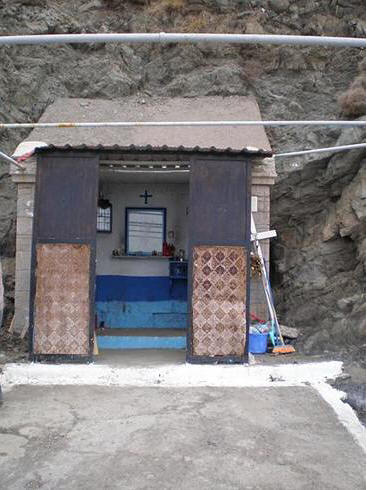
Location marking where the martyr was slaughtered and the water turns blood-red annually on her feast-day.
Shrine on the
coast - facing the
martyr's place of
martyrdom
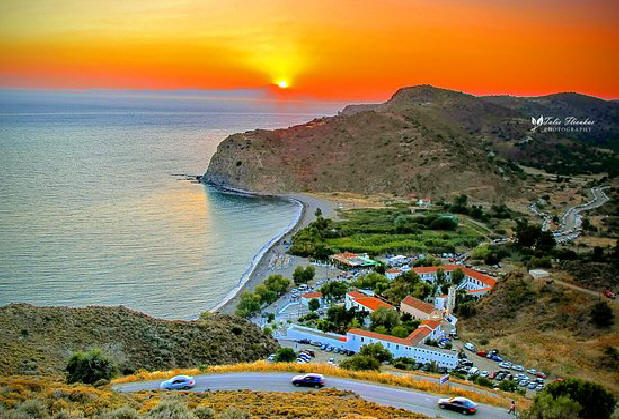
The Monastery of Saint Markella on Chios
Island, Greece
The same is true for the feast day of the
Holy Great
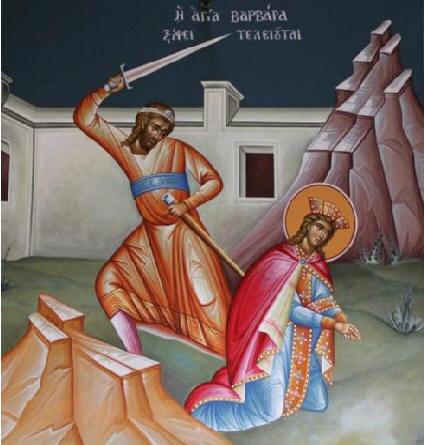
Martyr Barbara (December 4th), where the
predominant element of her life that has impressed people is the fact that her own father
betrayed her to the Romans as a Christian, allowing her to be subjected to gruesome torture and finally,upon his personal insistence,
to be decapitated
by his own hand
(only to be struck and killed
by a bolt of lightning a few days later). This detail is the reason Saint Barbara has been established
in Greece as the
patron saint of the Military Division of Heavy Artillery.
Saint Barbara being decapitated by her father
Two other (but less well-known) saints who were murdered by their
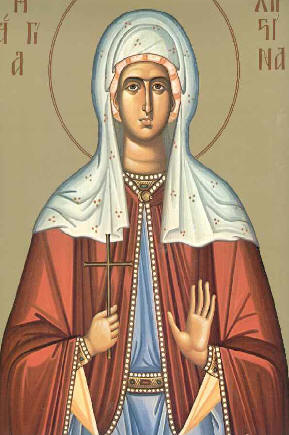
father are the Great Martyr Christina, horrifically
tortured for being a Christian (commemorated July 24th)
Saint Christina
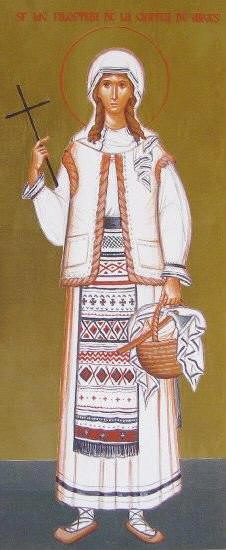
and Saint Philothea of Arges, Romania, (commemorated
December 7th). Orphaned on the mother’s side and with
an abusive stepmother, the saint was mortally wounded by her
father (possibly not intending to kill her) because she
was giving away to the poor most of the food her stepmother
would give her to take to her father working in the fields. She
was only 12 years old!
Saint Philothea of Arges, Romania
We might also mention two married Christianwomen who were victims of domestic violence
and are also honoured by the Church as martyrs: they are the
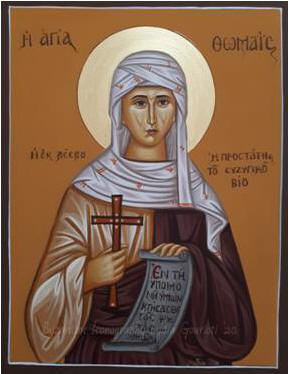
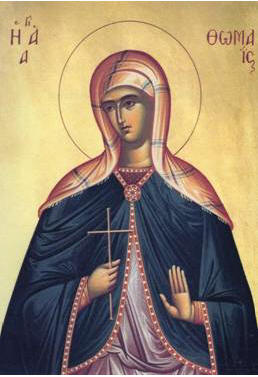
Saints both named Thomais: Saint Thomais of Lesvos Islqnd, Greece
(commemorated January 3rd) who was beaten to death by
her husband, and Saint Thomais of Alexandria,
Egypt (commemorated April 14th), who was murdered
by her father-in-law for resisting his sexual desires!
Saint Thomais of Lesvos
Island GreeceSaint Thomais of Alexandria Egypt
The conclusion
one reaches
from all the above
instances is that domestic violence and child abuse was brought
to light by Christians and openly denounced
through the Christian Synaxarions (Books of Saints’ biographies)
mentioning
womenvictims of
such violence who are
commemorated annually by the
Church as saints and martyrs.
It must be emphasized that a person
is deified (recognized by
the Church as a saint), through
evidence of their
unyielding faith and
love for Christ. They have alsobeen recognized as
saints for steadfastly defending
their moral Christian principles to their
dying breath - and not
merely because they happened to have fallen
victims to a certain kind of criminal behaviour. The same
applies to all the martyrs who had preferred torture and death
rather than betray their faith and their moral principles. Most
of them would have attained sainthood anyway, for having lived
holy lives; although a holy life
was also
understood as an occasion
for them to be tested unto death,even sacrificing their very lives
and - according to Orthodox Christianity – anticipating they have earnedEternity.
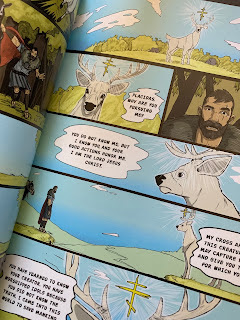
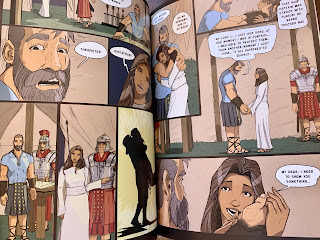
Today I'd like to introduce you to an inspiring new graphic novel for kids - The Cross and the Stag;the Incredible Adventures of Saint Eustathius, by Gabriel Wilson. It is Ancient Faith Publishing's
inaugural book into the graphic novel format, the first in their new
"Among the Saints" series written to inspire both children and adults. I am so excited about this book! Gabriel
Wilson's illustrations are striking, and graphic novels are a great way
to introduce kids to stories of the saints!
For those unfamiliar with graphic
novels, they are like comics, but the format is longer and the
self-contained story has a definite beginning, middle, and end. Wondering if graphic novels are a good fit for your child? Click on the link to explore this article from scholastic: A Guide to Using Graphic Novels with Children and Teens. Now, on to The Cross and the Stag...
This is one incredible adventure story,
about a very godly man and his brave family. Not all saint stories
would work well as graphic novels, but this one was practically begging
to for it! (As are many others - I can't wait to see what more will come
from Ancient Faith Publishing). In art school, author/artist Gabriel
Wilson became very interested in graphic design, animation, and comics
and was inspired to switch out super heroes for saints in his
comic-format stories! Drama, action, love, adventure, death, and hope -
they are all in this heroic tale.
Book description from AFP: He lost his wealth. He lost his family. He lost his station. He endured it all, to gain everything. Roman Commander Placidas was a man of
great power and influence. He and his family wanted for little, yet he
knew there had to be more to life. Once baptized into the Christian
faith as Eustathius, he faced trials beyond anything he had ever
experienced on the battlefield. His faith was challenged, but that same
faith gained him eternal life. Meet this great man in Ancient Faith
Publishing's first graphic novel.
Age Range: 7 years and up
Author/Illustrator: Gabriel Wilson
Format: Paperback
Dimensions: 7 x 10 inches
Page Length: 56 pages
Publisher: Ancient Faith Publishing
Listen to Bobby Maddex interview the author here, on Ancient Faith's podcast Ex Libris. And then order this book, available here.
The Broken Wheel: A Graphic Novel for a November Saint
Ancient Faith Publishing as just released Gabriel Wilson's latest graphic novel, THE BROKEN WHEEL, the Triumph of St. Katherine.
Gabriel
has done an excellent job of adapting the story of the Great and Holy
Martyr Katherine (305-313) into a gorgeously illustrated graphic novel
for ages 10 and up.
What a role model we find in this saint,
especially for girls! This young heroine loves learning. A governor's
daughter, she is intelligent, brave, and beautiful, but also very
confident. She tells her parents that she will enter into marriage only
with someone who has surpassed her in nobility, wealth, beauty, and
wisdom.
With the help of her secretly Christian mother, an elder monk,
and a miraculous dream, Katherine does find this Bridegroom, as she
ultimately chooses a Prince (of Peace) and puts her trust and hope in
Him.
Later,
Katherine's city is visited by the emperor Maximian. He comes to
Alexandria for a pagan festival and Katherine is horrified that
Christians are being burned alive and sacrificed because of their
refusal to deny Christ. She is compelled to speak with the emperor and
tell him about the True God, asking him to stop the human sacrifices.
Katherine
is cast into the dungeon and is visited by St. Michael the Archangel.
After the emperor sends 50 of his most renowned philosophers to debate
Katherine, they not only believe in Christ, but bravely face death for
their belief.
Now comes the part of the story that really sounds
like it was made for a graphic novel: The Wheel. Katherine, our brave
heroine, will not deny Christ and voluntarily walks up to her declared
method of cruel torture. Suddenly, St. Michael appears and blows the
dreaded wheel to smithereens!
Witnessing Katherine's bravery and
faith, Maximian's wife also comes to believe, along with the emperor's
military commander and 200 soldiers, who are beheaded.
And
that's not all...though St. Katherine herself is ultimately is
beheaded, angels miraculously transport her body to Mt. Sinai, where it
was discovered years later. To this day, her relics are still on Mt.
Sinai, at St. Katherine's Monastery.
At the end of the book is a historical note, along with several icons and the Troparion and Kontakion to St. Katherine.
From Ancient Faith Publishing:
Young
Katherine, born into noble wealth with an insatiable hunger for
knowledge, surpasses even her tutors when it comes to learning. But her
learning counts for nothing when she meets the only man worthy of her -
her heavenly Bridegroom. Trading worldly knowledge for eternal wisdom,
Katherine challenges even the emperor himself - and he prepares a cruel
invention to break her. Meet this great bride of Christ in the second
graphic novel in the Among the Saints series - written to inspire both
children and adults.
About the Author: Gabriel Wilson lives near his childhood home in
rural Indiana with his wife Emily and their three daughters. Their home
is over 100 years old - a true fixer-upper - and the subject of many of
his woodworking projects. In his free time, he pursues carpentry and
music and enjoys making homemade tacos with his wife and sketching with
his daughters. Graphic novels are his favorite form of artwork, and
aside from his comics based on the lives of saints, he has other secular
novels in the works. His first graphic novel was The Cross and the
Stag. (read my review, here)
Blessed
first day of Advent (if you're an Orthodox Christian). St.
Katherine/Catherine is commemorated in the Orthodox Church on November
24 or 25, depending on the tradition. The Broken Wheel
is a nice sized soft cover book, 7 x 10 inches, with 104 pages. It
would make a wonderful gift for any Katherine/Catherine in your life.
A comment from here:
"This book is
an Orthodox graphic novel. Yes, you read that right.... a graphic novel
for Orthodox youth and it is BEAUTIFUL. The artwork leaps off the page
with vibrant colors, expressive characters, and page-turning drama. I
found myself engrossed in Katherine's story, as I watched her come to
know the faith at age thirteen and then valiantly defend that faith at
the age of 16.
This novel covers so many important moments of the life
of St. Katherine in a way that is appealing and enthralling for young
readers. Her martyrdom is beautifully handled in the novel as a moment
of triumphant and peaceful resolve with the Archangel Michael by
Katherine's side. As much as I loved reading this book as an adult, this
book would have been so meaningful for me as an Orthodox teen,
especially a female Orthodox teen. St. Katherine exemplifies all the
qualities we strive to achieve with her unshakeable faith, unyielding
strength, and ever-flowing grace. Her young age and the artistry of the
author, Gabriel Wilson, in bringing her story to life in a relatable
format for Orthodox youth is strikingly effective. This is a "must-have"
for every Orthodox teen! (I'll have to order a second copy to gift
because I love it so much I am keeping my first copy!)".
Gleanings from a Book: “The Cross and the Stag” by Gabriel Wilson
Author’s note: Because I happened to
be in the right place at the right time, I was privileged to see a few
spreads of this book more than a year before its publication. Although
they were but sketches when I saw them, I was struck by their quality
and the images gripped me. And my first reading of the (now full-color)
book has confirmed what I suspected even then: this book is a treasure.
“The Cross and the Stag” by Gabriel Wilson
tells the true story of Placidas the soldier, who, amidst his worldly
successes and earthly means, was lovingly faithful to his wife and sons,
while also being very generous to those in need outside of his home.
Perhaps you have never heard of Placidas the Soldier? He was given the
name Eustathius at baptism. If you are not familiar with St. Eustathius,
either, his story is one that you will do well to learn. There is much
that each of us can learn from this saint: through his responses to both
misfortunes and pleasant experiences, and through his faithfulness to
God. Eustathius already had a good life when he first met Christ, and he
served Our Lord fervently after his conversion.
Just like many saints who had gone on
before him, Eustathius’ life did not continue to be “good” – well, at
least by worldly standards. However, also like those saints, he remained
faithful to Christ for his entire life. Like St. Paul, Eustathius had a
powerful visitation from Christ which became a conversion experience
for him and his household (although his wife had been mysteriously
forewarned in a dream, so she was ready!). Like Righteous Job the
Longsuffering, bit by bit Eustathius’ status, wealth, and finally even
his family were taken from him. Like Righteous Joseph the Patriarch, his
faithfulness in his work eventually brought Eustathius honor (and
miraculously his loved ones were restored to him once again, as well).
And finally, like the Three Holy Youths, the family faced a fiery
entrapment with faith and grace.
Throughout the book, Gabriel Wilson has
thoughtfully paired his images and text in a way which seamlessly tells
the story while also allowing the reader to read between the lines when
necessary. The illustrations are masterfully created, simultaneously
communicating actions and emotions in a way that is both tasteful and
effective. What a gift it is to have an artist of this caliber offer his
work to the Orthodox Christian world in a way that makes a saint’s
story so appealingly accessible to people of all ages!
Following St. Eustathius’ story in the
book, readers will find the troparion and kontakion for St. Eustathius.
There is also a spread featuring a variety of icons of him which have
been written. The book concludes with a few historical notes from the
author.
St. Eustathius’ story is gripping! I sat
down to just begin the book but ended up reading the whole thing in one
great gulp. Mystery, suspense, loss, love: all are found on the pages of
this beautiful work of art. I know that I’ll read it again, and I
suspect that I will not be the only one. There’s something here for
everyone. St. Eustathius’ story and the lessons that his life teaches us
will be treasured by each individual who reads this book.
Here are a few gleanings from the book
(this time, we are sharing the quotes in the context of their images),
as well as additional information about St. Eustathius:;
There’s even more of the story of St. Eustathius (including backstory of
his family’s experiences) in this detailed description of his life: https://pravoslavie.ru/74099.html
In the historical notes at the end of “The Cross and the Stag,” we
read that “St. Eustathius is the patron saint of hunters, firefighters,
and those who face adversity.” Author Gabriel Wilson also notes that
people request St. Eustathius’ prayers when they’re traveling over
rivers and seas. Readers facing adverse times (or traveling, hunting, or
firefighting) may be glad to learn this, and ask for his prayers.
"The St Theodore the Tyro Orthodox Mission Church is the second Afrikaans-speaking parish in the Archdiocese of Johannesburg and Pretoria (the first one was in Eldorado Park, in Johannesburg). On the lawn in front to the church is a statue of a stag with a cross between its antlers. It represente the vision of St Eustathius, who once when out hunting, saw a vision of such a stag. The statue was created by a Zimbabwean artist" (from our post about theNew Afrikaans Orthodox parish in South Africa).
*****
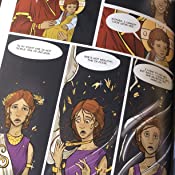
Theophano: A Byzantine Tale, the MUST read comic with the most beautiful illustrations
Images Credit: Chrysavgi Sakellaropoulou and Spyros Theocharis
A beautifully illustrated story by Chrysavgi Sakellaropoulou and
Spyros Theocharis has brought the East Roman Empire, or more commonly
known as the Byzantine Empire, to life with vivid imagery that captures
the imagination.
Theophano: A Byzantine Tale, is the story of a common girl who managed to become one of the most powerful women of 10th century medieval Europe.
Greek City Times spoke with both Sakellaropoulou, who prefers the
name Chrysa Sakel, and Theocharis, the two who brought this amazing
story to life.
Although Chrsa Sakel studied Chemistry, she told Greek City Times
that “my passion has always been art. I have been taking painting
lessons since childhood and I have created many classical artworks. Some
years ago, I began experimenting with digital art. This is how I got
involved in the project about Theophano.”
As for Theocharis, he said that he has always been a big fan of
historical fan fiction and a comic book fan, but studied English and
literature at university.
“For both of us, Theophano is a debut effort on the graphic novel scene,” they said.
Theocharis told Greek City Times that writing the comic book was not
so difficult, but the most challenging part was all the hours of
historical research “behind every page.” This has ensured that the story
is as authentic as can be to 10th century medieval East Rome.
For Chrysa, her greatest challenge was the “transition from classical
arts to digital art and comic book art” as it took a while for her to
develop her own style. “But, having the basic skills from the many years
of drawing in traditional medium, it only required a little research
and experimentation to manage to finish a project like that.”
The two said they always enjoyed watching medieval themed movies and
series like Game of Thrones, Vikings and The Lord of the Rings, but
Theocharis “always wondered why the Byzantine East never features in
fictional shows.”
“Byzantine history is full of stories which could easily become a series
or movies. So, having read a lot of books about Byzantium, I was
determined to create a story for a genre which could visually depict the
Byzantine world. Details such as the clothes, the architecture, the
lavish style of the Byzantine court can now be actually seen in the
pages of our graphic novel as we depict them according to our history
research. One example is the famous Cathedral of Hagia Sophia. Many
people would think that its interior resembled that of a typical
Orthodox church’s. From our research we found out that there were major
differences according to the descriptions in the primary sources,” he
explained.
Chrysa also added in her thoughts, saying that “series like Game of
Thrones gave us the motivation to start thinking about our own medieval
story, since some parts in the series reminded us a lot of what happened
in Byzantine history. We watched kings being poisoned, rebel generals
raising the banners to claim the throne, noble families allying and
betraying each other, eunuchs plotting according to their own interests
and ambitious women using unconventional means to climb the ladder of
power. Spyros already knew these things, but for me it was something
unexpected to read about the story of Theophano and the period she lived
in, and find out that it has so many exciting elements that are
movie-worthy.”
When asked whether Theophano was loosely based on a true story,
Theocharis said “the story is mostly based on historical facts with some
fictional additions to serve the cohesion of the narration.”
“Theophano, the protagonist of the story was a real historical
personality who may not feature as one of the highlighted personalities
of the Byzantine era, but her actions affected the course of Byzantine
history. In the primary sources, I found a lot of contradictory accounts
about her deeds and about her family background. This was actually
beneficial for me since I had the flexibility to alter the story without
the need to stray from the historical facts,” he told Greek City Times,
adding that “within the plot, the reader will stumble upon more
recognizable historical characters such as Nikephoros Phokas or John
Tzimiskes. There is also a character beyond the Byzantine world who
features in the second chapter and is known in countries like Ukraine
and Russia. I am speaking of Olga of Kiev, the famous saint. There has
been hours of historical research involved, combined with some parts
where I took the initiative to improvise a little bit so as to create a
narrative that could balance an interesting story combined with actual
historical events.”
Theocharis also explained that they chose this particularly time
period because it’s the point where the Byzantine Empire reaches its
medieval peak in terms of wealth, territorial expansion and culture.
“Many Byzantine artifacts which are hosted around museums all over
the world, were made during the 10th century. Many ancient Greek
manuscripts were saved from oblivion during that time. We must remember
that there was no printing press during that time and books were rare.
They had to be copied constantly in order to survive the test of time.,”
he said.
He also gave a vivid recount on just how rich and powerful the East Roman Empire was during this period.
“The Imperial palace was adorned with golden mosaics, there were at
least two throne rooms and the emperors did not have only one crown, but
many crowns which they used according to each ceremonial occasion. All
these indicate the splendor and the extravagance of an empire which
collectively has become known for its decline and backwardness. We
wanted to change that view and show how advanced the Byzantine world was
in the 10th century,” he added.
Chrysa also revealed to Greek City Times that they have plans to produce more graphic novels set in the Byzantine world.
“Right now we focus on Theophano and if this project is successful
then we are planning to produce a sequel. My dream is to someday have
enough time and produce a comic book script about the Alexiad. It’s a
catchy story which involves the crusaders and it is more familiar to a
western audience. I hope that the readers embrace this effort so that we
can have the means to continue with future project,” she said.
With such beautiful illustrations and untold hours of research, why would you not want to read Theophano?
Available now through Amazon (hardcover & digital format)
A fairytale marriage that goes terribly wrong, a ruling dynasty
struggling to keep everything together by having overly ambitious
eunuchs do the dirty work, and prominent Roman generals who dream of
taking the throne for themselves.
This explosive mixture of occurrences takes place in the 10th century
Medieval Roman Empire (aka The Byzantine Empire). An era of territorial
resurgence and massive Imperial extravagance, but also an era of
dynastic intrigues and endless plotting for the ultimate prize. The
Byzantine throne.
During that time, Anastasia, a common girl, marries the heir to the
throne, enters the palace and becomes Theophano an ambitious woman ready
to climb the ladder of power and sacrifice herself for her children.
Based on real historical events, this epic graphic novel offers an
immersion into a forgotten world. The world of the medieval Romans who
survived up until the Middle Ages with their capital, Constantinople
“the Queen of all cities” serving as a second Rome.
About the author:Spyros Theocharis was born in
Athens, Greece. He is a Graduate of the English language and literature
department of the university of Athens. He has been a Efl teacher for 10
years. He has lived in different countries experiencing life in both
urban and rural settings. Since childhood, he developed an interest in
mythology and history. It all began when he was six years old and came
across a book about the Ancient Greek gods. Tolkien’s books are his
“holy scriptures” and Byzantine history is his passion.
Chrysa
Sakel started taking classes on traditional painting when she was five years
old and has never stopped creating art ever since. After years of
working with traditional media, she began experimenting with digital
art. Her first project as a comic illustrator is the graphic novel
“Theophano: a Byzantine tale”. She plans to carry out many future
projects as a digital artist. (from here)
Katie discovers that the valley behind her grandmother’s garden is
more mysterious than it seems. After tumbling into tenth-century England
and encountering Saint Edith of Wilton along with her wild animal
menagerie, she is helped home, wondering whether her adventure was truly
real. But after Katie, her cousins, and a neighborhood friend are drawn
back in time once again, she realizes her grandmother’s garden gate is a
portal into faraway worlds, where patron saints are real people making
real-life decisions.
Join Katie and her cousins as they mingle with Rachel and Jacob, meet
Saint Mary Magdalene up close, trek across the sand with the matriarchs
Naomi and Ruth, and have a nail-biting adventure with the heroic Saint
Katherine of Alexandria. In seeing the richness of the family of God,
they glimpse how very much they are a part of it all.
About the Author:Edith M. Humphrey is an Orthodox
mother of three grown daughters and a grandmother of twenty. She teaches
Scripture and theology, and she loves to play with her red cavadoodle,
Angus. Edith taught for eighteen years at Pittsburgh Theological
Seminary and before then in various institutions across Canada and the
US, while lecturing around the globe in various lay and academic
contexts. Besides writing and speaking, she enjoys participating in
church activities with her husband, Chris, performing piano duos with a
friend, playing oboe in a community band, caring for her koi pond, and
writing on topics as diverse as Scripture and C. S. Lewis. This is her
first children’s book; writing it has brought her great joy!
Praise for Beyond the White Fence
"This book is a delight! Readers will be enchanted by the plot and
characters both ancient and modern, who come alive on the page. Fans of
the Chronicles of Narnia will love Beyond the White Fence." -Leslie Baynes, Associate Professor, New Testament and Second Temple Judaism, Department of Religious Studies, Missouri State University
"Beyond the White Fence is a great adventure story told by a
seasoned New Testament scholar and theologian who knows a thing or two
about great adventure stories. As readers follow these characters into
the past, they move beyond the confines of their own imaginations to
experience history and Scripture afresh. Perhaps it takes a magical
world to remind us of the important truth that the "great cloud of
witnesses" is very near to us indeed, and that God's story might
actually include, and bring together, the family dog and the characters
of Genesis. I look forward to reading this book to my children." -Dr. Tucker S. Ferda, Associate Professor of New Testament, Pittsburgh Theological Seminary & father of two
"This engaging troupe of kids and cousins take the reader on a series
of visits to holy women in the 'great cloud of witnesses.' By turns
lively, funny, and suspenseful, these fascinating stories, enhanced by
lovely illustrations, enable the reader to know these holy women as real
people of their era and community - and as examples to follow in our
own time." -Frederica Mathewes-Green, author and speaker
"Simple and deep - like all great children's books - this book is
also rich in history and faith. I can't wait to place it in the hands of
my grandchildren." -Scott W. Hahn, Founder &
President of the St. Paul Center; Author of The Lamb’s Supper; Scanlan
Professor of Biblical Theology, Franciscan University of Steubenville