At Christmas time, the Virgin Mary gets a bit of attention in the
wider culture. A woman gives birth in difficult circumstances: Mother,
baby, ox and ass, the manger. It’s a very touching scene. She quickly
fades from the scene however, with some five centuries of culture
desperately afraid that she will get too much attention.
In that vein, she is pretty much absent from Easter. We have eggs,
chocolate, bunny rabbits, and the resurrection of Christ (along with new
dresses and such), but Mary has no place in our culture’s Easter
imagination. Some of this is undoubtedly the result of 500 years of a
dominantly anti-Catholic Protestantism. You have to mention Mary at
Christmas, but she can conveniently be forgotten at Easter.
Unless you’re Orthodox.
In Orthodoxy, there is essentially no teaching regarding Christ that
ignores His mother. There is no teaching regarding Jesus that ignores
His humanity and His humanity requires that we remember her. When the
Council of 431 (3rd Ecumenical) declared Mary to be “Theotokos”
(“Birthgiver of God”) it was on account of its concern that the full
truth of who Christ is not be distorted. The mystery of the Incarnation
(rightly understood) makes it possible to speak the paradoxical title of
“Birthgiver of God” (not just “Birthgiver of Christ”). Christ is fully
God and fully man. The one born of Mary was God and man. God was born of
her.
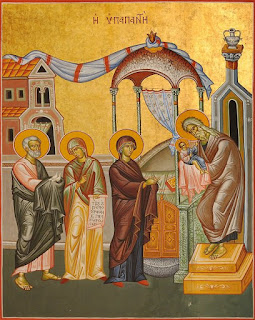
This is echoed as well in the prophetic word that was spoken to Mary
when she brought Jesus to the Temple 40 days after His birth (in
concordance with the Law). Simeon the prophet, holding the child in his
arms, said to His mother:
“Behold, this Child is destined for the fall and rising of
many in Israel, and for a sign which will be spoken against (yes, a
sword will pierce through your own soul also), that the thoughts of many
hearts may be revealed.” (Luke 2:34-35)
His words speak of a “sword.” This is far deeper than a hint that
what is to happen to her Son will make her sad. He didn’t say, “It will
cause you grief.” The suffering of Christ on the Cross is equally the
sword that pierces the soul of Mary. Mary is the first Christian, the
first to believe the word concerning her Son. His suffering is her
suffering. His suffering is to be our suffering as well. If you have
been united with Christ on the Cross, then, in some measure, your own
soul has been pierced by the sword that pierced the soul of Mary. St.
Paul says,
“I have been crucified with Christ, nevertheless, I live. Yet, not I,
but Christ lives in me, who loved me and gave Himself for me.” Mary is
the first of those who have been crucified with Christ.
Our ignorance of such things (or our forgetfulness), encourage us to
forget that our discipleship is marked by the Cross and defined by our
communion with the Crucified Lord. Too easily, the resurrection of Jesus
comes to mean nothing more than a promise of life after death. “Jesus
died and was resurrected so that I could go to heaven.” While that is
sort of true, it represents a serious diminishment of the gospel.
As Christ was on the Cross, His thoughts turned to His mother. He
endures the suffering and the shame of the crucifixion. She shares in
the shame and, in that, a sword pierces her own soul. Christ gives her
to the care of St. John, “the disciple whom He loved.” He does not
merely ask John to care for her, but says, “Behold your mother.” John
must now be her son. Incidentally, this supports the Church’s
teaching that the “brother and sisters of Christ” are not children of
Mary. It would have fallen to them to take of her had that been the
case.
As the Church enters into the depth of Holy Week and approaches the
Lord’s death and resurrection, the Theotokos is ever present on its
mind. At what becomes a liturgical climax the Church gathers around the
funeral shroud icon (epitaphios) in the center of the Church. Following
its commemoration of Christ’s suffering and death, the burial shroud had
been placed there for the faithful to venerate. They have offered their
lamentations.
At this last moment, as the priest stands before the image, we hear these verses from the choir:
Do not lament me, O Mother, seeing me in the tomb, the
Son conceived in the womb without seed, for I shall arise and be
glorified with eternal glory as God. I shall exalt all who magnify thee
in faith and in love.
Glory to Thee, our God, glory to Thee!
I escaped sufferings and was blessed beyond nature at Thy strange
birth, O Son, who art without beginning. But now, beholding Thee, my
God, dead and without breath, I am sorely pierced by the sword
of sorrow. But arise, that I may be magnified.
Glory to Thee, our God, glory to Thee!
By my own will, the earth covers me, O Mother, but the gatekeepers of
hell tremble at seeing me clothed in the blood-stained garments of
vengeance; for when I have vanquished my enemies on the cross, I
shall arise as God and magnify thee.
Glory to the Father and to the Son and to the Holy Spirit, now and ever and unto ages of ages. Amen.
Let creation rejoice, let all born on earth be glad, for hateful hell
has been despoiled, let the women with myrrh come to meet me, for I am
redeeming Adam and Eve and all their descendants, and on the third day
shall I arise.
Do not lament me, O Mother, seeing me in the tomb, the Son conceived
in the womb without seed, for I shall arise and be glorified with
eternal glory as God. I shall exalt all who magnify thee in faith and in
love.
The verses are a dialog between Christ and His mother. It gathers her
whose heart had been pierced with the sword of shame and grief into His
own compassion. He encourages her with the promise that He will rise
and vindicate her. He will be glorified and will magnify her. Her
faithfulness, humility, and obedience will be justified before all the
world. “All generations will call her blessed.”
She replies, recalling the mystery of her Son’s “strange birth.”
Though she now sees His body lying “dead and without breath,” she urges
Him to arise.
He responds that He is “covered by the earth” by His “own will.” He
is no one’s victim but is doing the very thing He was born to do. And
now He is clothed in the “blood-stained garments of vengeance.”
Vanquishing His foes by the cross, He will rise and magnify her.
He closes, repeating the initial verse. At the repetition of “I shall
arise,” the priest takes up the funeral shroud and bears it into the
altar. The doors are shut and every light, every candle in the Church,
is extinguished. In silence the Church waits. Mary waits. All creation
holds its breath.
Quietly, the priest begins to sing, “Thy resurrection, O Christ our
Savior, the angels in heaven sing…” He will shortly come forth bearing
the newly kindled light which spreads to all. And the Paschal procession
begins around the Church (I’m describing the Slavic practice).
His resurrection is a vindication of His mother. Equally, it is the
vindication of every believer. For we, too, have stood silently by the
tomb, venerating His dead body. We, too, have had some share in His
shame, either from others or cast upon us by our own unfaithfulness and
doubting. Was I wrong to believe in, O Lord? Have you forgotten me? I am
surrounded by my enemies and they mock me. Where are You, Lord?
“I shall arise,” Christ says.
Mary saw Him. Mary Magdalen saw Him. Peter and John saw Him. Then the
twelve. Then James the Brother of the Lord. Then by over 500. And even
to St. Paul He appeared, as if to one born out of time.
And they began the procession that continues to circle the earth
singing, “Enable us on earth, to glorify Thee in purity of heart.” At
the head of our procession is His Mother – now vindicated and magnified
by all. She told the truth. She gave birth to God the Word. We call her
blessed.
Videos from St. Maximus Orthodox Church Choirs & ORTODOX™ (Vatopedi monastery, Athos)