Κυριακή 19 Απριλίου 2026
Thomas Sunday: John 20:19–31 (not simply a “story of doubt,” but a concise revelation)
Παρασκευή 10 Απριλίου 2026
Culmination of Suffering: Great and Holy Friday in the Orthodox Tradition
Orthodox Times
On Great and Holy Friday the Orthodox Church commemorates the death of Christ on the Cross. This is the culmination of the observance of His Passion by which our Lord suffered and died for our sins. This commemoration begins on Thursday evening with the Matins of Holy Friday and concludes with a Vespers on Friday afternoon that observes the unnailing of Christ from the Cross and the placement of His body in the tomb.

Commemoration of Great and Holy Friday
On this day we commemorate the sufferings of Christ: the mockery, the crown of thorns, the scourging, the nails, the thirst, the vinegar and gall, the cry of desolation, and all the Savior endured on the Cross.
The day of Christ’s death is the day of sin. The sin which polluted God’s creation from the breaking dawn of time reached its frightful climax on the hill of Golgotha. There, sin and evil, destruction and death came into their own. Ungodly men had Him nailed to the Cross, in order to destroy Him. However, His death condemned irrevocably the fallen world by revealing its true and abnormal nature.
In Christ, who is the New Adam, there is no sin. And, therefore, there is no death. He accepted death because He assumed the whole tragedy of our life. He chose to pour His life into death, in order to destroy it; and in order to break the hold of evil. His death is the final and ultimate revelation of His perfect obedience and love. He suffered for us the excruciating pain of absolute solitude and alienation – “My God, my God, why hast Thou forsaken Me!” (Mark 15:34). Then, He accepted the ultimate horror of death with the agonizing cry, “It is finished” (John 19:30). His cry was at one and the same time an indication that He was in control of His death and that His work of redemption was accomplished, finished, fulfilled. How strange! While our death is radical unfulfillment, His is total fulfillment.
The day of Christ’s death has become our true birthday. “Within the mystery of Christ dead and resurrected, death acquires positive value. Even if physical, biological death still appears to reign, it is no longer the final stage in a long destructive process. It has become the indispensable doorway, as well as the sure sign of our ultimate Pascha, our passage from death to life, rather than from life to death.
From the beginning the Church observed an annual commemoration of the decisive and crucial three days of sacred history, i.e., Great Friday, Great Saturday and Pascha. Great Friday and Saturday have been observed as days of deep sorrow and strict fast from Christian antiquity.
Great Friday and Saturday direct our attention to the trial, crucifixion, death and burial of Christ. We are placed within the awesome mystery of the extreme humility of our suffering God. Therefore, these days are at once days of deep gloom as well as watchful expectation. The Author of life is at work transforming death into life: “Come, let us see our Life lying in the tomb, that he may give life to those that in their tombs lie dead” (Sticheron of Great Saturday Orthros).
Liturgically, the profound and awesome event of the death and burial of God in the flesh is marked by a particular kind of silence, i.e. by the absence of a eucharistic celebration. Great Friday and Great Saturday are the only two days of the year when no eucharistic assembly is held. However, before the twelfth century it was the custom to celebrate the Liturgy of the Pre-Sanctified Gifts on Great Friday.
The divine services of Great Friday with the richness of their ample Scripture lessons, superb hymnography and vivid liturgical actions bring the passion of Christ and its cosmic significance into sharp focus. The hymns of the services on this day help us to see how the Church understands and celebrates the awesome mystery of Christ’s passion and death.
Icon of the Commemoration of Great and Holy Friday
On Great and Holy Friday, Orthodox churches display the icon known as the “Axra Tapeinosis – The Extreme Humility.” This icon depicts the crucified dead body of Christ upright in the Tomb with the Cross in the background. It combines the two awesome events of Great Friday – the crucifixion and burial of Christ.
The Church also has an icon of the Crucifixion of Christ. He is shown nailed to the Cross. His right side is pierced and from the wound flows blood and water. At the foot of the Cross is a skull. (Golgotha, the Mount of the Crucifixion, means “the place of the skull.”) Tradition related that the Cross of Christ stood directly over the grave of our Forefather Adam. On the top bar of the Cross is the inscription “I.N.B.I.”, the initials for the Greek words meaning “Jesus of Nazareth, King of the Jews.” To the left of Christ, the Theotokos and St. Mary Magdalene are often pictured as well; the youthful St. John the Beloved Disciple and St. Longinus the Centurion (Mark 15:39) are shown to the right if they are depicted.
Another icon that depicts the events of Holy Friday is known as the Epitaphios Thrinos. In this icon, Christ has been taken off of the Cross, and His body is being prepared for burial. Shown around the body and mourning His death are His mother, the Theotokos and Virgin Mary, John the beloved disciple, Joseph of Arimathea, and Mary Magdelene.
In addition to these icons, Orthodox churches process with and display a large wooden Crucifix with an image of Christ attached. At the Vespers on Friday, the image of Christ is removed from the Cross and wrapped in a white cloth. Another icon, one that depicts the body of Christ removed from the Cross, appears on the Epitaphios that is carried and placed in the Tomb during this service.
Orthodox Celebration of Great And Holy Friday
The commemorations of Holy Friday begin with the Matins service of the day which is conducted on Thursday evening. The service is a very unique Matins service with twelve Gospel readings that begin with Christ’s discourse at the Last Supper and end with the account of His burial: John 13:31-18:1, John 18:1-29, Matthew 26:57-75, John 18:28 – 19:16, Matthew 27:3-32, Mark 15:16-32, Matthew 27:33-54, Luke 23:32-49, John 19:38-42, Mark 15:43-47, John 19:38-42, Matthew 27:62-66These readings relate the last instructions of Christ to His disciples, the prophecy of the drama of the Cross, the dramatic prayer of Christ and His new commandment. After the reading of the fifth Gospel comes the procession with the Crucifix around the church, while the priest chants the Fifteenth Antiphon:
“Today is hung upon the Tree, He Who did hang the land in the midst of the waters. A Crown of thorns crowns Him Who is King of Angels. He is wrapped about with the purple of mockery Who wrapped the Heavens with clouds. He received buffetings Who freed Adam in Jordan. He was transfixed with nails Who is the Bridegroom of the Church. He was pierced with a spear Who is the Son of the Virgin. We worship Thy Passion, O Christ. Show also unto us thy glorious Resurrection.”
During the Procession, Orthodox Christians kneel and venerate the Cross and pray for their spiritual well-being, imitating the thief on the Cross who confessed his faith and devotion to Christ. The faithful then approach and reverently kiss the Crucifix which has been placed at the front of the church.
On Friday morning, the services of the Royal Hours are observed. These services are primarily readings of prayers, hymns, and passages from the Old Testament, Epistles, and Gospels. The Scripture readings for these services are: First Hour: Zechariah 11:10-13, Galatians 6:14-18, Matthew 27:1-56; Third Hour: Isaiah 50:4-11, Romans 5:6-10, Mark 15:6-41; Sixth Hour: Isaiah 52:13-54:1, Hebrews 2:11-18; Luke 23:32-49; Ninth Hour: Jeremiah 11:18-23,12:1-5,9-11,14-15, Hebrews 10:19-31, John 18:28-19:37.
The Vespers of Friday afternoon are a continuation of the Royal Hours. During this service, the removal of the Body of Christ from the Cross is commemorated with a sense of mourning. Once more, excerpts from the Old Testament are read together with hymns, and again the entire story is related, followed by the removal of Christ from the Cross and the wrapping of His body with a white sheet as did Joseph of Arimathea.
As the priest reads the Gospel, “and taking the body, Joseph wrapped it in a white cloth,” he removes the Body of Christ from the Cross, wraps it in a white cloth and takes it to the altar. The priest then chants a mourning hymn: “When Joseph of Arimathea took Thee, the life of all, down from the Tree dead, he buried Thee with myrrh and fine linen . . . rejoicing. Glory to Thy humiliation, O Master, who clothest Thyself with light as it were with a garment.” The priest then carries the cloth on which the Body of Christ is painted or embroidered around the church before placing it inside the Sepulcher, a carved bier which symbolizes the Tomb of Christ. We are reminded that during Christ’s entombment He descends into Hades to free the dead of the ages before His Resurrection.
The Scripture readings for the Vespers are: Exodus 33:11-23; Job 42:12-17; Isaiah 52:13-54:1; I Corinthians 1:18-2:2; and from the Gospels Matthew 27:1-38; Luke 23:39-43; Matthew 27:39-54; John 19:31-37; and Matthew 27:55-61.
Phoro from here
Hymns and Prayers for Great and Holy Friday
Fifteenth Antiphon of the Matins (Plagal of the Second Tone)
Today He who hung the earth upon the waters is hung upon the Cross. He who is King of the angels is arrayed in a crown of thorns. He who wraps the heavens in clouds is wrapped in the purple of mockery. He who in Jordan set Adam free receives blows upon His face. The Bridegroom of the Church is transfixed with nails. The Son of the Virgin is pierced with a spear. We venerate Thy Passion, O Christ. Show us also Thy glorious Resurrection.
Exapostelarion
On the same day, O Lord, You granted the Robber Paradise. Now by the wood of the Cross, illumine me and save me.
Τετάρτη 8 Απριλίου 2026
Bearing Shame With Christ
The mockery of Christ, fresco in the holy monastery of Metamorfosis, Meteora (from here)
Public shaming is a commonplace in our culture. Public stocks and tar-and-feathering have disappeared, but shaming itself is as up-to-date as the internet itself. I well imagine that some view the use of ridicule and derision as an inherent part of public life. Those who enjoy the accolades of crowds must be prepared to endure their opprobrium. Of course, for those who live anonymous lives, such public shaming is about other people. The quiet sense (and sometimes not so quiet) that “they had it coming to them” is the strange pleasure of envy, a subset of shame. These are among the darkest parts of our public life.
Of course, there is nothing new about shame and envy. That our digital world is infected with them is nothing more than a manifestation of an ancient social contagion. It was envy that drove Cain to kill his brother. It continues to drive murders to this day.
It is deeply significant that the gospel account of Christ’s Passion includes ample descriptions of the shame and envy that permeated that event. Indeed, St. Mark’s gospel tells us that Christ perceived that it was “out of envy that the chief priests had delivered Him up” (Mark 15:10). I have noticed, across the years, that the texts for the services of Holy Week make far more mention of shame and envy (the “mocking and the spitting”) than they do of the specific suffering of the crucifixion itself. Crucifixion is not about the pain (the Romans had far more painful options at their employ). Crucifixion is specifically about the shame – it was considered the lowest form of execution – particularly suited for slaves.
St. Paul said, “I am crucified with Christ, nevertheless, I live…” Our attention is drawn to the Cross and its nails. However, if crucifixion is primarily an act of public shaming, then we have far more literal opportunities to be crucified with Christ. The mocking and the spitting, if only in their lesser forms, are likely common to us all.
Of course, there’s a very quiet crucifixion of shame endured by many: the torturous voices that haunt our lives, whispering in the dark. The insidious power of such shame makes us want to hide (hiding is in the very nature of shame). It attacks more than our actions – it goes for our very self.
We hear this in the mocking words hurled at Christ: “If you are the Son of God, come down from the cross…” A similar taunt was spoken by the devil in the temptations in the wilderness. “If you…”
The taunts within us take on their own form – but are almost always aimed at “who we are,” or “what kind” of person we imagine ourselves to be. They are likely the deepest source of pain in our lives.
If it is true that we are “crucified with Christ,” then it is also true that Christ is crucified “with us.” The mocking and the spitting that we undergo in our own minds and lives is something that Christ has made His own. We are not alone. This is at the very heart of God’s love. In my pastoral experience through the years, I see that we doubt the love of God. We are unworthy (of course). We fail to love Him in return (of course). There is something within us, I think, that makes us give greater weight to the words and thoughts of shame than we do to the assurance of God’s love.
Our brains are wired for protection (for which we give thanks). However, that same wiring tends to give greater emphasis to dangers and warnings than to joy and celebration. Christ knows this very aspect of our being:
“Inasmuch then as the children have partaken of flesh and blood, He Himself likewise shared in the same, that through death He might destroy him who had the power of death, that is, the devil, and release those who through fear of death were all their lifetime subject to bondage.”(Heb. 2:14–15)
I am aware of this, particularly, in the sacrament of confession, when the epitrahelion (stole) of the priest is placed over my head and I hear the soothing words that assure me of God’s forgiveness:
…May that same God forgive you all things, through me a sinner, both in this present world, and in that which is to come, and set you uncondemned before His dread Judgment Seat. And now, having no further care for the sins which you have declared, depart in peace.
I think of that space beneath the epitrahelion as the “secret place of the Most High.”
St. Paul wrote:
The Spirit Himself bears witness with our spirit that we are children of God, and if children, then heirs—heirs of God and joint heirs with Christ, if indeed we suffer with Him, that we may also be glorified together. (Rom. 8:17)
I suspect we often externalize this verse and presume that it refers only to those who endure physical torture. However, its focus is found in the phrase, “with Him.” We unite our sufferings (even our self-inflicted mental tortures) with Him with as small a phrase as, “Lord, have mercy!” I have also been taught to pray, “O God, comfort me!”
In these things, with Christ, we are “more than conquerors.”
Let us die with Christ in the Jerusalem of our minds, that we may reign with Him in the New Jerusalem of His Kingdom!
The Bridegroom and Judgment // Orthodox Holy Week
Behold, the Bridegroom comes at midnight, and blessed is the servant whom He shall find watching; and again, unworthy is the servant whom He shall find heedless. Beware, therefore, O my soul, do not be weighed down with sleep, lest you be given up to death and lest you be shut out of the Kingdom. But rouse yourself crying: Holy, holy, holy, art Thou, O our God. Through the Theotokos, have mercy on us.
+ Troparion of Bridegroom Matins
Please, see here
Κυριακή 25 Δεκεμβρίου 2022
The Child Who Came Among Us
Few things seem as confusing to our culture as the feast of Christmas. For many, it is the great feast of sentimentality. As such, it is our culture’s feast of feeling. We want to have the “spirit of Christmas.” It is identified with snow, with trees, with family, with giving and receiving of gifts. It is a remembrance, for many, of a magical point within childhood, likely out of reach but still there. It is associated with movies – some of which (like Die Hard) – seem at an odd remove from the feast itself. Gather all of the Christmas movies together and consider them. What are they trying to say? What is this thing that haunts our culture?
The vast majority of these Christmas movies have nothing whatsoever to do with the events described in the gospels. Christmas is thus a reference to itself (as a culture moment) rather than a reference to Christ or the Christian faith. Witness the popularity of Christmas in Japan, a country with only a 1 percent Christian population. Just a peek:
The popular fast-food restaurant, Kentucky Fried Chicken (KFC), is a national favorite in Japan at Christmas. According to the BBC, an estimated 3.6 million Japanese families celebrate with KFC on Christmas. During the Christmas period, the average KFC will increase their daily sales by 10 times their usual take. Often, families will have to order weeks in advance, or risk standing in line for hours.
In 1970, the manager of the first KFC in Japan, Takeshi Okawara, dreamt about a new promotional campaign called the “party barrel” to sell on Christmas. After overhearing two out of the country travelers in his store talk about missing turkey on Christmas, he hoped that chicken would suffice, and began marketing his Party Barrel as a way to celebrate Christmas.
In 1974, KFC took the marketing plan national and it became widely popular. Even the company mascot, Colonel Sanders, dresses up as Santa for the occasion. Many families in Japan view KFC on Christmas as a symbol of a family reunion. [This article is found here.]
Of course, the baby Jesus, is nowhere to be found in these cultural appropriations.
The Christmas story, on the level of history, is almost commonplace. Women have given birth to children in difficult circumstances from time immemorial. As poignant as its details might be (“no room in the inn”) they are still somewhat prosaic. Only theology can take us into the depths of that birth.
The mystery of Christ’s birth (just as the mystery of His conception) is the mystery of God’s union of Himself with His creation: God became man. Some reduce this mystery to a necessary step towards the crucifixion, in which Christ “paid for our sins.” This is a thought that says too little, and so diminishes the event itself.
In that the Child born at Christmas is God-made-man, His birth is also the birth into our world of the very meaning of the world itself. The meaning and purpose of everything and everyone, from human beings to the least sub-atomic particle, was already present in God from before creation. In Christ, the whole of that is born and comes among us. To honor Christ is to honor all.
Jesus Christ, the "Immanuel", from the prophecy of Isaiah, "Behold, a virgin shall conceive, and bear a son, and shall call His name Immanuel" (Is. 7:14) which means, "God is with us.". Orthodox holy icon from here
Back in the 50s, the British theologian, J.B. Phillips wrote the book, Your God is too Small. It is a fault of Christians that our Christmas is too small. Sentimentality (some of which is inescapable) essentially reduces Christmas to a set of feelings associated with a particular day. This makes of Christmas a very shallow holiday (rather than one of the greatest Holy Days).
Standing before the Child in that manger, our questions should turn towards what His coming means for all things. Orthodoxy sees in the manager an image of the tomb. Christ in swaddling cloths is an icon of Christ in the burial shroud. Christ in the burial shroud is the image of the whole of suffering: all suffering, everywhere, for all time. It is for us not only to help and comfort those who suffer, but to hold them in true veneration, for they bear in themselves the suffering of Christ.
The Child in the manger is also the self-emptying, self-sacrificial love of God, the love that does not hold the world at arms length, but enfolds it within His very being. It is well-spoken when we call Christmas the “Winter Pascha.”
I do not begrudge the sentiments of the world, nor the enjoyment of the feelings that accompany this feast. God Himself did not begrudge us our sins and refuse to come among us. I simply lament the fact that I myself too often settle for a little Christmas in place of the full feast. May God warm our hearts in the cold dead of winter as He warmed the universe, taking our flesh upon Himself.
Παρασκευή 5 Αυγούστου 2022
The Mount of Transfiguration and the Bridal Chamber of Christ
There is a propensity in our modern world to break things down – to analyze. We have gained a certain mastery over many things by analyzing the various components of their structure and manipulating what we find. It has become the default position for modern thought. This power of analysis, however, is weakened by its very success. Frequently the truth of something lies not in the summary of its parts but in the wonder of the whole.
This is certainly the case with the Christian faith. It is not uncommon for theology to be addressed under various headings: Christology, soteriology, eschatology, ecclesiology, hermeneutics, etc. It makes for an impresive array of titles on a seminary faculty listing. The problem, however, is that theology ultimately seeks to describe or state one thing (or it should). That one thing, however, is so large that it cannot be spoken with ease. The fullness of the faith is not revealed in the analysis of various constituent elements, but in the slow (and sometimes sudden) apprehension of the whole.
If I had to use a single word to describe the one thing that is “everything” it would be Pascha (in its fullness). I cannot think of any part of the Christian life or revelation that is not gathered into the fullness of Pascha. It is one of the reasons that the liturgical celebration of Pascha is as utterly overwhelming in its Orthodox expression.
Liturgy has a grammar, a way of speaking and revealing truth. This grammar does things that cannot be done as easily in discursive theological writing. I have written about this previously.
For one, Orthodox liturgical practice has a habit of bringing elements of the Christian story together that are frequently kept apart – particularly in our modern compartmentalized approach to the faith. There are “theological rhythms” within the Orthodox cycle of services. Each of the seven days of the week has a particular assigned theme (Mondays for the Angels, Tuesdays for St. John the Baptist, etc.). Every day on the calendar has one or more (usually many more) saints whose memory is kept on that day. There is also the cycle of feasts that depend on the date of Pascha, and others that are determined according to a fixed date.
These cycles are always meeting each other and bringing their own elements and insights into the service. Thus those who come to worship are never “just doing one thing” but are always presented with “several things.” And, greater than that, everything is brought together as a “whole” and not just a collection of parts. The “one thing” is seen at every service, even if one facet shines brighter than others.
August 6 marks the feast of the Transfiguration of Christ [icon]. The Church remembers His transfigured appearance before the disciples on Mt. Tabor, with Moses and Elijah appearing with Him. The material used in the liturgical celebration of the feast looks at this event from almost every conceivable angle. One of those angles caught me by surprise the first time I encountered it. – it was occasioned by the normal confluence of liturgical structure – but gave me an image that left me speechless in wonder.It came at Matins on the day before Transfiguration (known as the Forefeast). During Matins each day, there is the reading of “the canon.” This is a hymn that follows a particular poetic structure. It consists of nine odes, each of which takes its inner meditation from one of the nine traditional Biblical canticles of the Old Testament (such as the “Song of Moses” in Exodus 15:1 and following). The sixth ode is always a reflection on the hymn within the book of Jonah (whose three days in the whale is always seen as a “type” of Christ’s three days in the belly of the earth).
This is the verse that struck me:
Making ready for His friends a Bridal Chamber of the glory of that joy which is to come, Christ ascendeth the mountain, leading them up from life below to the life of heaven.
I have generally viewed the Transfiguration in its own “compartment.” I have extended that consideration to include reflection on the Palamite doctrine of the Divine Energies, since St. Gregory Palamas used the image of the Light of the Transfiguration for much of his theological understanding. But I had never made the leap to Pascha (to which belongs the image of the Bridal Chamber).
I found myself speechless. The idea was too full. The image of the bridal chamber and its affinity with Pascha is rich, in and of itself. The Church looks forward to the “marriage feast of the Lamb,” an image used for the close of the age and the fulfilling of all things. Pascha is that close and that fulfilling even though it also occurs at a particular moment in history in 33 A.D. The death and resurrection of Christ is the marriage of heaven and earth, the union of God and man, the fulfillment of all things. Having revealed to His disciples the “Bridal Chamber” (as far as they could bear to see it), He then begins to speak to them of His coming resurrection and His sufferings in Jerusalem
The Transfiguration is also the Bridal Chamber (and is described in many other ways as well). It is a glimpse, (out of sequence in a place where sequence has no place), of the fullness of Divinity. Christ appears with Elijah and Moses, the living and the dead, the prophets and the law, and speaks with them concerning His Pascha. And this happens in the context of the Divine Light – a brightness that was beyond the disciples’ ability to bear.
Our faith itself should have this quality of fullness about it – something that is greater than our ability to bear. Our compartmentalization of the world and our faith reduce both to bearable levels – but then we fail to live or to believe. Understanding begins with wonder – and wonder requires something beyond our normal limits. The Transfiguration is an invitation to the Bridal Chamber – the mystery of Christ’s death and resurrection in the depths of Pascha. Shame on us if we compartmentalize the event in a meditation on the Divine Light. The Light shines in the darkness for a reason, and for a reason the darkness does not comprehend it.
May Christ carry each of us into the Bridal Chamber of the glory of that joy which is to come – and bring us up from the life below to the life of heaven in the wonder of His Pascha!
Σάββατο 14 Μαΐου 2022
The Vindication of the Mother of God
At Christmas time, the Virgin Mary gets a bit of attention in the wider culture. A woman gives birth in difficult circumstances: Mother, baby, ox and ass, the manger. It’s a very touching scene. She quickly fades from the scene however, with some five centuries of culture desperately afraid that she will get too much attention.
In that vein, she is pretty much absent from Easter. We have eggs, chocolate, bunny rabbits, and the resurrection of Christ (along with new dresses and such), but Mary has no place in our culture’s Easter imagination. Some of this is undoubtedly the result of 500 years of a dominantly anti-Catholic Protestantism. You have to mention Mary at Christmas, but she can conveniently be forgotten at Easter.
Unless you’re Orthodox.
In Orthodoxy, there is essentially no teaching regarding Christ that ignores His mother. There is no teaching regarding Jesus that ignores His humanity and His humanity requires that we remember her. When the Council of 431 (3rd Ecumenical) declared Mary to be “Theotokos” (“Birthgiver of God”) it was on account of its concern that the full truth of who Christ is not be distorted. The mystery of the Incarnation (rightly understood) makes it possible to speak the paradoxical title of “Birthgiver of God” (not just “Birthgiver of Christ”). Christ is fully God and fully man. The one born of Mary was God and man. God was born of her.
This is echoed as well in the prophetic word that was spoken to Mary when she brought Jesus to the Temple 40 days after His birth (in concordance with the Law). Simeon the prophet, holding the child in his arms, said to His mother:
“Behold, this Child is destined for the fall and rising of many in Israel, and for a sign which will be spoken against (yes, a sword will pierce through your own soul also), that the thoughts of many hearts may be revealed.” (Luke 2:34-35)
His words speak of a “sword.” This is far deeper than a hint that what is to happen to her Son will make her sad. He didn’t say, “It will cause you grief.” The suffering of Christ on the Cross is equally the sword that pierces the soul of Mary. Mary is the first Christian, the first to believe the word concerning her Son. His suffering is her suffering. His suffering is to be our suffering as well. If you have been united with Christ on the Cross, then, in some measure, your own soul has been pierced by the sword that pierced the soul of Mary. St. Paul says,
“I have been crucified with Christ, nevertheless, I live. Yet, not I, but Christ lives in me, who loved me and gave Himself for me.” Mary is the first of those who have been crucified with Christ.
Our ignorance of such things (or our forgetfulness), encourage us to forget that our discipleship is marked by the Cross and defined by our communion with the Crucified Lord. Too easily, the resurrection of Jesus comes to mean nothing more than a promise of life after death. “Jesus died and was resurrected so that I could go to heaven.” While that is sort of true, it represents a serious diminishment of the gospel.
As Christ was on the Cross, His thoughts turned to His mother. He endures the suffering and the shame of the crucifixion. She shares in the shame and, in that, a sword pierces her own soul. Christ gives her to the care of St. John, “the disciple whom He loved.” He does not merely ask John to care for her, but says, “Behold your mother.” John must now be her son. Incidentally, this supports the Church’s teaching that the “brother and sisters of Christ” are not children of Mary. It would have fallen to them to take of her had that been the case.
As the Church enters into the depth of Holy Week and approaches the Lord’s death and resurrection, the Theotokos is ever present on its mind. At what becomes a liturgical climax the Church gathers around the funeral shroud icon (epitaphios) in the center of the Church. Following its commemoration of Christ’s suffering and death, the burial shroud had been placed there for the faithful to venerate. They have offered their lamentations.
At this last moment, as the priest stands before the image, we hear these verses from the choir:
Do not lament me, O Mother, seeing me in the tomb, the Son conceived in the womb without seed, for I shall arise and be glorified with eternal glory as God. I shall exalt all who magnify thee in faith and in love.
Glory to Thee, our God, glory to Thee!
I escaped sufferings and was blessed beyond nature at Thy strange birth, O Son, who art without beginning. But now, beholding Thee, my God, dead and without breath, I am sorely pierced by the sword of sorrow. But arise, that I may be magnified.
Glory to Thee, our God, glory to Thee!
By my own will, the earth covers me, O Mother, but the gatekeepers of hell tremble at seeing me clothed in the blood-stained garments of vengeance; for when I have vanquished my enemies on the cross, I shall arise as God and magnify thee.
Glory to the Father and to the Son and to the Holy Spirit, now and ever and unto ages of ages. Amen.
Let creation rejoice, let all born on earth be glad, for hateful hell has been despoiled, let the women with myrrh come to meet me, for I am redeeming Adam and Eve and all their descendants, and on the third day shall I arise.
Do not lament me, O Mother, seeing me in the tomb, the Son conceived in the womb without seed, for I shall arise and be glorified with eternal glory as God. I shall exalt all who magnify thee in faith and in love.
The verses are a dialog between Christ and His mother. It gathers her whose heart had been pierced with the sword of shame and grief into His own compassion. He encourages her with the promise that He will rise and vindicate her. He will be glorified and will magnify her. Her faithfulness, humility, and obedience will be justified before all the world. “All generations will call her blessed.”
She replies, recalling the mystery of her Son’s “strange birth.” Though she now sees His body lying “dead and without breath,” she urges Him to arise.
He responds that He is “covered by the earth” by His “own will.” He is no one’s victim but is doing the very thing He was born to do. And now He is clothed in the “blood-stained garments of vengeance.” Vanquishing His foes by the cross, He will rise and magnify her.
He closes, repeating the initial verse. At the repetition of “I shall arise,” the priest takes up the funeral shroud and bears it into the altar. The doors are shut and every light, every candle in the Church, is extinguished. In silence the Church waits. Mary waits. All creation holds its breath.
Quietly, the priest begins to sing, “Thy resurrection, O Christ our Savior, the angels in heaven sing…” He will shortly come forth bearing the newly kindled light which spreads to all. And the Paschal procession begins around the Church (I’m describing the Slavic practice).
His resurrection is a vindication of His mother. Equally, it is the vindication of every believer. For we, too, have stood silently by the tomb, venerating His dead body. We, too, have had some share in His shame, either from others or cast upon us by our own unfaithfulness and doubting. Was I wrong to believe in, O Lord? Have you forgotten me? I am surrounded by my enemies and they mock me. Where are You, Lord?
“I shall arise,” Christ says.
Mary saw Him. Mary Magdalen saw Him. Peter and John saw Him. Then the twelve. Then James the Brother of the Lord. Then by over 500. And even to St. Paul He appeared, as if to one born out of time.
And they began the procession that continues to circle the earth singing, “Enable us on earth, to glorify Thee in purity of heart.” At the head of our procession is His Mother – now vindicated and magnified by all. She told the truth. She gave birth to God the Word. We call her blessed.
Videos from St. Maximus Orthodox Church Choirs & ORTODOX™ (Vatopedi monastery, Athos)
Κυριακή 24 Απριλίου 2022
The Last Pascha – A Reverie
I had a reverie around the time of Pascha. My life has had many chapters. I have loved friends and lost friends. My memory is filled with much that is bittersweet – not my favorite flavor. But my reverie was a dream of Pascha – the Last Pascha. I wrote this in a Facebook post and have looked it up numerous times for balm for my tired soul. Today, I wanted more balm. So I’m posting this to share it with you. If it helps, that is well. If it doesn’t, then ignore the reverie of an old man. And have peace. And do not quit singing.
The Last Pascha.
It dawns and everyone is there. And we can’t quite remember what we might have had against each other. We’re so glad to see faces that we know. Memory fades like the pains in our bones as we stand with joy and see the Face of Christ. In the light of His Face, only the present has any reality. All things become present in Him. And a sound is heard, first in the distance, but we can’t quite figure where in the distance, and it draws nearer…
It is a song being sung. It seems strange though familiar and then I seem to know the words and I’m surprised at the sound and the strength of my own voice and how it interacts with every other voice, no two singing the same tune and yet it’s one song. Everyone hears it in their own language. It is the Song of the Lamb.
And since every moment is present, there is no sense of how long we have been singing or how long we will sing. But in the Song, everything comes right. The creation beneath our feet begins to awaken. And the Song is taken up by trees and rocks, rivers and sky, until all of creation sings.
And slowly, the motion of a Dance…
About The Paschal Lamb
by Fr. Patrick Henry Reardon
Preachers Institute
Very early in the Fourth Gospel, John the Baptist sees Jesus and exclaims,
The Evangelist tells us that John repeated this identification on the following day (1:36).“Behold the Lamb of God, who takes away the sins of the world!” (John 1:29)
Icon from here
For the rest of the Fourth Gospel, nothing more is said of John’s exclamation; he identified Jesus as the sacrificial lamb, but the theme is not further pursued in the story.
When Jesus dies, however, the Evangelist suddenly comments on the fact that Jesus’ legs were not broken on the Cross. Interpreting this fact as a fulfillment of biblical prophecy, he quotes the Book of Exodus:
“Not one of his bones shall be broken” (19:36; Exodus 12:46).John expects his readers to be familiar with that text; he assumes they will recognize that this verse pertains to the Paschal Lamb. In citing it, John identifies Jesus as the true Paschal Lamb.
If we look closely at this imagery, however, we recognize that the image of Jesus as Paschal Lamb has passed through a filter, so to speak. In the Mosaic Law the paschal lamb was not a sin offering. It was a special sacrifice immediately tied to Israel’s deliverance from Egyptian slavery. It represented—if the expression be allowed—the embodiment of liberation from slavery.
How, then, does John the Baptist, who identifies Jesus as the Paschal Lamb, declare that he takes away the sins of the world? Here is where I want to employ the metaphor of the filter: the theme of the paschal lamb has been filtered through the Isaian image of the Suffering Servant, whom the prophet declares,
“He was led as a sheep to the slaughter, and as a lamb is silent before his shearers, so he opens not his mouth.”
![]() |
| Holy Week 2018, Kenya (here) |
This new Lamb of God, however, does more than free the Israelites from servitude in Egypt. He is the Suffering Servant of the Lord, described in the Book of Isaiah as a sin offering. This new Paschal Lamb takes away the sins of the whole world. He does not perish for one people only, but to gather into one all the scattered children of God. This verse from Exodus, cited at the scene on the Cross, ties the end of John’s account back to the exclamation of John the Baptist in the first chapter.
This imagery ties St. John’s theology to that of St. Paul, who wrote to the Corinthians,
“Christ, our paschal lamb, has been sacrificed.”It ties John also to Peter, who declared our redemption by
“the precious blood of Christ, as of a lamb without blemish and without spot” (1 Peter 1:19).We are now observing the Christian Passover, that feast of which St. Gregory the Theologian wrote,
“Then comes the Sacred Night, the anniversary of the confused darkness of the present life, into which the primeval darkness is dissolved, and all things come into life and rank and form, and that which was chaos is constrained to order. Then we flee from Egypt; that is, from sullen persecuting sin; and from Pharaoh the unseen tyrant . . . (Orations 45.25).
“Thus then and for this cause the written Law came in, gathering us into Christ; and this is the account of the Sacrifices as I account for them. And that you may not be ignorant of the depth of His Wisdom and the riches of His inscrutable judgments. He did not leave even these unhallowed altogether, or useless, or with nothing in them but mere blood. But that great—and if I may say so—in its first [divine] nature ‘unsacrificeable’ Victim was intermingled with the Sacrifices of the Law, and was a purification, not for a part of the world, nor for only a short time, but for the whole world and for all time.”Recognizing that the wool of the lamb—though it is the lamb’s native nakedness—provides the clothing for the human being, Gregory transposes this imagery to the case of Christ, whose very innocence becomes the proper clothing for the wedding feast, the very garment of incorruption:
“For this reason a Lamb was chosen for its innocence, and its clothing of the original nakedness. For such is the Victim offered for us, who is both in name and fact the garment of incorruption.”Gregory continues the symbolism of the lamb, finally identifying it with the suffering Victim in Isaiah 53:
“And he was a perfect Victim not only on account of his divinity, than which nothing is more perfect; but also on account of that which he assumed, having been anointed with the divinity, and having become one with Him who anointed it, and I am bold to say, made equal with God. He was a male, because he was offered for Adam . . . He both took on Him our sins and bore our weakness (Isaiah 53:4), yet he did not himself suffer anything that needed healing. For he was tempted in all points like as we are yet without sin. For he that persecuted the Light that shines in darkness could not overcome him” (45.13).This is the meaning of the Passover, said Gregory, because
“the Lamb is slain, and act and word are sealed with the Precious Blood” (45.25).He goes on,
“we will feed on the Lamb toward evening— for Christ’s Passion was in the completion of the ages; because, in addition, he communicated his disciples in the evening with his Sacrament, destroying the darkness of sin” (45.26).Here we perceive the symbolism of the darkness that covered the earth for three hours, as the true Paschal Lamb was being slain. Here we detect the mystery of the redemptive blood that flowed from his side to anoint our hearts and minds against the avenging angel.
Σάββατο 23 Απριλίου 2022
Old Testament prophecies hinting the Crucifixion and confirmed historically
Source: https://ethnegersis.blogspot/ - (selected excerpts from Catechesis No.13)
Orthodox Outlet for Dogmatic Enquiries / Translation: K.N.
ΕΛΛΗΝΙΚΑ: ΑΓΙΟΥ ΚΥΡΙΛΛΟΥ ΙΕΡΟΣΟΛΥΜΩΝ: ΟΙ ΠΡΟΦΗΤΕΙΕΣ ΠΟΥ ΕΚΠΛΗΡΩΘΗΚΑΝ ΚΑΤΑ ΤΗ ΣΤΑΥΡΩΣΗ ΤΟΥ ΚΥΡΙΟΥ [Μέρος πρώτο]
|
Saint Cyril of Jerusalem**: “....and was crucified for our sake during the time of Pontius Pilate, and suffered and was buried....” ***** But let us now return to the subject of prophetic proofs that you asked for. The Lord was crucified - you have heard all the testimonies. You have seen the location of Golgotha hill. You agree with the information and applaud it as praiseworthy and you glorify it. But take care lest there come a time during a period of persecution that you renounce Him. Do not delight in the Cross only during a period of peace, but preserve the same faith also during a period of persecution. Do not be a friend of Jesus in a time of peace, and in a time of war become an enemy. (…) *********** So, Christ was crucified for our sake: He, who had been judged during an icy-cold night – which is why there was a coal burning fire nearby: John 18:18: “Now the slaves and servants who had made a fire of coals stood there, for it was cold, and they warmed themselves. And Peter was with them and warming himself.” Christ was crucified at the third hour: Mark 15:25: “Now it was the third hour, and they crucified Him”... (The “third hour” means it was 3 hours after sunrise, that is, at 9 in the morning when they crucified Him) Matthew 27:45: “Now from the sixth hour until the ninth hour there was darkness over all the land.” (The 6th hour was 12 noon, so from 12 noon, darkness covered the entire land, until 3 in the afternoon).
Could these same details have been written by the Old Testament Prophets also? Let us check it out: The prophet Zacharias said: Zacharias 14:7: “On that day there shall be no light; it will be cold and icy for one day – and that day is known to the Lord – and it is not day and not night, and at evening time there shall be light.” (During that one day, there will be no sunlight, so it will be a cold, icy day – hence Peter warming himself at a coal fire outside). ”So? Didn't the Lord know about the other days? Indeed, days are many, but this was the day of the Lord's patience, a day “which the Lord had created” (Psalm 117:24). He likewise knew the day that was “not day and not night” (Zacharias 14:7). What was the meaning of this enigma mentioned by the Prophet: “...and that day is known to the Lord – and it is not day and not night”? What was that day? What should we call it? The Gospel interprets this, as it narrates the events: It was not “day”, because the sun did not shine while moving from east to west; instead, from the 6th hour (12 noon) until the 9th (3 afternoon), complete darkness prevailed (as above, Matthew 27:45), in the middle of the day! Hence, darkness suddenly prevailed in the middle of the day – which darkness God had named “night” (Genesis 1:1: “...and God called the light “day”, and the darkness He called “night”). That is why it was neither “day” nor “night” literally, for there was not enough light to be called “day”, nor dark enough to be called “night”, given that after the 9th hour (3 afternoon) the sun shone again in the sky. This too was foretold by the Prophet when saying: “not day and not night” (Zacharias 14:7), and adding at the end of v.7: “and at evening time there shall be light”. Do you see the accuracy of the Prophets? Do you see how much truth there is in what has been prophesied and written in advance of the actualized events? *********** Do you want to know exactly what time the sun was blotted out from the face of the earth? Was it perhaps on the 5th hour or the 8th or the 10th? Then state the exact time to the inconvincible Jews, o Prophet! When did the sun set? The prophet Amos said: “And it will be on that day, says the Lord God, and the sun will set at noon, and the light will be darkened upon the earth in the daytime.” (Amos 8:9) – exactly as above: “Now from the sixth hour until the ninth hour there was darkness over all the land.” (as above, Matthew 27:45) What season would it take place in, o Prophet, and what day will it be? “And I will turn your feasts into mourning and all your songs into lamentation. And I will bring sackcloth on every loin and baldness on every head. And I will make Him like the mourning for a loved one and those with Him like a day of suffering” (Amos 8:10] These details implied the feast days of Unleavened Bread and the Jewish Passover - which was to “contain” the event of the Crucifixion during those days. To which the Prophet adds the following: “And I will make Him like the mourning for a loved one and those with him like a day of suffering.” “And a great multitude of the people followed Him, and women who also mourned and lamented Him” (Luke 23:27) While the Apostles may have remained in hiding, nevertheless, their souls were also filled with despair and mourning.... This prophecy also deserves our admiration.
*********** Now someone else might say: Find yet another characteristic from the Passions of Christ which had been preannounced by the Prophets with such precision.' What other accurate evidence is there, related to the event of the Crucifixion? When Jesus was being led to be crucified, He was wearing only a tunic and His robe was thrown over Him.
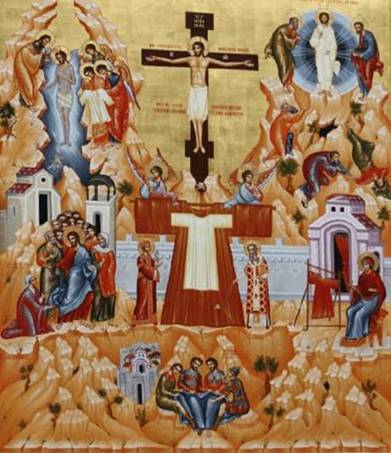
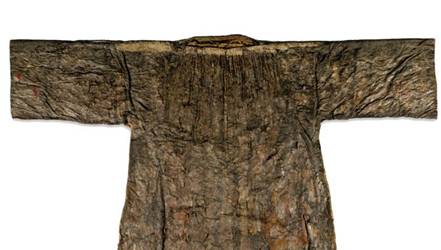
“Then the soldiers, after they had crucified Jesus, took His clothes and made them into four parts, to each soldier one part, and also His undergarment (tunic). Now the tunic was seamless, woven from the top all in one piece.” (John 19:23) This garment was not torn into parts, as it would have become useless. So they decided to cast lots to see who it would fall to: “They said therefore among themselves, ‘Let us not tear it, but cast lots for it, whose it shall be’, so that the Scripture might be fulfilled which says: ’They divided My garments among them, and on My clothing they cast lots.” (John 19:24) Was this also mentioned somewhere else? Let us see what the Book of Psalms (11th century B.C.)says: “they divided my clothes for themselves, and on my tunic they cast lots.” (Psalm 21:19) ***********
Also, when He was being interrogated by Pilate, He had been wrapped in a red cloak: “And they stripped Him and put a scarlet robe on Him”. (Matthew 27:28) They had intentionally stripped Him, wishing to mock Him for making claims of royalty. Was this also written in the old Testament? Isaiah says: “Who is He that has come here from Edom, with a redness of garments from Bosor – so splendid in apparel, mighty, with power?” (Isaiah 63:1) Who is He that wears scarlet and is being dishonoured? Bosor apparently had such an interpretation for the Jews. “Why are your clothes red, and your garments like those of a wine press worker?” (Isaiah 63:2) To which He replied: “I had My arms outstretched all day long towards an inconvincible and contrary people who did not walk in a true way, but after their own sins.” (Isaiah 65:2)
**************
He extended His arms upon the Cross, thus “embracing” the ends of the inhabited world. Because the centremost point on earth is Golgotha. And this is not my own reasoning. The Prophet is the one who said: “Yet God is our King from before aeons; He laboured for salvation in the midst of the earth.” (Psalm 73:12). (You, o Lord, forged our salvation through Your world-saving Passions at the centre of the earth). He who had stretched out the firmament with His divine arms has stretched out His human arms, which were pierced with nails so that when His human nature was nailed to the Cross – bearing the sins of mankind – and eventually perished, sin would also perish with it, but we would also be resurrected blameless and righteous. “For one may die with difficulty for a righteous man; but for a good man, perhaps someone may dare to die”. (Romans 5:7) So, because death originated from a man (Romans 5:17), life was restored also by a Man – our Saviour - who died voluntarily. To be certain that this is the case, remember the One who said: “No one takes it away from Me, but I lay it down of Myself. I have authority to lay it down, and I have power to take it back again”. (John 10:18]. (No-one has the authority to take my life and kill Me if I do not want it. But I give it up on my own. I have the authority to offer my life, and I have the authority also to take it back again)
*************
But He of course had endured all these things in order to save everyone, but His people reciprocated with a wretched repayment. Jesus said “I am thirsty” (John 19:28]. He who made abundant water spring from a steep precipice, and had asked for the fruits of the vine that He had planted: “Yet I planted you as a fruitful vine, from pure stock. How did you turn to bitterness, you foreign vine?” (Jeremiah 2:21): But what was that “vine”? As regards its nature, it is of course mentioned by the Holy Fathers; as for its proclivity, it was Sodomic, because their vine originated in Sodom and its branches in Gomorrah; and yet, when the Lord thirsted, they took a sponge dipped in vinegar, tied it to a reed and offered that to Him! “Immediately one of them ran and took a sponge, filled it with soured wine, and put it on a reed, and offered it to Him to drink.” (Matthew 27:48) In the book of Psalms we read: “And they gave gall as my food, and for my thirst they gave me vinegar to drink.” (Psalms 68:22) Do you see the transparency in the foretelling by Prophets? Well, what kind of gall (bile) did they put in His mouth? They gave him, he says, 'wine mixed with myrrh, but He did not take it” (Mark 15:23). Myrrh is disgusting and terribly bitter to taste; is that how you reciprocate to the Lord? Is that the kind of offering that the vine gives to its master? Isaiah has rightly mourned for you ever since, saying: “I must sing to my beloved one a song concerning My vineyard: A vineyard was created for My beloved one upon a hill, on a fertile place”. (Isaiah 5:1) But let us see what he says further on: 2 And I put a border around it and furrowed it and planted a Sorech vine, and I built a tower in the midst of it and dug out a wine vat in advance in it and I waited for it to produce grapes but, it produced thorns. And now, those who dwell in Jerusalem and you of Judah, judge between Me and My vineyard. 4 What more should I do for My vineyard that I have not done for it? For I have waited for it to produce grapes, but it produced thorns.5 So now I will announce to you what I will do to My vineyard: I will remove its border and it shall be seized; and I will tear down its wall, and it shall be trampled on. 6 And I will abandon My vineyard and it shall not be pruned or dug, and they shall walk over it as if it is a wasteland of thorns; and I shall command the clouds to not deposit any rain on it. 7 For the vineyard of the Lord Shavaoth is the house of Israel and the man of Judah is the beloved new plant. I waited in order to make judgment, but it has made lawlessness; not justice, but noisiness.” (Isaiah 5:2-7) Look at the border of thorns that they surrounded My head with; I waited for the vine (Israel) to make Me grapes to quench My thirst with its wine, but My vineyard brought forth thorns.... So what decision should I make? I will order the clouds not to let rain fall on this vineyard... And of course the clouds stopped raining over that vineyard - that is, the prophetic voice stopped revealing God's will to them. And as the apostle Paul said, Prophets thereafter would act within the Church: “28 But if there is no interpreter, let him keep silent in church, and let him speak to himself and to God. 29 Let two or three prophets speak, and let the others judge. 30 But if anything is revealed to another who sits by, let the first keep silent. 31 For you can all prophesy one by one, so that all may learn and all may be encouraged. 32 And the spirits of the prophets are subject to the prophets. 33 For God is not the author of confusion but of peace, as in all the churches of the saints. (1 Corin.1:28-33) And elsewhere: “And He Himself gave that some be apostles, some prophets, some evangelists, and some pastors and teachers, 12 for the equipping of the saints for the work of ministry, for edifying the body of Christ.” (Ephesians 4:11-12) Agabus was also a prophet, who tied his hands and feet with a waistband and thus prophesied the apostle's imprisonment in Jerusalem “10 And as we stayed many days, a certain prophet named Agabus came down from Judea. 11 When he had come to us, he took Paul’s belt, bound his own hands and feet, and said, ‘Thus says the Holy Spirit - thus shall the Jews at Jerusalem bind the man who owns this belt, and deliver him into the hands of the Gentile Romans.’ ” (Acts 21:10-11)
***********************
Saint Cyril of Jerusalem on the Creed**
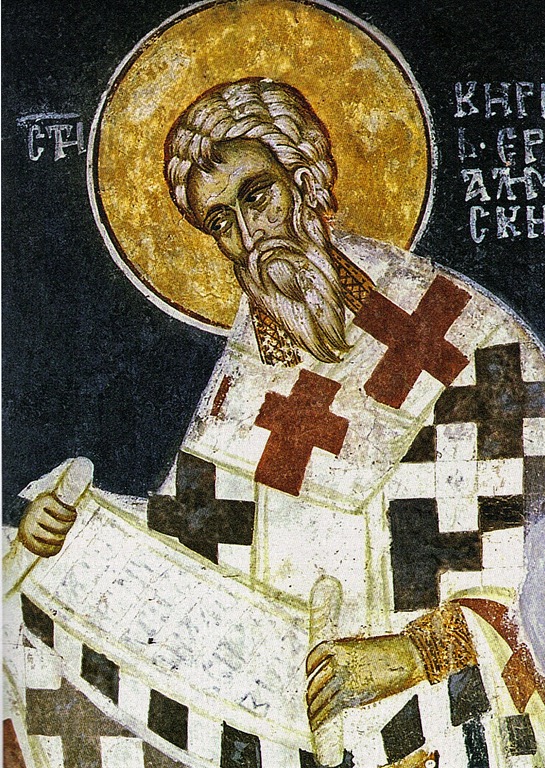
Cyril became Bishop of Jerusalem ca. 350, during the years of Arian controversy that persisted after the first ecumenical Council of Nicea, convened by the emperor Constantine in 325. Cyril came to accept wholeheartedly the Nicene Creed’s definition of the divinity of Christ as “consubstantial” with God the Father. He attended the First Council of Constantinople in 381. Of his many writings, Cyril’s twenty-four famous catecheses (lectures on aspects of the faith), which he delivered as bishop in about 350, have been preserved. The first five of the catecheses concern 1) the prerequisites for Baptism, 2) repentance and remission of sins, 3) the Sacrament of Baptism, 4) ten key points of doctrine, and 5) on faith and the Creed, or Symbol of Faith. Following is an excerpt from his Catechesis No. 5 on the Creed, §§12 and 13. But in learning the Faith and in professing it, acquire and keep that only, which is now delivered to you by the Church, and which has been built up strongly out of all the Scriptures. For since all cannot read the Scriptures, some being hindered as to the knowledge of them by want of learning, and others by a want of leisure, in order that the soul may not perish from ignorance, we comprise the whole doctrine of the Faith in a few lines. This summary I wish you both to commit to memory when I recite it, and to rehearse it with all diligence among yourselves, not writing it out on paper, but engraving it by the memory upon your heart, taking care while you rehearse it that no catechumen chance to overhear the things which have been delivered to you. I wish you also to keep this as a provision through the whole course of your life, and beside this to receive no other, neither if we ourselves should change and contradict our present teaching, nor if an adverse angel, transformed into an angel of light (II Corinthians 11:14) should wish to lead you astray. For though we or an angel from heaven preach to you any other gospel than that you have received, let him be to you anathema. (Galatians 1:8-9) So for the present listen while I simply say the Creed, and commit it to memory; but at the proper season expect the confirmation out of Holy Scripture of each part of the contents. For the articles of the Faith were not composed as seemed good to men; but the most important points collected out of all the Scripture make up one complete teaching of the Faith. And just as the mustard seed in one small grain contains many branches, so also this Faith has embraced in few words all the knowledge of godliness in the Old and New Testaments. Take heed then, brethren, and hold fast the traditions which you now receive, and write them on the table of your heart. (§12) Guard them with reverence, lest per chance the enemy despoil any who have grown slack; or lest some heretic pervert any of the truths delivered to you. For faith is like putting money into the bank, even as we have now done; but from you God requires the accounts of the deposit. I charge you, as the Apostle says, before God who quickens all things, and Christ Jesus, who before Pontius Pilate witnessed the good confession, that you keep this faith which is committed to you, without spot, until the appearing of our Lord Jesus Christ. A treasure of life has now been committed to you, and the Master demands the deposit at His appearing, “which in His own times He shall show, Who is the blessed and only Potentate, the King of kings, and Lord of lords; Who only has immortality, dwelling in light which no man can approach unto; Whom no man has seen nor can see. To Whom be glory, honor and power for ever and ever. Amen”. [I Timothy 6:15-16] (§13) ***** Translated by Edwin Hamilton Gifford. From Nicene and Post-Nicene Fathers, Second Series, Vol. 7. Edited by Philip Schaff and Henry Wace. (Buffalo, NY: Christian Literature Publishing Co.,1894.) Revised and edited by Kevin Knight for New Advent. Reprinted with permission. (Complete text: newadvent.org/fathers/310105.htm). https://adoremus.org/2010/11/saint-cyril-of-jerusalem-on-the-creed/ |


.jpg)


.jpeg)