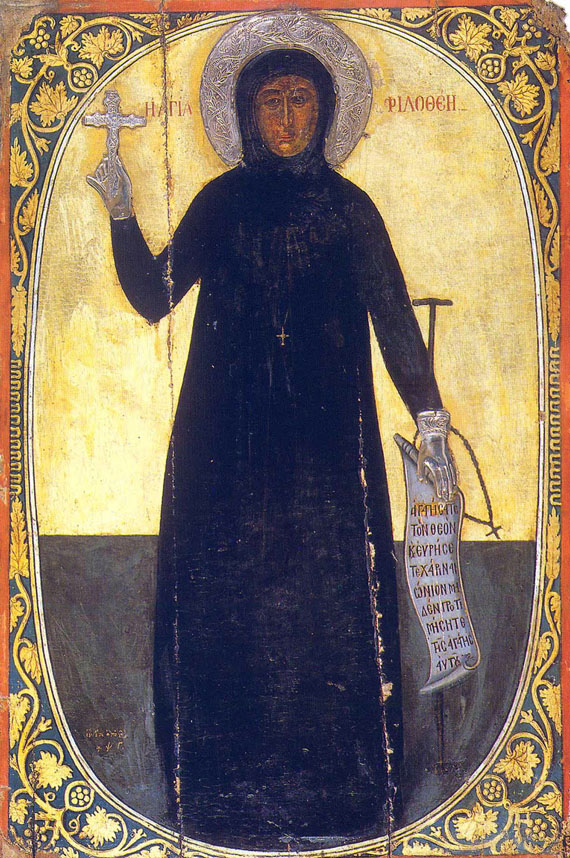
Εμφάνιση αναρτήσεων με ετικέτα Woman. Εμφάνιση όλων των αναρτήσεων

Παρασκευή 28 Ιουλίου 2023

The feast-day of St. Markella of Chios (July 22n) & a shocking message regarding child abuse


This article was written on the occasion of the feast of the holy Virgin Martyr Markella of Chios (the 'Chiopolitis' - a native of Chios), whose memory is commemorated on July 22nd.

Orthodox Outlet for Dogmatic Enquiries

Source: euxh.gr (Translation:  K.N.)

Saint Markella was murdered with unprecedented ferocity by her own father, who was obsessed with sexual lust for her! The girl resisted his wishes to the death – literally - but he finally chased her to the shore and slaughtered her when she became trapped among the rocks! The people of Chios confirm that every year, on the day of her memory, the waters at the site of her slaughter turn red by themselves, as if they too want to honour the pure, virgin blood that was so unjustly and tragically spilled there.

The saint is characterized as 'Virgin-Martyr', because 'virgin' in the ancient Greek language (parthenos) does not only mean a person who is sexually untouched and pure; it is also used when referring to a girl (a young woman, mainly a teenager - unmarried of course). A Christian girl who has not been married is taken for granted to be physically (sexually) unmolested, which is why the Greek terms for 'daughter' and 'virgin' have become synonymous. This is why young and unmarried women who had martyred for their faith in Christ and His teaching are called 'Virgin Martyrs'.  Examples of Virgin Martyrs are Saint Marina, Saint Kyriake, Saint Paraskeve, Saint Christina, Saint Barbara, Saint Ekaterina, e.a.. The first four mentioned here are commemorated in July.

The feast-day of St. Markella marks the commemoration of her exceptionally brutal martyrdom (by an abhorrent example of a father who had lost his senses with carnal lust for his daughter to such a degree that he finally hunted her down and slaughtered her far more viciously than the slaughtering of a lamb); a martyrdom that conveys through the centuries a profoundly shocking message regarding child abuse. The element underlying her story that has left a deep impression in people more than any other is precisely the shocking manner of her death and the natural perpetrator of her murder.
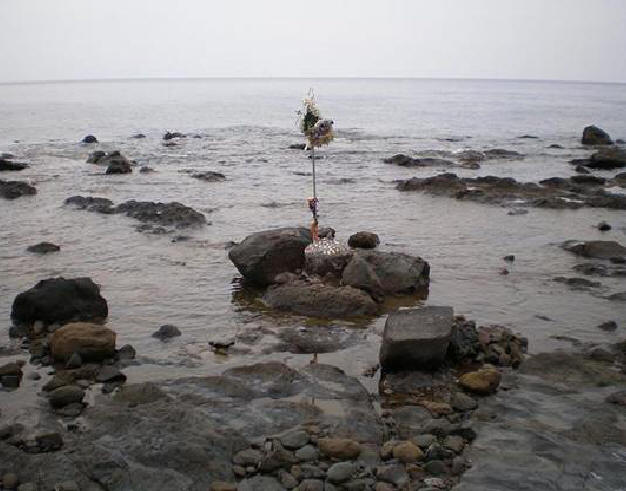
 

Location marking where the martyr was slaughtered and the water turns blood-red annually on her feast-day.
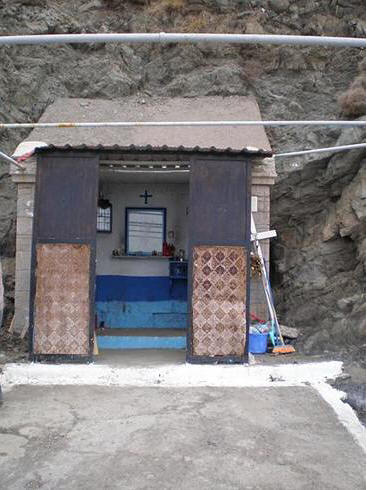
Shrine on the coast - facing the martyr's place of martyrdom
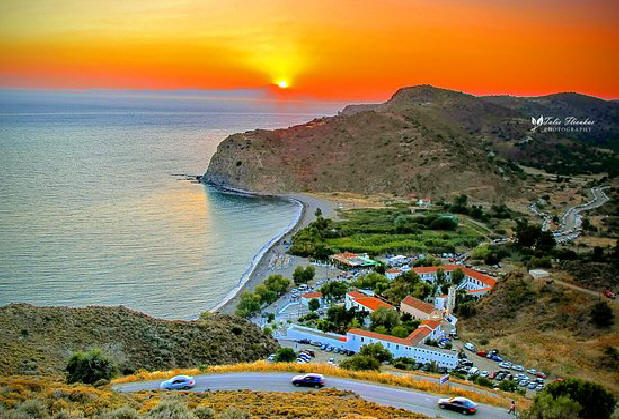
The Monastery of Saint Markella on Chios Island, Greece

The same is true for the feast day of the Holy Great Martyr Barbara (December 4th), where the predominant element of her life that has impressed people is the fact that her own father betrayed her to the Romans as a Christian, allowing her to be subjected to gruesome torture and finally, upon his personal insistence, to be decapitated by his own hand (only to be struck and killed by a bolt of lightning a few days later).  This detail is the reason Saint Barbara has been established in Greece as the patron saint of the Military Division of Heavy Artillery.
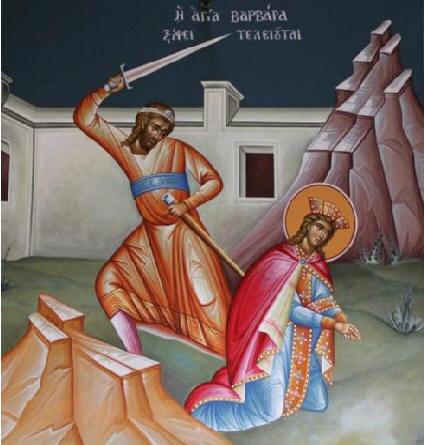
Saint Barbara being decapitated by her father

Two other (but less well-known) saints who were murdered by their father are the Great Martyr Christina, horrifically tortured for being a Christian (commemorated July 24th)
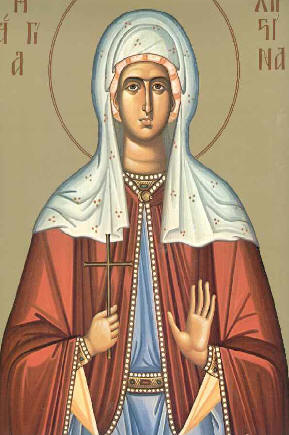
 

Saint Christina

and Saint Philothea of Arges, Romania, (commemorated December 7th). Orphaned on the mother’s side and with an abusive stepmother, the saint was mortally wounded by her father (possibly not intending to kill her) because she was giving away to the poor most of the food her stepmother would give her to take to her father working in the fields. She was only 12 years old!
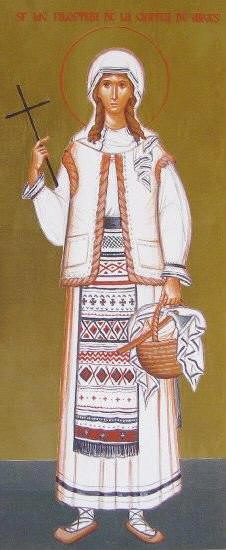
 

Saint Philothea of Arges, Romania

We might also mention two married Christian women who were victims of domestic violence and are also honoured by the Church as martyrs: they are the Saints both named Thomais: Saint Thomais of Lesvos Islqnd, Greece (commemorated January 3rd) who was beaten to death by her husband, and Saint Thomais of Alexandria, Egypt (commemorated April 14th), who was murdered by her father-in-law for resisting his sexual desires!
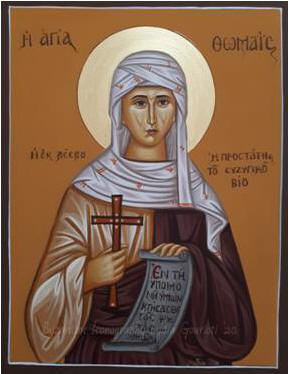
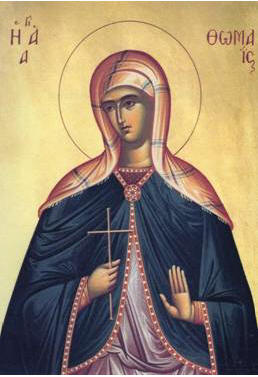
        

Saint Thomais of Lesvos Island Greece          Saint Thomais of Alexandria Egypt

The conclusion one reaches from all the above instances is that domestic violence and child abuse was brought to light by Christians and openly denounced through the Christian Synaxarions (Books of Saints’ biographies) mentioning women victims of such violence who are commemorated annually by the Church as saints and martyrs.

It must be emphasized that a person is deified (recognized by the Church as a saint), through evidence of their unyielding faith and love for Christ. They have also been recognized as saints for steadfastly defending their moral Christian principles to their dying breath - and not merely because they happened to have fallen victims to a certain kind of criminal behaviour. The same applies to all the martyrs who had preferred torture and death rather than betray their faith and their moral principles. Most of them would have attained sainthood anyway, for having lived holy lives; although a holy life was also understood as an occasion for them to be tested unto death, even sacrificing their very lives and - according to Orthodox Christianity – anticipating they have earned Eternity.


Τετάρτη 7 Σεπτεμβρίου 2022

The Whole Adam

Fr. Stephen Freeman
Ancient faith / Glory 2 God for all things

Orthodox Outlet for Dogmatic Enquiries

Mt. Athos, in popular treatments, is often described as a “male enclave,” a place where no woman has set foot in a thousand years (this is not actually true). The exclusion of women from the Holy Mountain is deeply offensive to some (cf. European Union) and is imagined as a bastion of machismo in a cassock. It is therefore strange to discover, when you visit the Holy Mountain, that the central figure in its life is a woman: the Mother of God. She is described as the “Abbess of the Holy Mountain.” It is her icon, Axion Estin, that has the place of central honor in the course of the year (she is carried from the Protaton Church to visit the surrounding monasteries on Bright Monday). Indeed, I believe the Holy Mountain would be a place of deep distortion were the Theotokos not given such prominence. There is no wholeness for human beings that is not also a wholeness of male and female: “It is not good for the man to be alone.” (Gen. 2:18).

I have seen some recent conversations (and heard presentations at conferences) that ponder the influx of young men into Orthodox Churches in America. Spiritual pundits draw various conclusions about the phenomenon (some even suggesting that credit should be given to podcasters and bloggers!). I give credit to the providence of God that is always at work in all things drawing all things together into one (Eph. 1:10). But, of the things that God means to draw together into one, I take it to be pre-eminent that the union of male and female is chief among them.

One conversation that I’ve heard has asked the question, “What do young men need to learn?” It is, unfortunately, only half the question. We cannot teach men apart from women. If masculinity is disordered, femininity will be distorted as well. The destruction of men and women has been a constant by-product of the sexual revolution of the past century and the present. It only ever asked half a question and offered answers that destroyed the very context of our existence. We are a deeply disordered society – and this at the most fundamental levels.

The sexual revolution was constructed with the dynamics of criticism. What had gone before had flaws, injustice, unaddressed oppressions, and foundations in a variety of false narratives. To point out the flaws and deconstruct the edifice is easy work. To build something better, something true, something whole, is hard work, indeed, and it has received almost no attention. Building a civilization is among the hardest tasks that human beings ever undertake. Destoying them can be the work of an evening.

Karl Stern, in his classic work, The Flight from Woman (1965), spends time discussing the difference between scientific knowledge and poetic knowledge. There are many ways to frame this distinction. “Scientific knowledge” describes knowledge that is “outside” of us: such as objective, verifiable, experimental results. “Poetic knowledge” (by far the harder to describe) refers to the knowledge we have from the “inside.” It is what we know because it is us, or because we have a participation in its life. Scientific knowledge gives us an ability to master and control the world around us. It also gives us a knowledge that is “alien” to us.

…poetic knowledge is acquired by union with and attachment to the object; scientific knowledge is acquired by distance and detachment from the object. (p. 74)

Living in a world of machines can be wonderfully abundant but lonely and isolating. Even when we study other humans, with scientific knowledge we place them in a category that we loathe: that of objects.

Poetic knowledge is a reality seeking for a name. Its difficulty in finding an apropos name is itself indicative of its very nature. We all have it, we cannot live without it, and we have a hard time describing it or defending the conclusions that it presses on our reality.

We want to live in a beautiful world while finding ourselves in a world designed for profit and manageability. We want empathy from the people around us, but discover that having to explain what we mean (much less to actually ask for that quality) defeats the very purpose of our desire. The machines in our world will not try harder simply because we are having a bad day.

I suggest Stern’s book to anyone wanting to explore this distinction further. Fr. Tom Hopko held it in great regard and recommended it.

But all of this brings me back to the problem of male and female in the life of the world and in the life of the Church. Hopko once opined that issues surrounding male and female would be a profound source of heresy in this century – one that would mark our time the way Arianism marked the 4th century. His words were prescient. I believe that the problem is compounded by the fact that we are considering something that is largely rooted in “poetic knowledge.” Though it is certainly the case that there is a fairly straight-forward biological definition of male and female (despite the present confusion maintained by some), stating a biological fact doesn’t even begin to address the mystery.

We are embodied beings and we cannot experience the world in a disembodied form. To describe our bodies from the outside (scientific knowledge) says nothing about what it is like to actually be that embodied person. This becomes yet more complex when the reality of who and what we are extends beyond my body and encompasses the bodies that are around me. For the terms “male” and “female” have no meaning in and of themselves – they are relational terms. Thus it is true that men cannot know what it is to be male without, in some manner, knowing what it is to be male-in-relation-to-female. The same is true of women. In perhaps the most tortured passage in all of St. Paul’s writings he says (profoundly):

… man [is not] independent of woman, nor woman independent of man, in the Lord. For as woman is from man, even so man also comes through woman; but all things are from God. (1 Cor. 11:12)

Poetic knowledge comes in a patient act of listening and reflection. It is often spoken in signs and symbols. In the life of the Church the story of Adam and Eve are profoundly intertwined with the story of salvation itself. Male and female are not just bits of biological necessity – they are sacramental elements in the wonder of theosis.

Modern Christianity has largely followed the lead of the culture. We have listened uncritically to the messaging of what it means to be male and female (largely derived from concepts grounded in consumerist and modern philosophies) while ignoring the poetic knowledge of the tradition. Thus, we have a genderless Jesus saving men and women as though they were genderless drones (which is pretty much what the world wants – “worker bees”). Modern theologies treat the mother of God and the entire drama of Christ’s nativity as nothing more than an “arrival” story, without any consideration for the full nature of what is taking place.

Mary’s conception of Christ is first foretold in Genesis: “And your seed will bruise his head” (Gen. 3:15). The coming of the Messiah, as prophesied in Isaiah, is specifically told in terms that engage human sexuality: “A virgin shall conceive and bear a child” (Is. 7:14). These, and other such references, are not incidental, but integral to our salvation.

By the same token, our own humanity (how is this not obvious?) is the story of generations of conceptions and births. We do not exist as genderless worker bees, but as embodied, engendered human beings, male and female, and the mystery of who we are cannot be spoken without uttering that very same mystery.

It is not accident, nor a product of some historical prejudice, that the priesthood of the Church is borne by men (and only a very few men, at that). Neither is it an accident that the Mother of God holds such a central place in the liturgies and piety of the Church. The poetic reality of our being, particularly our being as justified, sanctified, deified human beings, is drawn forth in the poetic imagery and speech of the Church. It speaks to the heart when the heart can hear it.

What shall we do with young men? What shall we do with young women? What shall we do with the rest of us as well? We must sing the Lord’s song, and sing it well, until the generations of the moment and of the years to come can begin to hear that it is the song of their true lives. It is God’s love song to us all, sung in a human key. It is also the key of the Divine, but only the most silent hearts can hear that.

I have more to say on this, but it will have to wait.


Κυριακή 20 Φεβρουαρίου 2022

The House of Agia Filothei / La plus vieille maison d'Athènes


The historic mansion of Agia Filothei the Athenian, one of the oldest remaining houses of Athens, fully restored, opened its doors recently. It is the mansion of the Byzantine family of Mpenizelos-Palaiologos, in constant use since the 16th c., which will be used for the needs of the Non-Profit Philantropic Organization "Apostoli" (Mission) of the Athenian Archdiocese.
The whole building is a museum of sorts, since within it a visitor can identify important remnants of the historic course of Athens itself. Archaeologists found at a depth of almost 4,5 m (15 ft) ruins of the Roman City Wall. On the ground floor there are signs of older buildings dating to the 16th c., when St. Filothei lived, while in the upper floor which was added much later, we see a typical Athenian wealthy family house of the early and mid Ottoman occupation period. More & photos here.

Quand on visite Athènes, une promenade à travers Plaka semble inévitable ; le petit quartier s'est développé juste sous la colline de l'Acropole et, avec le temps, son ensemble de ruelles, de maisons et de magasins est devenu un lieu de passage pour quiconque visite le Parthenon. Plaka était l'endroit où la plupart des quelques Athéniens "modernes" vivaient et avaient leur maison, il n'est donc pas surprenant que les visiteurs y découvrent la plus ancienne maison d'Athènes : un hôtel particulier à deux étages au cœur même de ce quartier animé, restauré, transformé en musée, et désormais accessible aux visiteurs et aux habitants.

L'affirmation "la plus vieille maison d'Athènes" peut être un peu trompeuse cependant ; beaucoup penseraient que la maison est en quelque sorte liée à l'époque grecque antique - peut-être un grand philosophe vivait-il ici ? Ou peut-être une famille athénienne riche et dévouée, ou était-ce le théâtre de pièces secrètes et sacrilèges ? Rien de tout cela en fait. La maison date du XVIème siècle et c'est le dernier exemple d'une Konaki, une construction ottomane typique, dans le sud de la Grèce. La maison est également appelée la Manoir de Benizelos, d'après le nom de son premier propriétaire Angelos Benizelos, qui était le descendant d'une famille aristocratique et le père de Saint Filothei, considéré comme un patron de la ville d'Athènes. L'histoire du bâtiment n'est pas encore tout à fait claire. L'édifice conserve encore des structures datant du XVIe siècle. Il fut reconstruit à la fin du XVIIe et au début du XVIIIe siècle, puis abandonné pendant des années au XIXe siècle. Enfin, la maison fut reprise par les institutions grecques en 1972 et est gérée par l'archidiocèse d'Athènes depuis 1999. Elle a ensuite fait l'objet d'une importante restauration jusqu'à sa réouverture en 2017.

itinari.com

Federico Spadoni 


St. Philothei of Athens 1522-1589

The revolution of a Woman - Saint Philothei of Athens (February 19)


Σάββατο 19 Φεβρουαρίου 2022

St. Philothei of Athens 1522-1589


Pemptousia

St. Philothei lived in the Turkish-occupied, sixteenth-century Athens. Her spiritual and social work was groundbreaking, especially for a woman of that era. It was accomplished within the Church and dedicated to the service of the Greek people as a continuation and consequence of Orthodoxy and Romanity. On 19 February 1589, she passed into the ranks of the New Martyrs who, with their blood, paid for their dynamic missionary work during the years of the Turkish occupation.

αγια Φιλοθεη

As we leaf through the Synaxarion, the Spiritual Meadow, and the lives of the athletes of the Church, a complete army of righteous, heroes, martyrs, venerable ones, and Saints come to mind. And that Church that is “adorned in the blood of the martyrs as purple and fine linen” praises martyrdom, setting up and lauding the spirit and sanctity of the martyrs as an example to the faithful, aimed at encouraging them to emulation and the praise of their spiritual strength.

Do not be frightened, brethren, by the frightful faces of tyrants, nor by their great numbers, nor by their voices, nor by their terrible actions. Do not be afraid of wounds, by swords, by chains, by imprisonment. Do not be frightened of gallows, of hooks, of fire…

So writes St. Nicodemus the Athonite in the New Martyrlogion. And Philothei Angelou Venizelou was one of those rare personalities of her era that stood against the vested interests, the threats, personal torture, and affronts, and “first raised up the banner of faith, beneath which was hiding a great and noble idea, the free development and education of women,” as John Gennadios writes.

Sixteenth Century Athens, the time of St. Philothei 

Philothei Venizelou’s birth is surrounded by the mystery of divine intervention. Very quickly, even from her childhood and teen years, her life is described as a ray of hope and consolation, and more: she reacted against Athenian indifference and the spiritual lethargy of the Greek people and her life ended, through her faith, vision, and boldness, in her personal and unavoidable martyrdom.

“Oh ruler, I desire to suffer different types of tortures for the name of Christ, whom I worship and venerate as the true God and perfect man, from the depths of my heart and soul. You will do me a great favor, if you would like to send me to Him an hour earlier through this crown of martyrdom.”

With these few words, which echo a deeper state of freedom, vision, and social presence, the blessed Philothei Venizelou responds to her judge and tyrant Voivod, who violently demands that she choose “death by the sword or rejection of her faith”! This choice of hers happens during a historic phase of the Greek people, during which the thought alone of using some argument against the ruling social institutions, would mean certain destruction, especially when the person speaking is a woman! All mechanisms are closed down. And the idea and possibility for personal action comes and goes, not only in the realm of production, rivalry, and spirituality, but also in the revelation of understanding some metaphysic. It is very important that one understand the era about which we are speaking, in all realms of personal and social life, so that one is able to present and interpret the capabilities, the actions, and the final ideas of a developing group or a single person. These things took place in sixteenth century Athens, with its 3,500 – 4,000 inhabitants, where, as various chronographers, writers, and historians relate, poverty was commonplace, as was illiteracy, piracy, mass kidnapping of children, epidemics, and unscrupulous violence. 

A. Vakalopoulos notes that this period of the Turkish occupation, “the first two centuries of the occupation (1453-1669) were truly the Greek Middle Ages; they were centuries of dark chaos. The Greek people seem to have been destroyed, to have lost their orientation and to move forward without any guidance.” Athens was an unknown Turkish village at that time, when travelers were even unaware of the city’s name! Some occasionally saw the city from Porto Drako, Piraeus, and went on a massacre there, and immediately sailed away in their ships. Athenians spent most of their time in their small houses, speaking their local tongue, which would sometimes be incomprehensible to other people – both Greeks and foreigners – and it was drifters: Voivods, Disdaris, Katis, and Tzambitis that ruled the city. In a letter of response to the Athenian Krousios, Portos the Frank writes, “I wept at the disorder and change of fortune that has happened, in Athens, and in Greece…it has now become enslaved to the barbarians and destruction, and nothing of that famous name has been saved.” And the further Islam spread in the Balkans, and the eastern Mediterranean fell into the crooked claws of the Ottomans, the deeper the Athenians descended into the darkness of despair and, hidden from the Turkish authorities and the local spies, they mourned:

           Athens sits and mourns,
She weeps and does not endure.
Woe is me the downtrodden one,
Woe is me the saddened one,
Woe is me the sinful one
More than the others.
Once again Athens in lamenting
From her depths she laments.

So, in this Athens, without light or hope, in this nearly invisible and darkened culture, “a fragrant flower and gentle light appeared in the depths of the winter of bondage….” In 1522, Reboula (Paraskevoula) is born, who would later be Philothei, the daughter of “Bas Kotsambasi” (“Lord”) Angelos Venizelou and Syringas, of the line of the Paleologans of Moria.

Reboula Venizelou – Childhood and Teen Years

From her earliest years of childhood, Reboula lived an economically and socially comfortable life. Her experiences were the benefit of a rich ancestral inheritance. And her education was a marked by self-reliance and a spiritual and moral struggle. Charismatic elements of her personality would eventually reveal to those around her, and beyond, that she was a significant personality whose well-ordered life would have great effect. At the beginning of her life, she followed the established traditional principles of those who wielded power, those lawfully entrusted with manners and traditions. And at the age of fourteen she married some Athenian lord! Just three years later, however, she became a widow, after an unsuccessful and tortuous marriage, as her biographer recounts. And so once again, she gives herself over to herself. The social circle to which she belongs as well as her family, among whom she is now living, pressure her to remarry so as to find a place in the established social setting, and so as to leave children for her renowned family, since she had a traditional and social obligation. Though she was just seventeen years old, she now refuses to enter the ranks and the molds that preserve the exclusivity and the static condition of their lives. Thousands of realms open up before her! These realms await this anti-conformist who will serve them and will pour upon her numb people the word, action, free movement, overcoming, the resurrectional vision.

Philothei is Tonsured a Nun

So, she decisively insists that she is not going to remarry. And ten years later, after the repose of her parents, she is tonsured a nun and takes the name Philothei. In the place of the present Archbishopric of Athens, there where the family home of the Venizelos’ family was located, she built the Monastery of St. Andrew around the year 1551, and endowed it with her entire fortune, which was one of the greatest in Athens. This was how she began her dynamic offering to the Church, and her unstoppable quest to boost the education, self-confidence, and material and moral comfort of her people. Regarding this, Nikos Tomadakis notes, “It is well known that…she abandoned worldly things and the marriage bed, not only for the Bridegroom Christ, but also for the glory of the former Athens whose denizens had become illiterate, barbarous, and which did not care for the poor, the homeless, and the sick, nor for the unprotected young women, many of whom were serving Muslim families or who, because of their beauty and physical graces, aroused the passions of the local Muslims, and were in danger of becoming Muslim either under pressure or by having been talked into it.”

agia-philothei syn

So, considering these facts, the social setting, and the conditions that ruled the ideological, social, and economic lives of the people, and that were required for survival in Athens, it becomes clear that Philothei:

1. Was an urban lady, who dared to move from her class.

2. Was a world-weary lady, whose marriage was unsuccessful and who was left early on as a widow and without children.

3. Was a lady who dared to throw off the veil of slavery to established ideas, and who tried to give practical and decisive answers and solutions to an era in which everything was voiceless and hopeless.

4. Was basically an unprotected woman, who gave herself and her wealth to the Church, with the only certain return being her martyrdom by the Tzambitis Ottomans.

Her Spiritual and Social Work

Her monastery (Parthenona) was a spiritual and social center, unique in its services and philanthropy. It quickly became very well known in East and West. Philothei personally overlooked its educational work. There, her young ladies systematically taught the common language, handiwork, weaving, and basic art, as well as housekeeping and cooking. In this way, she prepared the young women of Athens, as well as others who came from far away locations, not only to become nuns, but also for the domestic life. In addition, young ladies that were being hunted by both Greeks and Turks would find refuge at the Parthenona. And she did not offer them only material relief. She also helped them escape secretly to Tzia, to Andros, to Aegina, or to Salamina, if there was a need, and she would protect them in those places. And as if this was not enough, the tireless and prudent Philothei also offered a great deal of money to free those in bondage, as various manuscripts inform us, “…and beyond this, she never ceased to free – as is widely known – that she truly freed many slaves.” The synaxarian account of her life also tells us about her broader philanthropic work, which was dynamic and well-organized, and included progressive means of social work, remarkable by even today’s standards. 

It is written, “The hospitals and hotels that she built at a certain distance from the monastery, are sufficient examples of her incredibly merciful and compassionate soul, and when she came to these places, to visit the various ill people living there, not only did she care for them as regards their food and the necessary physical comforts, but she fed their souls with consoling and evangelical words, becoming all things to all people so she might win all, as Paul said.” Truly and without question, the historical confirmation of all of the above comes through a reference in a letter sent by Philothei on 22 February 1583 to the Venetian Gerousia, where she asks for monetary support so as to manage to pay off her debts from ransom money, duties, bribes, and taxes to the Turks. It is a document that reveals many things that Constantine Bertzios of blessed memory brought to light from the archives of the Venetians in 1953. Preserving the orthography of the text untouched, we reproduce only one section from this request of Philothei’s, which describes her missionary work and her daily adventures in clear language,

Most enlightened, most esteemed, most righteous…rulers of Venice…As you know, I have built a monastery dedicated to the all-praised holy Apostle Andrew the First-Called, along with two dependencies in Athens and I brought together a hundred and fifty virgins to live a normal coenobitic life, but the Turks have slandered me during this time of trial because of the enslaved Christians that we have managed to liberate, and because some Turks were discovered in the monastery, who had come to believe in Christ and became nuns…and in the never-ending month of August the Turks came and searched the monasteries and found a slave of the flag, where we had been protecting him for his freedom, as well as three Turkish women that had become nuns, and at the same time they took me into their hands and put me into jail, a large jail, and they robbed the monasteries, and the virgins fled, some of whom managed to escape secretly, and the rest of whom are here with us. And every hour they try to convince me and the sisters to become Turks, or else they will burn me.

After this letter, a correspondence followed until she received some help from Gerousia of Galinotatis. Among these manuscripts is a document of the Latin bishop Paul of Zakynthos and Kefalonia, on 25 May 1583, who among other things writes regarding the “venerable Philothei, who is of good social standing, and is well known for her good Christian works,” and the following, “her goodness and good works were renowned, and she drew many Turkish women to her and she made them Christian. She also receives many sinful women at her monastery, who are pregnant and she hides them at the monastery, so that the Turks do not punish them. Because of all of these actions, she is persecuted by the unbelievers.”

And it was only natural! Such a progressive and provocative social and pedagogical actions could only elicit ferment, whispered slander, strident testimony by locals, blackmailing, and the immediate threat of the Ottoman conqueror. Her monastery was frequently plundered, they would leave it barren, sabotaging her farming and agricultural program, which was a basic source of sustaining her work. They also frequently put her in jail, interrogated her, whipped her, and forced her to abandon her successful service to the Church and her people. Her dynamic life, which transcended the narrow bounds of Athens and its four thousand souls, had become known by many supporters in the Ecumenical Patriarchate, in its areas along the Danube, in Crete, in the Eptanisa, and on many islands of the White Sea. 

And this shows how the Tyrant always tries to find an opportunity to close the center of revival that flourishes and extends its influence before his eyes. In the center of Athens. And later, to get rid of Philothei, who was the active agent behind this change. And the opportunity for this terrible catastrophic event appeared on 3 October 1588, the eve of the feast of St. Dionysius the Areopagite, at the dependency of St. Andrew in Patisia. During the nighttime service, five Turks that had been paid entered the church, “took Philothei and after whipping and beating her, left her nearly half dead.” The nuns took her to her crypt, in the suburb known today as “Philothei.” And there, 139 days later, on 19 February 1589, she passed into the ranks of the New Martyrs who, with their blood, paid for their dynamic missionary work during the years of the Turkish occupation.

For these souls, obedient to the will of God and faithful to the vision of the freedom of their people, Photios Kontoglou writes in his “Downtrodden Romanity,” “What heights and what spiritual grace did our race have during [this] period that we describe them as illiterate and barbarous. We moderns, we are the barbarians, who are unable to feel as we should their nobility and the greatness of their sacrifice for the name of Christ, which those lion-hearted ones offered with their bodies, and about whom the Evangelist John wrote that they were not born of blood, nor the will of the flesh, nor the will of man, but they were born from God.”

Philothei Venizelou, Continuer and Fruit of Romanity and Orthodoxy

Philothei Venizelou, “…in Athens, warmed and enlightened the very enslaved and those in the darkness…,” in broad strokes, she stood within the sphere of the spiritual and the revivalists, the revolutionary powers of our race and of the Church. The realization of the contemporary feminist ideal pales before the progressive achievements and positions of this young woman living more than four hundred years ago. Even before the educational battles, in a timely and effective manner Eugene Voulgaris, Kosmas the Aetolian, Rigas Velestinlis, Philothei made dynamic steps towards preparing the social groups. In practice, Philothei harmonized her service with the Orthodox way of life. She developed the solutions to her problems according to her own ethic, which proved to be justified through her inspiration, faith, and personal ethic. She broke many established bonds of social ethics. And she used old, strong wine, in completely new, revolutionary wine sacks. This is why the enslaved people had nearly boundless faith in her. In her day, the common consciousness was united and all of Athens willingly ceded their power to Philothei, imitating her dynamic example. We could even say that there was no other similar anarchic personality, which was, at the same time, prophetic and that brought revival to her era.

These ideas are based on the following beliefs that preserved a certain vision and goal in Philothei’s work:

1. Philothei was a cultivated Athenian. This was a very significant fact for her era. Cultivation (“cultured” according to contemporary terminology) is that luminosity of the nous and soul that remains after knowledge and information have disappeared.

2. She had a real awareness of many things, situations, and persons, difficulties and necessities, and even as regards the broader European reality. Whoever passed through Athens at that time would have necessarily visited her paternal home, and later on her monastery.

3. Her actions, as a woman, were unprecedented. And they neutralized every local Ottoman or bondsman’s reaction. Even today, it seems remarkable that a woman of that era would have had a direct correspondence with the Collegio of the Venetian Democracy.

4. The great Logothete Ierakas who, sent from the Patriarchate, came to deal with questions of the Monastery of St. Andrew with certain ill-mannered Athenians was deeply moved by the person of Philothei and vindicated her with fanfare.

And let us not forget that the Greeks were always suspicious and guarded in the face of every spiritual or social extreme. They would often judge anything that they, themselves, could not attain.

5. Philothei understood, in a complete and radical manner, the meaning of philanthropy and education. She does not offer her young women only food and shelter, but shows them the ways of Romanity and of freedom within the ark of Orthodoxy.

“This habit that we wear, my sisters, we do not wear just for prostrations and prayers, to save, in short, our souls; but also to show mercy to the people around us. So, let us see the many and innumerable benefactions that our Lord bestows every hour. We also, for our part, have a great obligation to give our blessings to those on the streets and, openly or in secret, to have mercy on souls, so that they will not be lost.”

 6. Philothei’s work is ecclesiastical. For this reason, it is also evangelical and ecumenical. It goes beyond the bounds of the parish, of the Metropolis, and of Athens. It has diachronic dimensions. And it is grounded, so that its benevolent influence reaches even into the twenty-first century.

She gave, she distributed
her wealth everywhere, rejoicing
the poor and the hungry.
Through God she lent
And she freely gave,
Therefore the Savior richly gave
Tο Philothei,
She was recompensed with divine grace…

Reading the biography of the Athenian lady and teacher (as they called her), Philothei Venizelou, one sees unravel before one’s eyes the whole continuation of Romanity and Orthodoxy and one “feels…a shiver that belongs to such a stream of ethnic and spiritual life.”

And yet, there are many today who occasionally come up with misconstrued interpretations, or raise false problems, so as to falsify the true historical reality. Despite their insufferable dependence on irrelevant fixations, they do not know that during the Turkish occupation we see the purest form of lived Orthodoxy. During this period, everything took place within the church and outside in her courtyard. That was where the mystery of life, of hope, and of the vision for tangible changes to their enslaved condition was lived. It was from this place that the ideologically and socially bold deed leapt, the personal objective and the eschatological position of the Greek as regards the realities of daily life. And along with this, those who would be bold enough to lead the people, through organization and priorities, would be witnesses from the seat of introspection, of revelation, of responsibility, and of self-sacrifice. Philothei was a child of the Church as were Leontia, Andromaris, Kosmas the Aetolian, Makrigiannis, K. Paparrigopoulos, Phlamiatos, Papoulakos, Papadiamandis, Priest monk Nicholas Planas, Photios Kontoglou, and all those who rooted self-consciousness and love of freedom in the consciousness of the Modern Greek. Despite this, secular history tells us nearly nothing of their lives and their sacrifices for the Greek people and for Orthodoxy. However, this intentional neglect for 170 years, now acts in a positive way in the service of the truth. So, through denials and deceptions, the unaffected reality shines in the open light: that which Philothei Venizelou revealed from the darkness of neglect. The teacher and lady of Athens, as is chanted in her church service:

           Rejoice, Light of Athens
Who lived a burning and public life
Faithful in your benefactions
And in your life of purity
You taught those who came to you
And you fed them
You were a protectress and bulwark,
You were a safe haven for those who were pursued
And saved the young and imprisoned.
And you were truly a luminary giving light
Lighting up the night
The darkness of slavery,
Oh Philothei, for your people
We praise you
And we ask you to intercede
For us before the Lord.

The work of Philothei Venizelou was so important, missionary and educational for the Greek people during the years of the Turkish Occupation, that she was recognized and immediately found worthy by the Church and by the people. And just a few years after her martyric death, she was canonized a Saint, in the days of the Ecumenical Patriarch Matthew the Second (1595-1600).

After the report of Metropolitan Neophytos of Athens, which was also signed by the Metropolitans of Corinth and Thebes, as well as by the clergy of Athens and the lords-notables of Athens, was sent to the Patriarchate, a Synodal Letter was “released, regarding the annual celebration and Church memorial of the Venerable Philothei,” on 19 February. So,

            Come, oh lovers of the feast
Let us praise Philothei
In songs and hymns
To her feast we go
A feast that is holy and divine
For she truly lived
A holy life here on earth
And through her works showed forth her faith
Therefore she also received
The crown of the athlete
From the hand of the One Whom she glorified
And for Whom she loved the people.
– From the Synaxarion

A few sources:
Dim. Kampouroglou, Ioannis Gennadios, A. Goudas, K. A. Christomanos, K. Sathas, N. Th. Filadelfeas, Pan. Skouzes, Sp. Lambrou, K. Biris, T. Neroutsos, G. Th. Maltezos, D. Sisilianos, T. Konstantinidis, F. Michalopoulos, M. Honiatis, E. K. Frangkaki, Dim. S. Ferousis, N. Tomadakis, K. Dimitriadis. In particular, the book by Demetrius Ferousi, Philothei Venizelou, published by Astir Publications, Athens, 1982.

The revolution of a Woman - Saint Philothei of Athens (February 19)


From Wikipedia (images from here)


Philothei
St.Philothei.jpg
BornNovember 21, 1522
Athens, Greece then Ottoman Empire
DiedFebruary 19, 1589 (aged 66)
Venerated inEastern Orthodoxy
FeastFebruary 19
PatronageAthens, Women and Charitable works

Saint Philothei of Athens, (also known as Philotheia or Philothea) (Greek: Άγια Φιλοθέη η Αθηναία) (November 21, 1522 - February 19, 1589), née Revoula Benizelos (Ρεβούλα Μπενιζέλου), was a Greek Orthodox religious sister, martyr and saint from Ottoman-era Greece.

Life

Philothei was born as Revoula Benizelou in Athens on November 21, 1522 to the illustrious and wealthy Benizelos family. Her parents were Angelos Benizelos and Syrigi Palaiologina, both from old Byzantine families. They had no children, but after fervent prayer her mother gave birth to a daughter whom they named Revoula, her birth name. Against her will, she was married at the age of 14 to the noble Andrea Chila, who mistreated her. When he died in 1539, she was only 17, beautiful and wealthy and her parents insisted that she get remarried. Instead, she remained at home, spending much of her time in prayer. The family wealth gave her the opportunity for charitable work, and while still a young woman she had gained the respect and love of the community.

When her parents died in 1549, Philothei found herself the owner of extensive holdings. She took up the monastic life and around 1551, establishing a women's monastery under the patronage of St. Andrew. She took the name Philothei.[1] There the young nuns taught handiwork, weaving, housekeeping and cooking. In this way, she prepared the young women who came to her for the domestic life. 

Philothei is primarily remembered for her abundant philanthropy. The convent had a great deal of charity establishments both in Athens and on the islands of the Aegean sea. Philothei founded a second, more secluded monastery at Patisia. She also built hospices, homes for the elderly, and schools for the girls and boys of Athens. One of her more controversial activities was to buy the freedom of Greeks taken as slaves by the Ottoman Turks, especially women taken to the harems. She offered shelter to the young women, some pregnant. Despite being hunted by the Turks, she helped them escape secretly to Tzia, Andros, Aegina and Salamina, where they were safe.[2] In a 22 February 1583 letter to the Venetian Gerousia, Philothei asked for monetary support to pay off her debts from ransom money, duties, bribes, and taxes that she owed to the occupying Turks. Her monasteries were frequently plundered, and the farming and agricultural program, which were a basic source of sustaining her work, devastated.[2]

Four women enslaved by the Ottoman Turks in harems also ran to her for refuge. The women were traced, and Philothei was beaten and brought before the magistrate who put her in prison. Friends intervened and paid the district governor for her release. As her fame grew, so did the animosity against her. On 3 October 1588, four Ottoman mercenaries broke into the monastery at Patisia [photo] during the evening vigil service and beat her severely. She remained bedridden and died of her injuries on 19 February 1589.[2]


Benizelos mansion

The bay window at the south facade of Benizelos mansion.

The mansion of St Philothei's family locates in Plaka and is probably the oldest house in Athens.

Veneration

The shrine of Saint Filothei

Philothei is considered a martyr by the Eastern Orthodox Church. Just a few years after her death, she was canonized a Saint, in the days of the Ecumenical Patriarch Matthew the Second (1595-1600). Her memory is venerated on February 19. Along with Saints Hierotheus and Dionysius the Areopagite, Saint Philothei is considered a patron of the city of Athens. Her relics are interred in the Metropolitan Cathedral of Athens. The Filothei district of Athens is named after her. 

Saint Philothei has a Troparion written about her:

Troparion to St. Philothei (Tone 5) The Faithful of Athens and all the world honor Philothei the martyred nun and rejoice in her holy relics. For she has exchanged this passing life for the life that knows no end through her struggle and martyrdom; and she begs the Savior to have mercy on us all.[3]

References

Further reading

 "Saint Philothei the Righteous Martyr of Athens", Greek Orthodox Metropolis of Toronto