 |
| Icon from here |
Theophany (from Greek theophania, meaning "appearance of God") is one of the Great Feasts of the Orthodox Church, celebrated on January 6. It is the feast which reveals the Most Holy Trinity to the world through the Baptism of the Lord (Mt.3:13-17; Mark 1:9-11; Luke 3:21-22).
Baptism of Christ
Celebration of
the feast
- For as many as been baptized into Christ have put on Christ: Alleluia.

Blessing of water (from here)
Hymns
When Thou, O Lord, wast baptized in
the Jordan, worship of the Trinity wast made manifest; for the voice of the
Father bore witness to Thee, calling Thee His beloved Son. And the Spirit in the
form of a dove confirmed the truth of His word. O Christ our God, Who hath
appeared and enlightened the world, glory to Thee.
Kontakion (Tone 4)
On this day Thou hast appeared unto
the whole world, and Thy light, O Sovereign Lord, is signed on us who sing Thy
praise and chant with knowledge: Thou hast now come, Thou hast appeared, O Thou
Light unappproachable.
Forefeast hymns
Troparion (Tone 4)
Be thou ready, Zabulon; prepare
thyself, O Nephthalim. River Jordan, stay thy course and skip for gladness to
receive the Sovereign Master, Who cometh now to be baptized. O Adam, be thou
glad with our first mother, Eve; hide not as ye did of old in Paradise. Seeing
you naked, He hath appeared now to clothe you in the first robe again. Christ
hath appeared, for He truly willeth to renew all creation.
Kontakion (Tone 4)
In the running waters of the Jordan
River, on this day the Lord of all crieth to John: Be not afraid and hesitate
not to baptize Me, for I am come to save Adam, the first-formed man.
Eve and
Afterfeast hymn
Troparion (Tone 4)
The River Jordan receded of old by
the mantle of Elisha when Elijah ascended into heaven; and the water was
separated to this side and that, the wet element turning into a dry path for
Him, being truly a symbol of Baptism, by which we cross the path of transient
age. Christ appeared in the Jordan to sanctify its waters.
 |
| Icon from here |
Church Year : Epiphany
The sixth of January is the feast
of the Epiphany.
Originally it was the one Christian feast of the “shining forth” of God to the
world in the human form of Jesus of Nazareth. It included the celebration of
Christ’s birth, the adoration of the Wise men, and all of the childhood events
of Christ such as his circumcision and presentation to the temple as well as his
baptism by John in the Jordan. There seems to be little doubt that this feast,
like Easter and Pentecost, was understood as the fulfillment of a previous
Jewish festival, in this case the
Feast of Lights.
Epiphany means shining
forth or manifestation.
The feast is often called, as it is in the Orthodox service books, Theophany,
which means the shining forth and manifestation of God.
The emphasis in the present day celebration is on the appearance of Jesus as the
human Messiah of Israel and the divine Son of God, One of the Holy Trinity with
the Father and the Holy Spirit.
Thus, in the baptism by John in the
Jordan, Jesus identifies himself with sinners as the “Lamb of God who
takes away the sin of the world” (John
1:29), the “Beloved” of the Father whose messianic task it is to redeem
men from their sins (Lk 3:21, Mk 1:35).
And he is revealed as well as One of the Divine Trinity, testified to by the
voice of the Father, and by the Spirit in the form of a dove. This is the
central epiphany glorified
in the main hymns of the feast:
When Thou, O Lord, wast baptized in the Jordan the worship of the Trinity was made manifest! For the voice of the Father bare witness to Thee, calling Thee his Beloved Son. And the Spirit, in the form of a dove, confirmed the truthfulness of his Word. O Christ our God, who hast revealed Thyself and hast enlightened the world, glory to Thee (Troparion).Today Thou hast appeared to the universe, end Thy Light, O Lord, has shone on us, who with understanding praise Thee: Thou hast come and revealed Thyself, O Light Unapproachable! (Kontakion).
The services of Epiphany are set up
exactly as those of Christmas, although historically it was most certainly
Christmas which was made to imitate Epiphany since it was established later.
Once again the Royal Hours and
theLiturgy of Saint Basil are
celebrated together with Vespers on
the eve of the feast; and the Vigil is made up of Great Compline and Matins. The
prophecies of Epiphany repeat the God
is with Us from Isaiah and stress the foretelling of the Messiah as
well as the coming of his forerunner, John the Baptist:
The voice of one crying in the wilderness: Prepare the way of the Lord, make his path straight. Every valley shall be filled and every mountain and hill brought low, and the crooked shall be made straight, and the rough ways shall be made smooth; and all flesh shall see the salvation of God (Is 40:3-5; Lk 3:4-6).
Once more special psalms are sung to begin the Divine
Liturgy of the feast, and the baptismal line of Galatians
3:27 replaces the song of the Thrice-Holy. The gospel readings of all
the Epiphany services tell of the Lord’s baptism by John in the Jordan River.
The epistle reading of the Divine Liturgy tells of the consequences of the
Lord’s appearing which is the divine epiphany.
For the grace of God has appeared for the salvation of all men, training us to renounce irreligion and worldly passions, and to live sober, upright and godly lives in this world, awaiting our blessed hope, the appearing of the glory of our great God and Saviour Jesus Christ, who gave himself for us to redeem us from all iniquity and to purify for himself a people of his own who are zealous for good deeds (Titus 2:11-14).
The main feature of the feast of
the Epiphany is the Great
Blessing of Water. It is prescribed to follow both the Divine Liturgy
of the eve of the feast and the Divine Liturgy of the day itself. Usually it is
done just once in parish churches at the time when most people can be present.
It begins with the singing of special hymns and the censing of the water which
has been placed in the center of the church building. Surrounded by candles and
flowers, this water stands for the beautiful world of God’s original creation
and ultimate glorification by Christ in the Kingdom of God. Sometimes this
service of blessing is done out of doors at a place where the water is flowing
naturally.
The voice of the Lord cries over the waters, saying: Come all ye, receive the Spirit of wisdom, the Spirit of understanding, the Spirit of the fear of God, even Christ who is made manifest.Today the nature of water is sanctified. Jordan is divided in two, and turns back the stream of its waters, beholding the Master being baptized.As a man Thou didst come to that river, O Christ our King, and dost hasten O Good One, to receive the baptism of a servant at the hands of the Forerunner (John), because of our sins, O Lover of Man(Hymns of the Great Blessing of Waters).
 |
| St. Isaiah the Prophet (here) |
Following are three readings from
the Prophecy of Isaiah concerning the messianic age:
Let the thirsty wilderness be glad, let the desert rejoice, let it blossom as a rose, let it blossom abundantly, let everything rejoice… (Is 35: 1-10)Go to that water, O you who thirst, and as many as have no money, let them eat and drink without price, both wine and fat… (Is 55:1-13)With joy draw the water out of the wells of salvation. And in that day shall you say: Confess ye unto the Lord and call upon his Name; declare his glorious deeds… his Name is exalted… Hymn the Name of the Lord… Rejoice and exult… (Is 12:3.6).
After the epistle (1
Cor 1:10-14) and the gospel reading (Mk
1:9-11) the special great litany is chanted invoking the grace of the Holy
Spirit upon the water and upon those who will partake of it. It ends with the
great prayer of the cosmic glorification of God in which Christ is called upon
to sanctify the water, and all men and all creation, by the manifestation of his
saving and sanctifying divine presence by the indwelling of the Holy and Good
and Life-creating Spirit.
As the troparion of the feast is
sung, the celebrant immerses the Cross into the water three times and then
proceeds to sprinkle the water in the four directions of the world. He then
blesses the people and their homes with the sanctified water which stands for
the salvation of all men and all creation which Christ has effected by his
“epiphany” in the flesh for the life of the world.
Sometimes people think that the
blessing of water and the practice of drinking it and sprinkling it over
everyone and everything is a “paganism” which has falsely entered the Christian
Church. We know, however, that this ritual was practiced by the People of God in
the Old Testament, and that in the Christian Church it has a very special and
important significance.
It is the faith of Christians that
since the Son of God has taken human flesh and has been immersed in the streams
of the Jordan, all matter is sanctified and made pure in him, purged of its
death-dealing qualities inherited from the devil and the wickedness of men. In
the Lord’s epiphany all creation becomes good again, indeed “very good,” the way
that God himself made it and proclaimed it to be in the beginning when “the
Spirit of God was moving over the face of the waters” (Gen
1:2) and when the “Breath of Life” was breathing in man and in everything
that God made (Gen 1:30; 2:7).
The world and everything in it is
indeed “very good” (Gen 1:31)
and when it becomes polluted, corrupted and dead, God saves it once more by
effecting the “new creation” in Christ, his divine Son and our Lord by the grace
of the Holy Spirit (Gal 6:15).
This is what is celebrated on Epiphany, particularly in the Great
Blessing of Water. The consecration of the waters on this feast places
the entire world—through its “prime element” of watering the perspective of the
cosmic creation, sanctification, and glorification of the Kingdom of God in
Christ arid the Spirit. It tells us that man and the world were indeed created
and saved in order to be “filled with all the fullness of God” (Eph
3:19), the “fullness of him who fills all in all” (Eph
1:22). It tells us that Christ, in who in “the whole fullness of deity
dwells bodily,” is and shall be truly “all, and in all” (Col
2:9, 3:11). It tells us as well that the “new heavens and the new earth”
which God has promised through his prophets and apostles (Is
66:2; 2 Peter 3:13, Rev 21:1) are truly “with us” already now in the,
mystery of Christ and his Church.
Thus, the sanctification and
sprinkling of the Epiphany water is no pagan ritual. It is the expression of the
most central fact of the Christian vision of man, his life and his world. It is
the liturgical testimony that the vocation and destiny of creation is to be
“filled with all the fullness of God” (Eph
3:19).
Discourse On the Day of the Baptism of Christ
Saint John Chrysostom, Archbishop of Constantinople
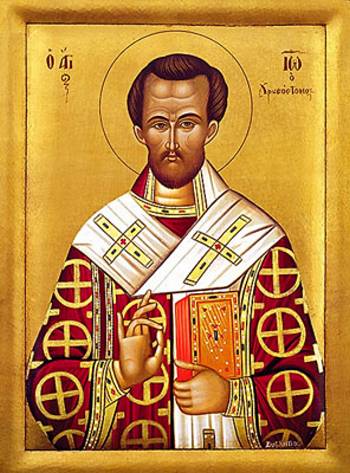 We shall now say something about the present
feast. Many celebrate the feast days and know their designations, but the cause
for which they were established they know not. Thus concerning this, that the
present feast is called Theophany -- everyone knows; but what this is --
Theophany, and whether it be one thing or another, they know not. And this is
shameful -- every year to celebrate the feast day and not know its reason.
We shall now say something about the present
feast. Many celebrate the feast days and know their designations, but the cause
for which they were established they know not. Thus concerning this, that the
present feast is called Theophany -- everyone knows; but what this is --
Theophany, and whether it be one thing or another, they know not. And this is
shameful -- every year to celebrate the feast day and not know its reason.
First of all therefore, it is necessary to say
that there is not one Theophany, but two: the one actual, which already has
occurred, and the second in future, which will happen with glory at the end of
the world. About this one and about the other you will hear today from Paul, who
in conversing with Titus, speaks thus about the present: "The grace of God
hath revealed itself, having saved all mankind, decreeing, that we reject
iniquity and worldly desires, and dwell in the present age in prudence and in
righteousness and piety" -- and about the future: "awaiting the
blessed hope and glorious appearance of our great God and Saviour Jesus Christ"
(Tit 2:11-13). And a prophet speaks thus about this latter: "the sun shalt
turn to darkness, and the moon to blood at first, then shalt come the great and
illuminating Day of the Lord" (Joel 2:31). Why is not that day, on which
the Lord was born, considered Theophany -- but rather this day on which He was
baptized? This present day it is, on which He was baptized and sanctified the
nature of water. Because on this day all, having obtained the waters, do carry
it home and keep it all year, since today the waters are sanctified; and an
obvious phenomenon occurs: these waters in their essence do not spoil with the
passage of time, but obtained today, for one whole year and often for two or
three years, they remain unharmed and fresh, and afterwards for a long time do
not stop being water, just as that obtained from the fountains.
Why then is this day called Theophany? Because
Christ made Himself known to all -- not then when He was born -- but then when
He was baptized. Until this time He was not known to the people. And that the
people did not know Him, Who He was, listen about this to John the Baptist, who
says: "Amidst you standeth, Him Whom ye know not of" (Jn.1:26).
And is it surprising that others did not know Him, when even the Baptist did not
know Him until that day? "And I -- said he -- knew Him not: but He that
did send me to baptize with water, about This One did tell unto me: over Him
that shalt see the Spirit descending and abiding upon Him, This One it is Who
baptizeth in the Holy Spirit" (Jn. 1:33). Thus from this it is evident,
that -- there are two Theophanies, and why Christ comes at baptism and on
whichever baptism He comes, about this it is necessary to say: it is therefore
necessary to know both the one and equally the other. And first it is necessary
to speak your love about the latter, so that we might learn about the former.
There was a Jewish baptism, which cleansed from bodily impurities, but not to
remove sins. Thus, whoever committed adultery, or decided on thievery, or who
did some other kind of misdeed, it did not free him from guilt. But whoever
touched the bones of the dead, whoever tasted food forbidden by the law, whoever
approached from contamination, whoever consorted with lepers -- that one washed,
and until evening was impure, and then cleansed. "Let one wash his body in
pure water -- it says in the Scriptures, -- and he will be unclean until
evening, and then he will be clean" (Lev 15:5, 22:4). This was not truly
of sins or impurities, but since the Jews lacked perfection, then God,
accomplishing it by means of this greater piety, prepared them by their
beginnings for a precise observance of important things.
Thus, Jewish cleansings did not free from sins,
but only from bodily impurities. Not so with ours: it is far more sublime and it
manifests a great grace, whereby it sets free from sin, it cleanses the spirit
and bestows the gifts of the Spirit. And the baptism of John was far more
sublime than the Jewish, but less so than ours: it was like a bridge between
both baptisms, leading across itself from the first to the last. Wherefore John
did not give guidance for observance of bodily purifications, but together with
them he exhorted and advised to be converted from vice to good deeds and to
trust in the hope of salvation and the accomplishing of good deeds, rather than
in different washings and purifications by water. John did not say: wash your
clothes, wash your body, and ye will be pure, but what? -- "bear ye fruits
worthy of repentance" (Mt 3:8). Since it was more than of the Jews, but
less than ours: the baptism of John did not impart the Holy Spirit and it did
not grant forgiveness by grace: it gave the commandment to repent, but it was
powerless to absolve sins. Wherefore John did also say: "I baptize you
with water...That One however will baptize you with the Holy Spirit and with
fire" (Mt 3:11). Obviously, he did not baptize with the Spirit. But what
does this mean: "with the Holy Spirit and with fire?" Call to mind
that day, on which for the Apostles "there appeared disparate tongues like
fire, and sat over each one of them" (Acts 2:3).
And that the baptism of
John did not impart the Spirit and remission of sins is evident from the
following: Paul "found certain disciples, and said to them: received ye
the Holy Spirit since ye have believed? They said to him: but furthermore
whether it be of the Holy Spirit, we shall hear. He said to them: into what were
ye baptized? They answered: into the baptism of John. Paul then said: John
indeed baptized with the baptism of repentance," -- repentance, but not
remission of sins; for whom did he baptize? "Having proclaimed to the people,
that they should believe in the One coming after him, namely, Christ Jesus.
Having heard this, they were baptized in the Name of the Lord Jesus: and Paul
laying his hands on them, the Holy Spirit came upon them" (Acts 19:1-6).
Do you see, how incomplete was the baptism of John? If the one were not
incomplete, would then Paul have baptized them again, and placed his hands on
them; having performed also the second, he shew the superiority of the apostolic
Baptism and that the baptism of John was far less than his. Thus, from this we
recognise the difference of the baptisms.
 |
| Icon from here. |
Now it is necessary to say, for whom was Christ
baptized and by which baptism? Neither the former the Jewish, nor the last --
ours. Whence hath He need for remission of sins, how is this possible for Him,
Who hath not any sins? "Of sin, -- it says in the Scriptures, -- worked He
not, nor was there deceit found in His mouth" (1 Pet 2:22); and further,
"who of you convicteth Me of Sin?" (Jn 8:46). And His flesh was
privy to the Holy Spirit; how might this be possible, when it in the beginning
was fashioned by the Holy Spirit? And so, if His flesh was privy to the Holy
Spirit, and He was not subject to sins, then for whom was He baptized? But first
of all it is necessary for us to recognise, by which baptism He was baptized,
and then it will be clear for us. By which baptism indeed was He baptized? --
Not the Jewish, nor ours, nor John's. For whom, since thou from thine own aspect
of baptism dost perceive, that He was baptized not by reason of sin and not
having need of the gift of the Spirit; therefore, as we have demonstrated, this
baptism was alien to the one and to the other. Hence it is evident, that He came
to Jordan not for the forgiveness of sins and not for receiving the gifts of the
Spirit. But so that some from those present then should not think, that He came
for repentance like others, listen to how John precluded this. What he then
spoke to the others then was: "Bear ye fruits worthy of repentance";
but listen what he said to Him: "I have need to be baptized of Thee, and
Thou art come to me?" (Mt 3:8, 14). With these words he demonstrated,
that Christ came to him not through that need with which people came, and that
He was so far from the need to be baptized for this reason -- so much more
sublime and perfectly purer than Baptism itself. For whom was He baptized, if
this was done not for repentance, nor for the remission of sins, nor for
receiving the gifts of the Spirit? Through the other two reasons, of which about
the one the disciple speaks, and about the other He Himself spoke to John. Which
reason of this baptism did John declare? Namely, that Christ should become known
to the people, as Paul also mentions: "John therefore baptized with the
baptism of repentance, so that through him they should believe on Him that
cometh" (Acts 19:4); this was the consequence of the baptism.
If John
had gone to the home of each and, standing at the door, had spoken out for
Christ and said: "He is the Son of God," such a testimony would have been
suspicious, and this deed would have been extremely perplexing. So too, if he in
advocating Christ had gone into the synagogues and witnessed to Him, this
testimony of his might be suspiciously fabricated. But when all the people
thronged out from all the cities to Jordan and remained on the banks of the
river, and when He Himself came to be baptized and received the testimony of the
Father by a voice from above and by the coming-upon of the Spirit in the form of
a dove, then the testimony of John about Him was made beyond all questioning.
And since he said: "and I knew Him not" (Jn 1:31), his testimony
put forth is trustworthy. They were kindred after the flesh between themselves "wherefore
Elizabeth, thy kinswoman, hath also conceived a son" -- said the Angel
to Mary about the mother of John (Lk. 1: 36); if however the mothers were
relatives, then obviously so also were the children. Thus, since they were
kinsmen -- in order that it should not seem that John would testify concerning
Christ because of kinship, the grace of the Spirit organised it such, that John
spent all his early years in the wilderness, so that it should not seem that
John had declared his testimony out of friendship or some similar reason. But
John, as he was instructed of God, thus also announced about Him, wherein also
he did say: "and I knew Him not." From whence didst thou find out? "He
having sent me that sayeth to baptize with water, That One did tell me" What did
He tell thee? "Over Him thou shalt see the Spirit descending, like to a dove,
and abiding over Him, That One is baptized by the Holy Spirit" (Jn
1:32-33). Dost thou see, that the Holy Spirit did not descend as in a first time
then coming down upon Him, but in order to point out that preached by His
inspiration -- as though by a finger, it pointed Him out to all. For this reason
He came to baptism.
And there is a second reason, about which He
Himself spoke -- what exactly is it? When John said: "I have need to be
baptized of Thee, and Thou art come to me?" -- He answered thus: "stay now, for
thus it becometh us to fulfill every righteousness" (Mt 3:14-15). Dost
thou see the meekness of the servant? Dost thou see the humility of the Master?
What does He mean: "to fulfill every righteousness?" By righteousness is meant
the fulfillment of all the commandments, as is said: "both were righteous,
walking faultlessly in the commandments of the Lord" (Lk 1:6). Since
fulfilling this righteousness was necessary for all people -- but no one of them
kept it or fulfilled it -- Christ came then and fulfilled this righteousness.
 | |
| Icon from here
Saint John the Forerunner preaches in Hades, to prepare the souls of the people about the arrival of Christ, Who was to descend there after His Crucifixion in order to plunder it and to open up Paradise.
|
And what righteousness is there, someone will
say, in being baptized? Obedience for a prophet was righteous. As Christ was
circumcised, offered sacrifice, kept the sabbath and observed the Jewish feasts,
so also He added this remaining thing, that He was obedient to having been
baptized by a prophet. It was the will of God then, that all should be baptized
-- about which listen, as John speaks: "He having sent me to baptize with
water" (Jn 1:33); so also Christ: "the publicans and the people do
justify God, having been baptized with the baptism of John; the pharisees and
the lawyers reject the counsel of God concerning themselves, not having been
baptized by him" (Lk 7:29-30). Thus, if obedience to God constitutes
righteousness, and God sent John to baptize the nation, then Christ has also
fulfilled this along with all the other commandments.
Consider, that the commandments of the law is the
main point of the two denarii: this -- debt, which our race has needed to pay;
but we did not pay it, and we, falling under such an accusation, are embraced by
death. Christ came, and finding us afflicted by it -- He paid the debt,
fulfilled the necessary and seized from it those, who were not able to pay.
Wherefore He does not say: "it is necessary for us to do this or that," but
rather "to fulfill every righteousness." "It is for Me, being the Master, --
says He, -- proper to make payment for the needy."
Such was the reason for His
baptism -- wherefore they should see, that He had fulfilled all the law -- both
this reason and also that, about which was spoken of before. Wherefore also the
Spirit did descend as a dove: because where there is reconciliation with God --
there also is the dove. So also in the ark of Noah the dove did bring the branch
of olive -- a sign of God's love of mankind and of the cessation of the flood.
And now in the form of a dove, and not in a body -- this particularly deserves
to be noted -- the Spirit descended, announcing the universal mercy of God and
showing with it, that the spiritual man needs to be gentle, simple and innocent,
as Christ also says: "Except ye be converted and become as children, ye
shalt not enter into the Heavenly Kingdom" (Mt 18:3). But that ark,
after the cessation of the flood, remained upon the earth; this ark, after the
cessation of wrath, is taken to heaven, and now this Immaculate and Imperishable
Body is situated at the right hand of the Father.
Having made mention about the Body of the Lord, I
shall also say a little about this, and then the conclusion of the talk. Many
now will approach the Holy Table on the occasion of the feast. But some approach
not with trembling, but shoving, hitting others, blazing with anger, shouting,
cursing, roughing it up with their fellows with great confusion. What, tell me,
art thou troubled by, my fellow? What disturbeth thee? Do urgent affairs, for
certain, summon thee? At this hour art thou particularly aware, that these
affairs of thine that thou particularly rememberest, that thou art situated upon
the earth, and dost thou think to mix about with people? But is it not with a
soul of stone naturally to think, that in such a time thou stand upon the earth,
and not exult with the Angels with whom to raise up victorious song to God? For
this Christ also did describe us with eagles, saying: "where the corpse
is, there are the eagles gathered" (Mt 24:28) -- so that we might have
risen to heaven and soared to the heights, having ascended on the wings of the
spirit; but we, like snakes, crawl upon the earth and eat dirt. Having been
invited to supper, thou, although satiated before others, would not dare to
leave before others while others are still reclining. But here, when the sacred
doings are going on, thou at the very middle would pass by everything and leave?
Is it for a worthy excuse? What excuse might it be? Judas, having communed that
last evening on that final night, left hastily then as all the others were still
reclining.
Here these also are in imitation of him, who
leave before the final blessing! If he had not gone, then he would not have made
the betrayal; if he did not leave his co-disciples, then he would not have
perished; if he had not removed himself from the flock, then the wolf would not
have seized and devoured him alone; if he had separated himself from the Pastor,
then he would not have made himself the prey of wild beasts. Wherefore he
(Judas) was with the Jews, and those (the apostles) went out with the Lord. Dost
thou see, by what manner the final prayer after the offering of the sacrifice is
accomplished? We should, beloved, stand forth for this, we should ponder this,
fearful of the coming judgment for this. We should approach the Holy Sacrifice
with great decorum, with proper piety, so as to merit us more of God's
benevolence, to cleanse one's soul and to receive eternal blessings, of which
may we all be worthy by the grace and love for mankind of our Lord Jesus Christ,
to with Whom the Father, together with the Holy Spirit, be glory, power, and worship now and ever and unto ages of ages. Amen.
Why do we bless homes on Theophany with Holy Water?
From here

Why do we bless houses (and almost anything else that we can sprinkle) with water?
Many years ago, when I was yet a deacon, I was visiting with some non-Orthodox
friends who were inquirers into Orthodoxy (they sadly, never followed through
with their interest - or even their promise to become Orthodox) and we were
discussing this topic in the context of blessing their house. I look at it like
this. This world, this creation, is in captivity; it is enemy held territory. The
evil one, having enslaved all of creation at the fall, has laid claim to every
nook and cranny of this earth. And for a while it looked as though he might be
able to hold onto it. But then he reached too far and attempted to enslave the
Master of All and to bind Life with the chains of death and his power was broken.
But creation is still fallen, it is still contested land in the spiritual
battle.
We, as Christians, are engaged in this struggle to reclaim fallen nature for the Kingdom of God. We often talk about this in terms of our own salvation, but the Church, addressing all of creation in a wholistic manner, also reaches out and reclaims a bit here and a bit there of creation in general. We do this in order that we might restore the usefulness of creation for working out our own salvation. Hence we bless anything that might help us in our salvation - and by blessing it we reclaim it for the Kingdom of God.
There are few things more vital to our lives than our homes. In our homes we pray, we work, we talk to others, we order our lives, we work out our marriages, etc. What more important place to reclaim for the Kingdom of God - or is it better to continue living in a place which is occupied by the enemy. For the most effective working out of our salvation, we must drive the enemy out of our homes, and keep him at bay by our prayers, our righteous life, and the annual sprinkling by Holy Water at Theophany.
We, as Christians, are engaged in this struggle to reclaim fallen nature for the Kingdom of God. We often talk about this in terms of our own salvation, but the Church, addressing all of creation in a wholistic manner, also reaches out and reclaims a bit here and a bit there of creation in general. We do this in order that we might restore the usefulness of creation for working out our own salvation. Hence we bless anything that might help us in our salvation - and by blessing it we reclaim it for the Kingdom of God.
There are few things more vital to our lives than our homes. In our homes we pray, we work, we talk to others, we order our lives, we work out our marriages, etc. What more important place to reclaim for the Kingdom of God - or is it better to continue living in a place which is occupied by the enemy. For the most effective working out of our salvation, we must drive the enemy out of our homes, and keep him at bay by our prayers, our righteous life, and the annual sprinkling by Holy Water at Theophany.
(From a Post to the Orthodox mailing list, dated April 30,
1996 by Priest David Moser, St Seraphim of Sarov Orthodox Church, 872 N 29th St, Boise ID. Used with permission)
Baptism of Christ – The Theophany Icon
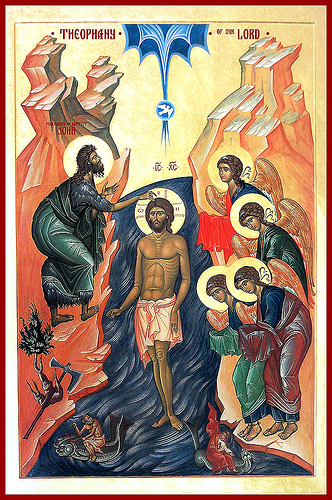
From here
From the first century of the Christian Church, there has always been “The Festival of Lights”. In the depth of Midwinter, this feast celebrated the advent of the Son of God’s coming into the world as Jesus Christ, and His early years up to and including His baptism in the Jordan, which heralded the beginning of Jesus’ ministry on earth.
Over the centuries, the various aspects of Christ’s early years were separated into individual feasts on different days: His Nativity, the Visitation of the Magi, His presentation in the Temple, and His circumcision. But the principal event of the Feast of Lights – Christ’s Baptism – continued to be commemorated on the 6th of January. Why is this event so important?
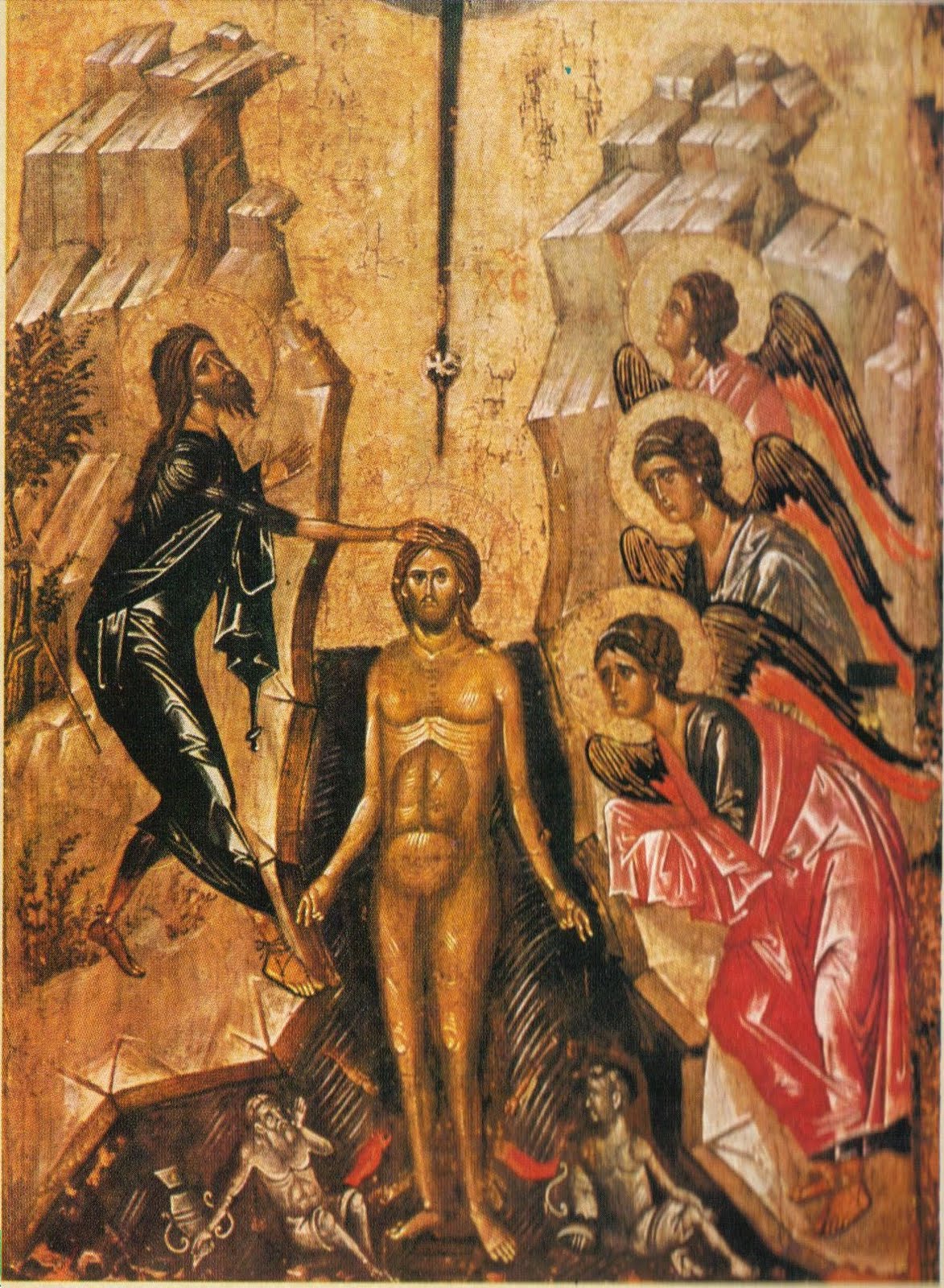
Then Jesus came from Galilee to John at the Jordan to be baptized by him. And John tried to prevent Him, saying, “I need to be baptized by You, and are You coming to me?”This, then, is the Epiphany (revelation) of the Holy Trinity, otherwise known as Theophany which literally means a “revelation of God” in Greek (Θεοφάνεια; the Russian is Богоявление and means the same).
But Jesus answered and said to him, “Permit it to be so now, for thus it is fitting for us to fulfill all righteousness.” Then he allowed Him. When He had been baptized, Jesus came up immediately from the water; and behold, the heavens were opened to Him, and He saw the Spirit of God descending like a dove and alighting upon Him. And suddenly a voice came from heaven, saying, “This is My beloved Son, in whom I am well pleased.” (Matthew 3:13-17)

John the Baptist, baptizer and worshiper
Present in the icon, this shows that whilst the Baptizer must now “decrease so Christ may increase”, John’s teachings and role are not done away with now the Holy Trinity has been revealed. On the opposite bank to John the Baptist, angels wait invisibly to receive the newly baptized Christ and clothe Him. And so, on the left is the forerunner of Christ, John, with his sermon of repentance represented by the tree and axe; on the right, the angels wait with reverence to accept the newly revealed Son of God. In the middle – the moment of revelation itself.
 Jesus Christ, despite being the one submerged in the Jordan, is shown
as though standing up and staring straight at us. His body is depicted
as strong and beautiful, as it is understood classically, and in older
icons He is naked. Christ appears almost as wide as the river Jordan
itself; indeed: it is as though it is Jesus Christ, rather than the
river, which cuts a swathe through the rocky wilderness on either side.
The Icon of the Theophany, as well as depicting the Holy Trinity, also answers the question of John the Baptist: I need to be baptized by You, and are You coming to me? The answer is in what Jesus does with His hands. Whilst in Western art, like this painting by Da Vinci,
Jesus is shown as submitting to John’s authority, in Orthodox icons
Christ’s hands are not shown in prayer, but in a sign of blessing.
Rather than the waters of Jordan cleansing Christ, it is Christ Who
cleans the waters. This is why in the bottom of most Theophany Icons,
little creatures appear to be fleeing from the feet of Christ. This is a
reflection of the words of the Psalmist regarding the Messiah (Christ):
“the sea saw and fled, the Jordan turned back” (Psalm 114:3).
Jesus Christ, despite being the one submerged in the Jordan, is shown
as though standing up and staring straight at us. His body is depicted
as strong and beautiful, as it is understood classically, and in older
icons He is naked. Christ appears almost as wide as the river Jordan
itself; indeed: it is as though it is Jesus Christ, rather than the
river, which cuts a swathe through the rocky wilderness on either side.
The Icon of the Theophany, as well as depicting the Holy Trinity, also answers the question of John the Baptist: I need to be baptized by You, and are You coming to me? The answer is in what Jesus does with His hands. Whilst in Western art, like this painting by Da Vinci,
Jesus is shown as submitting to John’s authority, in Orthodox icons
Christ’s hands are not shown in prayer, but in a sign of blessing.
Rather than the waters of Jordan cleansing Christ, it is Christ Who
cleans the waters. This is why in the bottom of most Theophany Icons,
little creatures appear to be fleeing from the feet of Christ. This is a
reflection of the words of the Psalmist regarding the Messiah (Christ):
“the sea saw and fled, the Jordan turned back” (Psalm 114:3).
The Jordan (left) and the Sea, which is also represented as a woman wearing a crown, or as a monster
Of old, the river Jordan
Turned back before Elisha’s mantle at Elijah’s ascension.
The waters were parted in two
And the waterway became a dry path.
This is truly a symbol of baptism
By which we pass through this mortal life.
Christ has appeared in the Jordan to sanctify the waters!
Turned back before Elisha’s mantle at Elijah’s ascension.
The waters were parted in two
And the waterway became a dry path.
This is truly a symbol of baptism
By which we pass through this mortal life.
Christ has appeared in the Jordan to sanctify the waters!
You can see also:
Epiphany The Orthodox Faith by Fr. Thomas Hopko
Feast of the Theophany of our Lord and Savior Jesus Christ - OCA website
The Baptism of Christ - Uncovering Bethany beyond the Jordan - 47 min Documentary


