Κυριακή 18 Απριλίου 2021

Saturday of the Akathist Hymn to the Theotokos

Orthodox Church in America

On the Fifth Saturday of Great Lent, the Saturday of the Akathist, we commemorate the “Laudation of the Virgin” Icon of the Most Holy Theotokos.

In 625, when the emperor Heraclius was fighting the Persians, the Khan sent forces to attack Constantinople by land and by sea. Patriarch Sergius urged the people not to lose heart, but to trust in God.

A procession was made around the city with the Cross of the Lord, the robe of the Virgin, the Icon of the Savior not made by hands, and the Hodēgḗtria Icon of the Mother of God. The Patriarch dipped the Virgin’s robe in the sea, and the city’s defenders beat back the Khan’s sea forces. The sea became very rough, and many boats sank. The invaders retreated, and the people of Constantinople gave thanks to God and to His Most Pure Mother.

On two other occasions, in 655 and 705, the Theotokos protected the city from Saracen invaders. A feastday dedicated to the Laudation of the Virgin was established to commemorate these victories. The Akathist to the Mother of God is believed to originate from this period, and its use has spread from Constantinople to other Orthodox lands.

The icon before which the Akathist was sung was given to the Dionysiou Monastery on Mt. Athos by Emperor Alexius Comnenos. There, it began to flow with myrrh. There were at least three wonderworking copies of this icon in Russia before the Revolution.

This icon shows the Mother of God seated on a throne, and surrounded by Prophets with scrolls. 

Troparion & Kontakion

Troparion — Tone 8

When the archangel understood the mysterious command, / he came to the house of Joseph with haste and proclaimed to the unwedded Lady: / The One Who bowed the heavens by His condescension / is contained wholly and without change in you! / As I behold Him in your womb, taking the form of a servant, I am frightened, but cry: / Rejoice, unwedded Bride!

Kontakion — Tone 8

Victorious leader of triumphant hosts, / we your servants, delivered from evil, sing our grateful thanks to you, Theotokos! / As you possess invincible might set us free from every calamity, / so that we may sing: Rejoice, unwedded Bride!

Akathist

Orthodoxwiki.org

 
Akathist Hymn to the Theotokos
 

An akathist (Greek, akathistos) is a hymn dedicated to a saint, holy event, or one of the persons of the Holy Trinity. The word akathist itself means "not sitting." The akathist par excellence is that written in the 6th century to the Theotokos. In its use as part of the Salutations to the Theotokos service (used in the Byzantine tradition during Great Lent), it is often known by its Greek or Arabic names, Chairetismoi and Madayeh, respectively.

The writing of akathists (occasionally spelled acathist) continues today as part of the general composition of an akolouthia, especially in the Slavic tradition, although not all are widely known nor translated beyond the original language. Isaac E. Lambertsen has done a large amount of translation work, including many different akathists. Most of the newer akathists are pastiche, that is, a generic form imitating the original 6th century akathist into which a particular saint's name is inserted.

There is more than one icon "of the Akathist": the Hilandar icon (January 12), the Dionysiou icon (March 27 and Fifth Saturday of Great Lent), and the Zographou icon (October 10).
 

Structure

The Trisagion Prayers are often said as a prelude to the akathist hymn. The akathist hymn itself is divided into thirteen parts, each of which has a kontakion and an oikos. The kontakion usually ends with the exclamation: "Alleluia!" Within the latter part of the oikos comes an anaphoric entreaty, such as "Come!" or "Rejoice!" The thirteenth kontakion (which does not have a corresponding ikos) is usually followed by the repetition of the first ikos and kontakion. After the thirteen kontakia and ikoi, additional prayers are added, such as a troparion and another kontakion. In some akathists, Psalms are also included.

Akathists

Relating to the Trinity

Akathist to

Relating to the Theotokos

When the word akathist is used alone, it most commonly refers to the original hymn by this name, the 6th century Akathist to the Theotokos, attributed to St. Roman the Melodist (though this attribution is hotly debated). This hymn is often split into four parts and sung at the "Salutations to the Theotokos" service on the first four Friday evenings in Great Lent; the entire Akathist is then sung on the fifth Friday evening. Traditionally it is included in the Orthros of the fifth Saturday of Great Lent. In monasteries of Athonite tradition, the whole Akathist is usually inserted nightly at Compline.

The four sections into which the Akathist is divided correspond to the themes of the Annunciation, Nativity, Christ, and the Theotokos herself.

The hymn itself forms an alphabetical acrostic—that is, each oikos ("house," possibly from the Syriac terminology) begins with a letter of the Greek alphabet, in order—and it consists of twelve long and twelve short oikoi. Each of the long oikoi include a seven-line stanza followed by six couplets, employing rhyme, assonance, and alliteration, beginning with the word Chaire (translated as either "Hail!" or "Rejoice!") and ending with the refrain, "Hail, Bride without bridegroom!" In the short oikoi, the seven-line stanza is followed by the refrain, "Alleluia!"

The Salutations to the Theotokos service, often known by its Greek name, the Chairetismoi (from the Chaire! so often used in the hymn), consists of Compline with the Akathist hymn inserted. It is known in Arabic as the Madayeh.

Akathist of the

Akathist to the

  • Holy Virgin Theotokos (by St. Roman the Melodist)
English - 1, 2, 3, 4, 5, 6, 7, 8, 9, 10, 11, 12 (PDF), 13 (PDF)
Other - 14 (French), 15 (German-PDF), 16 (Spanish) 17 (Finnish)
  • Burning Bush of the Theotokos - 1 (PDF), 2 (Romanian)
  • Most Holy Theotokos "Keeper of the Portal" of Iviron - 1, 2, 3 (Slavonic), 4 (Romanian)
  • Most Holy Theotokos, Myrrh-streaming Montreal-Iveron Icon - 1, 2 (Slavonic)
  • Theotokos of All Protection - 1

Akathist to the Theotokos,

  • All-Venerable Abbess to Monasteries of the Entire World
  • Daughter of Zion - 1
  • the Deliverer
  • the Door-keeper
  • the Enricher of the Harvest
  • the Inexhaustible Cup - 1, 2, 3, Finnish
  • Joy of All Who Sorrow - 1
  • the Milkgiver
  • Nurturer of Children - 1
  • Our Lady of Sitka - 1 (PDF)
  • Port Arthur Mother of God - 1 (PDF), 2 (Russian)
  • Queen of All (Pantanassa, or "Healer of Cancer") - 1, 2
  • Spring of Healing
  • Swift to Aid
  • Unexpected Joy

Akathist to the Theotokos for Reconciliation

Akathist to the Theotokos at her

Relating to the Great Feasts

Akathist of the

Relating to Saints

Singular - Akathist to St.

Plural - Akathist to

  • All Saints 1 (Romanian)
  • the Chinese martyr saints who died in the Boxer (Yihetuan Movement) Rebellion - 1 (PDF), 2
  • to all the Saints that shone forth in the lands of the West - 1 (PDF), 2 (PDF-Romanian)
  • Ss. Joachim and Anna [2] (includes music)
  • Ss. Peter and Paul - [3]
  • Ss. Sergei and Herman of Valaam - 1 (Finnish)

Local/Diocesan Saints

Relating to Angels

Akathist to the

  • Holy Archangel Michael - 1 2 - (Finnish)
  • Holy Archangels Michael and Gabriel
  • Guardian Angel

Other Akathists

  • Akathist for Holy Communion - 1, 2 (Finnish)
  • Akathist to the Tomb and the Resurrection of the Lord - 1, 2 (Finnish), 3
  • Akathist to the Resurrection of Christ 1 (Finnish)
  • Akathist "Glory to God for All Things" or "of Thanksgiving" - 1, 2, 3, 4, 5 (Finnish)
The Akathist is often attributed to Priest Gregory Petrov who died in a Soviet prison camp in 1940, but also to Metropolitan Tryphon (Prince Boris Petrovich Turkestanov) +1934. The title is from the words of St. John Chrysostom as he was dying in exile. It is a song of praise from amidst the most terrible sufferings.
  • Akathist in Praise of God's Creation (by Metropolitan Tryphon (Turkestanov)) - 1
  • Akathist for the Repose of the Departed - 1, 2 (Finnish)
External links

About

Collections

Other languages

Other traditions

Multimedia


Παρασκευή 16 Απριλίου 2021

The prayers of the saints / Honoring holy relics

Orthodox Outlet for Dogmatic Enquiries 

“Worship” is one thing, “Veneration” is another

We need to distinguish between these two different words, from the very beginning.

“Veneration” does not always imply “Worship”!  It could imply worship, but it could also refer to an honorific bow. When a hotel porter bows to a guest, surely he isn’t actually worshipping the guest!  He is merely honoring him, with a respectful bow.  In the case of God, however, this respectful bow is also a gesture of worship.

When a Christian bows before one of God’s (sanctified) people, he is not worshipping that person; he is merely honoring that person as a person of God. In the same way, when he bows before the icon of a Saint, he is not worshipping the icon; he is paying homage to the person portrayed on it.

But : if the icon portrays the Lord Jesus Christ, then only is the portrayed person worshipped; not the image, but the actual person that it portrays.

What kind of veneration is forbidden by the Holy Bible?

Let’s take a look at a few passages of the Holy Bible that are used by contemporary iconoclasts, in their attempt to convince us that veneration is the same as worship.  They make reference to the incident in Acts, 14:11-15, where the crowds attempted to offer sacrifices to Paul and Barnabas (because they thought those two were the gods Jupiter and Mercury), but the two Christians outrightly refused.

In this instance, the sacrifice that was going to be offered was in the context of worship, as the people had mistaken them for gods. This was not a case of honorific veneration, hence it was only natural that they would refuse a gesture befitting God only.

In Exodus 20 :  4,5, in one of the 10 commandments, it refers clearly to likenesses of  anything found in the skies, or the earth, or the sea: “you shall not prostrate yourself before them, nor worship them.”

Here, we have the following comment to make:  To begin with, (even though the 10 commandments were still in force), this passage again implies a prostration of worship, and not just an honorific veneration.  This can be seen in  Deuteronomy 4: 12-19. It is very clear, that it refers to a likeness of god, and not of creations. It is therefore speaking of a prostration of worship, which is what is forbidden. Honorific veneration is not forbidden. It speaks in exactly the same way, wherever prostration of worship is addressed to a likeness of gods. (for example Isaiah 4: 9-20)

The phrase “you shall not prostrate yourself before them, nor worship them” is a Hebraism; a characteristic, Hebrew form of speech, where the same thing is repeated, using different words which have a slightly different significance. Here, the word “prostration” is used along with the word “worship”, consequently implying a prostration of worship.  

Another, similar Hebraism is found in the familiar words of the Lord’s mother, when she prophesied together with Elizabeth in Luke, 1: 46,47:My soul magnifies the Lord, and my spirit has rejoiced, in God my savior”.  We also notice the same thing in Hebrews, 13:5: “I shall not leave you, nor shall I desert you”.  The examples are many more.

The passages therefore that we examined, do not prohibit any kind of veneration; only the veneration/prostration that accompanies worship. They forbid prostration of worship.

  Which veneration of creatures is forbidden?

“Well, why did the angel refuse John’s veneration/prostration in Revelations 19:10”?, one might ask.  

Well, to begin with, we have to say that John – despite the angel’s reluctance – attempted a second time to prostrate himself before the angel, in 22: 8.9.  But the angel again didn’t let him do it.  If veneration were indeed the same thing as worship, could it be, that the apostle John intended to worship the angel and thus disrespect God?  Are we to assume that today’s opposers of veneration are better acquainted than John, as to what is forbidden and what is permissible?  Even if we did assume that John intended (perhaps out of ignorance) to worship the angel even though the angel hindered him, then why did John re-attempt it?  Was he such an unrepentant idolater, that disciple “whom the Lord loved”?

It is naturally out of the question, that the apostle didn’t know that only God is worshipped. Consequently, his prostration was not of worship; it was his honorific veneration of the angel!  And the angel had respectively declined this veneration, not because it was a sin, but because out of humility, he declined to be venerated by a saint.  But the apostle also deemed it proper - despite the angel’s reluctance - to repeat his attempt to venerate the angel, since this was not a sin.

As opposed to the above, the angel that is referred to as the Commander-in-Chief of the hosts of the Lord, conceded to the prostration of Joshua (Joshua 5:13-15) “And Joshua fell prostrate on the ground before him, and venerated him”.

So that there is no doubt left whatsoever that the veneration of Saints is permissible as an honorific gesture, let’s see what our Lord Jesus Christ’s opinion is: It can be found in Revelations 3:7-10. There, the Lord Jesus Christ speaks to the “angel” of the Church of Philadelphia, who is the Bishop of the local Church and not some heavenly angel (as confirmed by verse 10, where the “angel” is numbered among those “who inhabit the earth”. If he inhabited the earth, he was definitely a human!)

Since the Lord is praising him for his works, He says the following, important words: “..behold,  I will make those of the synagogue of Satan, who say they are Jews and are not, but lie, indeed, I will make them come and worship before your feet, and they will know that I have loved you.”

Take notice here!  The Lord Himself claims that He will make people fall prostrate before the feet of the Bishop of the Church of Philadelphia, because God has loved him. Is it possible that God would not have known if this was a sin? Would God have made them worship the Bishop as a god?  Of course not! God clearly stated that they would be made to “worship” him, so that they would see that God loved him.  This obviously means that they would honorifically “worship” the Bishop, as a servant of God, and not as a god.

If, therefore, our critics believe that they are better versed than the Lord, then they may continue to criticize the honorific veneration that we bestow on the servants of God.

Is there such a thing as dead saints?

“But the Lord was speaking of a living person, not someone deceased! You Orthodox venerate the images of dead Saints!”

Are we to believe that whoever makes such statements is the kind of person who would venerate the living?  Or does he consider that to be idolatry as well?  We have certainly made no distinction between living and “dead” Saints, simply because there are no dead Saints!

If there were dead Saints, then the Lord must have lied to Lazarus’ sister, when he said that “whomsoever is alive and believes in me, shall not die, for all eternity (John, 11:26)  For everyone lives in God” and “He is not the God of the dead, but of the living(Luke, 20:38).  John the apostle also indicates that all the faithful are alive, and that they observe and they pray in heaven (Revelations, 6: 9-11. 18: 20. 19: 1,4,6. 20: 4-6 etc.).

The fact that their body is dead does not mean that they too are dead! “…if the housing of our terrestrial body is abolished, yet from God we HAVE (=present tense, =as of our present life on earth; imagine in the future, in heaven) an eternal, non-handmade house in the heavens.” (Corinthians II, 5: 1-4).

The saints are most certainly alive!  And if the above examples from the Holy Bible speak of venerations of living saints, then the veneration of rested (not dead) saints is even more appropriate. They remained “faithful to the death” and received the “wreath of life (Revelations, 2: 10).  And if they are referred to as “rested”, the term pertains to their physical body, which is laying at rest until the day of its resurrection, and not their soul.  They are presently “the kings and priests of the Lord (Revelations, 20: 4-6), and they deserve the appropriate honor.

In Revelations, 6:  9-11, it appears that the “rested” (in body) vigilantly observe from heaven whatever takes place on earth, and they pray for it.  As for God, He “judges their judgment” (Revelations, 18:  20.21) when hearkening to their prayers, and He acts according to their prayers. (Revelations, 8:  3-5).  This is apparently where the fire that burns in the celestial altar – as well as whatever happens on earth – is the result of those prayers.

All of the above are clear proof that the saints live and reign, alongside the Lord.

The prayers of the saints

“But, only Jesus is the mediator between God and mankind! How can you pray to the saints?” someone might persist in asking.

He should contemplate here:  Don’t we often ask our brethren to pray for us?

Although we do agree that only Jesus is the mediator, how is it that we ask our living brethren to pray for us? Isn’t that a relatively similar mediation also?  Aren’t we asking them to stand before the Lord for our sake?

Even the Apostle Paul used to ask for the prayers of the Christians (Thessalonians I, 5: 25).  If, therefore, we ask and we accept the prayers of our brethren (who have not yet proven to be faithful to the death) toGod for our sake, shouldn’t we even more so ask our “slept” brethren (who have proven themselves Saints to the death) for their prayers for us? Won’t the Lord hear their prayers more certainly?

Honoring holy relics

“And why do you honor their relics (remains)”?  a mistrustful reader may ask.

Well, because they literally were “temples of God” (Corinthians I,  3:16), just like any saint’s body.

These relics remain the vessels of divine Grace; for example, when they placed the corpse of a man inside the prophet Elisha’s grave and it touched the bones of the buried prophet, the dead man was resurrected! (Kings II, 13 :21). This occurs much more frequently now, in the New Testament.  .

And let no-one wonder, why we honor the objects that belonged to the saints and have been preserved to our day. The same was done by Christians during the time of the Apostles, when they brought various items of the apostles to heal the sick, or used even their shadow!!! (Not to mention their images). (Acts, 5: 15. 19: 11,12).  Both the bodies therefore of the Saints, as well as the objects that belonged to them, are all vessels of divine Grace, and this is why we honor them. (We do NOT worship them however).

Finally, we would like to point out that in every era, God –through miraculous signs and revelations- ensures that we are kept informed of which saints He desires to make known to us, so that we may call upon them as assistants in our hour of grief, and difficulty.  We do not arbitrarily select whom we will honor as saints. Our prayer however, is firstly addressed to God, and afterwards to them. And just as we ask for their prayers, we in turn pray for them, as the Lord Himself and the Church itself unite us all, whether we are in heaven, or on earth.

Text: N.M.

Translation by A.N.

Greek text

Are holy icons “idols”?

Orthodoxy, Protestantism and Watchtower


"Beg him to enter your heart..."


Image from here
 

Christ accepts a hundred, accepts all thirty, accepts all five you will give him.
If you can't remember him a thousand times, a hundred times, fifty times a day, remember him ten times and tell him with love: "Jesus!"
Not beg him for your poverty, for your mother, for your sickness, for your success.
No, no, no!
Beg him to enter your heart.
Can't you ten times a day?
Five times can't you?
If you feel it and call it twice a day, after a month you will sweeten and ask for it ten times, then twenty times, then you will start feeling it in your heart.

From Elder Amilianos of Simonopetra
(photo)

"Fanaticism has nothing to do with Christ. Be a true Christian. Then you won’t leap to conclusions about anybody, but your love will ‘cover all things.’ Even to a person of another religion you will always act as a Christian. That is to say, you will show respect for him in a gracious manner irrespective of his religion … There must be respect for the freedom of the other person. Just as Christ stands at the door and knocks and does not force an entry, but waits for the soul to accept Him freely on its own, so we should stand in the same way in relation to every soul."

St. Porphyrios (here)

Icom from here
 

On the sweet satisfaction of virtue:

"If we would desire to rejoice continually, we have many resources for doing so. For if we take hold of virtue, there will be nothing to cause us to grieve. For virtue presents good hopes to those who possess her, making them well-pleasing to God, and approved among men; and she infuses ineffable delight (hēdonēn).

"Yes, though doing what’s right requires labor, yet this fills one’s conscience with much gladness, and lays up within such great pleasure (hēdonēn) as no speech can be able to express. . . . For nothing is so sweet as a clear conscience, and a good hope."

St. John Chrysostom, Homily 53 on St. Matthew (here).


Τρίτη 13 Απριλίου 2021

Does the Church bless Military Arms?


The excerpt quoted below is part of a far more extensive text by an orthodox theologian on a number of topics, and was addressed as a letter to an a-dogmatic Protestant.

Source: Η ΕΚΚΛΗΣΙΑ ΕΥΛΟΓΕΙ ΤΑ ΟΠΛΑ;
Orthodox Outlet for Dogmatic Enquiries (Translation: A.N.)

In Romans 13: 4, the apostle Paul mentions that “it is not proper for the king to bear the sword, for he is a minister of God in wrath, judging committed evil.” (=he does not carry a sword without reason, but serves God, meting Justice upon the one who commits evil).

If Paul says this about the pagan ruler and king, then, when the king is a Christian (or should kings be excluded from baptism and salvation?) and hordes of barbarians attack, should the Church pray for divine help to the king or not?

If not - and more so if he enforces the abolition of the army - then he is condemning the people to compulsory martyrdom; however, martyrdom cannot be imposed compulsorily - not everyone is ready to be slaughtered like lambs, and many will be those who will grumble against God and thus lose their souls during the onslaught of the enemy, just because they or their families perish.

It is no coincidence that the Church prays to God for victories only to the king (“victories granted to kings, against barbarians” according to the hymn), and not for victories of the army, because in Rom. 13:4, the king 'does not bear the sword' (he does not carry his sword by chance) and that when he uses it against the one committing evil, he is 'a deacon of God'.

There is no ecclesiastic prayer for an army to be victorious - not only in today's ecclesiastic books, but also in the old ones, when the land was living in a time of war! The only relevant prayer is '…for our Christ-loving army, let us pray'. Naturally, soldiers cannot be excluded from the prayers of the Church; that is, to be excommunicated and surrendered to the devil! (Needless to highlight that those prayers only pertain to the ‘Christ-loving' army and as such a philanthropic one, and not to any and every army).

Of course there is no ecclesiastic prayer for the blessing of military arms (whereas there are prayers, for example, for Easter eggs or the pie of Saint Phanourios, e.a.). On the contrary, in every ecclesiastic ritual, the first supplication is in favor of peace, followed by other prayers on this subject. And then the Cross (through which we ask for 'victories to the kings') is characterized as 'a weapon of peace, an invincible trophy'. This characterization meets the warlike similes in the New Testament, such as Ephesians. 6: 11-17.


The holy 40 Martyr-saints who had disobeyed the emperor's commands, albeit soldiers, and were condemned to martyrdom. I could say that Christian Witnesses have been the most populous anti-authoritarian movement in History. Their presence even to this day solves every dilemma about how the words of the apostle Paul are applied faithfully, and where the authority of every political ruler, king or other ends ...

Ecclesiastic rules regarding murder during war

Also dealing with killings during wars are two canons by Saint Basil the Great, ratified by the Quinisext Ecumenical Council:

Rule 8, 'On murder and murderers', includes those 'voluntarily killing' who murder during war attacks: '[…]

«Voluntary is also (considered) to be that which is (committed) wholly and without any doubt; that is, attacks by robbers and by wars. For the former kill for the sake of money (and also) avoiding controls, while the latter that are in wars have come to murder; not to intimidate, nor to reform, but to kill the opposing ones, openly displaying their intention. […] ».

Consequently, these fall under Rule 56, for those who voluntarily murder; that is, they are subject to excommunication for twenty years: the first four to be standing outside the church confessing their crime and asking for the prayers of the Christians:

“The one who has murdered voluntarily and has afterwards repented, let him be excommunicated from all sanctifications, and twenty years of excommunication be imposed upon him. For four years, he is obliged to stand tearfully outside the door of the house of prayer, beseeching the prayers of the people entering therein, and publicly declaring his transgressions. After the four years, he will be accepted by those listening (to the church service), and in five years, he can exit together with them. In seven years, he can exit, having prayed together with the other attendees. In four years, he is introduced only to the faithful, but not receiving any offerings. After fulfilling all the above, he can partake of the sanctifications.»

Rule 13, «On those who have killed in wars» clearly refers to defensive wars, hence writes: «The killings in wars our Fathers did not take into account as murders; I think they were providing forgiveness, to those who were defending sobriety and piety. Apparently, he did well to advise that for having unclean hands, they should abstain only from Communion for three years.»

Significant points here are: (a) The saint mentions that those in the past (= the Church during the persecutions, when Christian soldiers participated in wars, before the supposed 'submission' of the Church to the state) had forgiven murder during war. (b) But he also differentiates himself from those Fathers, asking for three years of excommunication!! (c) Τhe Quinisext Council validated this rule by Basil the Great and not the previous ecclesiastic practice, despite the fact that it was conducted in a Christianized state, whereas the ancient Church was outlawed, within an idolatrous state.

The 66th Apostolic Canon defrocks the clergy and excommunicates (cuts off from the divine Communion) the lay persons who kill during war: “If any of the clergy strikes someone in a battle and with one blow causes death, let him be expelled for his haste. And if it be a lay person, let him be excommunicated». [According to an article by Archimandrite Nicodemus Barousis, “Murder in war and our Priesthood”, this Rule obstructs the recognition of martyred clergymen who had committed murders in revolutions against the Turks – for example, the recognition as martyr-saint of Bishop Isaiah of Salona, the priest Ioannis (brother of the former) and of Athanasios the Deacon, were all rejected by the Church of Greece].

According to the 5th Rule of Saint Gregory of Nyssa, even the one who has killed someone inadvertently is barred from the priesthood: «Even if inadvertently, one becomes a miasma on account of murder, having rendered himself desecrated by the sin, thus the Canon pertaining to hieratic grace deems him rejected». «That is, whoever kills, even if hesitatingly and involuntarily, if he be a layman will not become a priest, and if he be a priest, is defrocked», as Saint Nicodemus comments in the “Pedalion”, pp. 657-658.

And he then adds: «And generally speaking, all the Clergy who might kill, either voluntarily or involuntarily, whether with their own hands, or put others to kill, are defrocked, according to the diagnosis of Constantine Chliarinos. (Balsamon also adds that he had seen a priest be defrocked, because when grabbing his book from someone, after arguing with another priest, the latter fainted because of this hassle and died. Likewise he had seen another priest-monk also defrocked, when, after an exchange of harsh words with another monk who -unable to tolerate those words - had sighed heavily, and who, immediately after that sigh, also promptly died. He had also seen, he says, a High Priest deposed for having killed a Hagarene in a time of war, “having re-wielded his sword against him”).

After all of the above, do you still insist that the Church “has no official view on bloody war”?


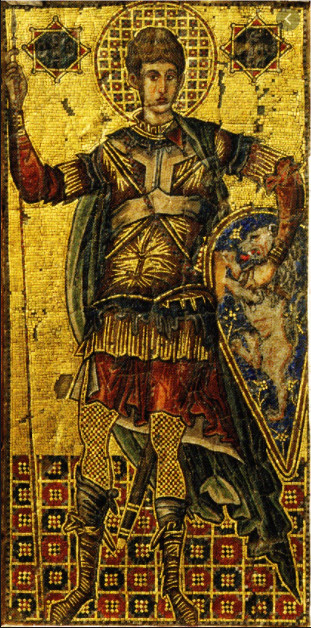
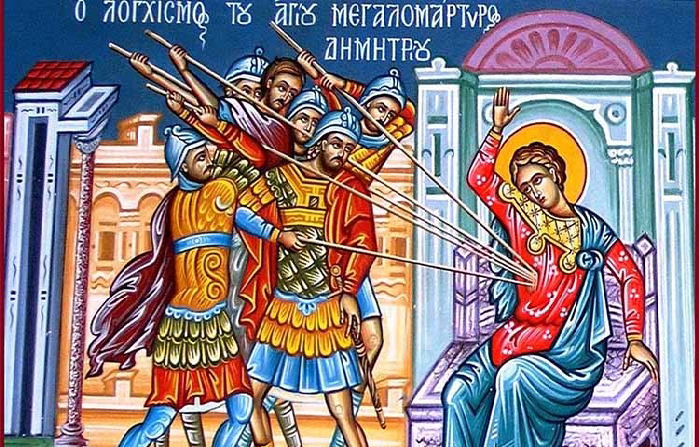
The spear-piercing martyrdom of Saint Demetrius.

As a certain author has pointed out, military saints are always defeated saints - and yet, they are the ones who have been recognized and honored as saints - not the proud victors. They were victorious, through their defeat.

The implementation in practice of the Church's view against war is evident in the Book of Saints:

A) Those who were killed in war against infidels are not honored as martyrs and saints (Nicephoros Phokas had requested it, but the then patriarch and the synod had rejected it, citing rule 13 of Basil the Great); recognizing only those who were killed during various persecutions without any war. (Some commentators, like Ms. Hélène Ahrweiler, by judging with social and political (but not Christian) criteria, puts blame on the Church for not recognizing the Emperor Constantine Palaiologos as a saint).

B) The saints serving in the military normally also become martyrs, inasmuch as they have washed away the blood of the enemies (even if shed during defensive wars) with their own blood. Even Nicephoros Phokas, who is a saint, had died of a knife wound but is not honored for having liberated lands from the harsh Arab occupation, but solely for his piety. He too died by a knife, albeit in his marital bed and not on the 'glorious' battlefield! Was it by chance?

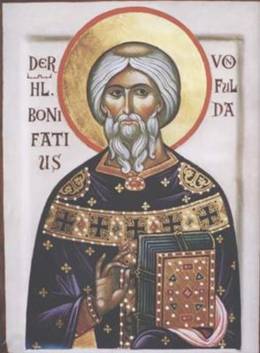
C) In addition to the thousands of martyrs during the persecutions, there are other saints who refused to fight, having comprehended the viewpoint on war in their spiritual heritage. Saint Boniface, the enlightener of the Germans, in 754 AD, had refused to defend himself when he was attacked by barbarians in the woods across the Rhine, and had simply covered his head with the manuscript of the gospel.


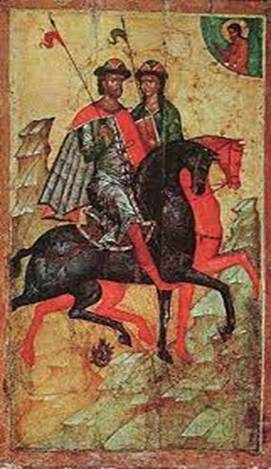
The Russian saints, princes Boris and Gleb, in 1015, when their older brother Sviatopolk invited them to his palace and they realized he sought to murder them, went there anyway, and in fact within a month of each other, considering it contrary to their Christian faith to put their soldiers to fight for their sake.


In 452 AD, when Rome was besieged by Attila, the Pope - Saint Leo the Great - averted the occupation of the city by going out to meet him unarmed, in uniform, together with the priests of Rome. This act was repeated by Pope Saint Gregory II (717-731 AD), preventing the occupation of Rome by the Lombard king Liutprand.

What should a Christian king do when his country and people are under attack? Abolish the army (thus attracting the attacks of the barbarians) and impose involuntary martyrdom on everyone, or to have an army to defend itself?

This dilemma is huge, and has a direct bearing on Rom.13:4 mentioned above. Some holy kings tried to give a solution, based on their personal thoughts. Are they perhaps “not saints” if the solution they had given was wrong or misplaced? At any rate, they did what they believed most befitted Christianity, even sacrificing their own lives and in defence of their people:

Saint Sigebert [icon], king of East Anglia, in 637 AD, while under pressure, was forced to lead his army into battle, after having abdicated the throne and become a monk. So he came down unarmed, with only a stick, and of course was killed. We do not know if he had prayed for his soldiers - that is, for them to be forgiven for the enemies they would kill - or if he had come unarmed, sacrificing himself for his soldiers.


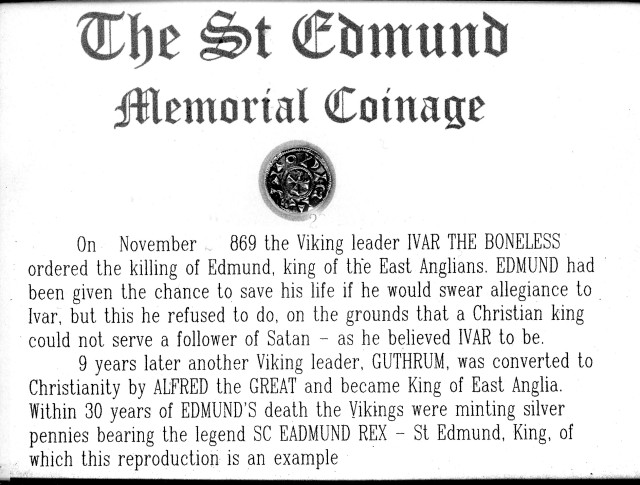
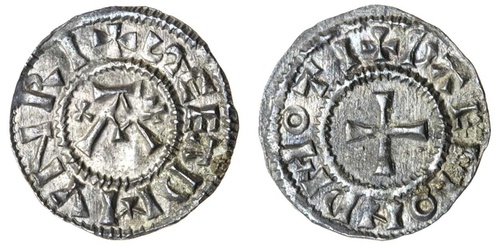
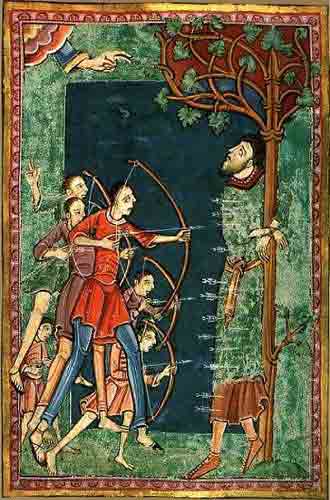
Saint Edmund, another King of England, in 869 following a desperate resistance against the Viking invaders, surrendered his kingdom and himself in order to stop the war and was killed by arrows, like St. Sebastian, after refusing to renounce his Christian Faith. He was immediately honored as a miracle-working saint, while some 10-20 years later the Vikings minted coins dedicated to his memory!


Holy Martyr-king Edmund, who sacrificed himself for his people. He is holding an arrow, because he was killed with arrows.


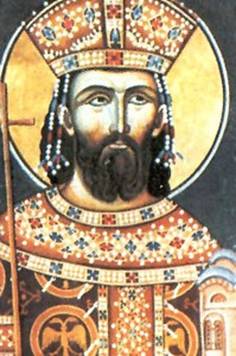
On June 15, 1389, Saint Lazarus, King of Serbia, with 35,000 soldiers, fought against 100,000 Turks in Kosovo, in one of the most important battles in (at least European) history. His biography says that, before the battle, an angel of the Lord put him before the choice between the earthly or the heavenly kingdom: he could immediately attack the Turks and defeat them, or wait for the next day, for the army to attend the divine Liturgy and receive Holy Communion, but be defeated. The saint preferred the latter, choosing to send his soldiers to God equipped with Holy Communion. He was captured and executed, and before being beheaded, he prayed for the forgiveness of his sins and the salvation of his people. Despite the terrible losses of the Turks, the defeated Serbia became their vassal.


Even if we regard these miracles as myths (although they are no different to biblical miracles), the fact that these people are orthodox saints - that these DEFEATED kings were honored as saints – denotes many things as regards the Church's views on war.

The notion that a war for liberation is a holy war does actually exist among our people and to some priests (privately), but such a thing has not been established in any Ecumenical Synod, nor do I know if the Church Fathers express such an opinion. However, biblically speaking, we cannot rule out such a thing, since it is done for the benefit of the people and not for reasons of sovereignty, when we always have Rom. 13: 4, according to which “it is not proper for the king to bear the sword”.

Of course, if we followed the Bible verbatim we could imagine that holy wars do exist, which must be fought rabidly - according to the 4th chapter of Joel; the fact that he talks there about the final War does not change the fact that there are other wars “for the sake of God’s people”: when for instance the pagan Turks or the heretical Latins launch attacks. And yet, ecclesiastically, nothing has been spoken.

Glorifications sung during national holidays also praise God for His granting of liberation (=as His own gift, not thanks our weapons), but they do not highlight any victory over enemies, and even less, the extermination of an enemy.

Strangely enough, although we constantly voice praises in Church on the extermination of the Pharaoh in the Red Sea - as a miraculous intervention by God of course – we naturally utter no praises whatsoever for the extermination of the barbarians who had attacked Byzantium, or for those who had enslaved our nation, tormented us, killed us, burned our churches, pushed for a change in our Faith etc.. We only thank God or the Holy Mother Theotokos (with the hymn “To the Great Defender….”) for Her repulsion of the invaders. Should we not thank Her? Wouldn’t David have sung thanks when he defeated the Philistines?
The Church, by certain others, is accused of abstaining from the National Struggles! Saint Athanasios of Paros and Saint Cosmas of Aetolia had taught that the irreligious conquering Turk was unknowingly the guardian of the Orthodox faith against the lurking Franks; however, neither saint had ever incited the populace to embark on an armed revolution, but only to a spiritual awakening (through education and Orthodoxy). Were they truly traitors, as accused by atheists and neo-pagans, or were they genuine Orthodox Christians?

Κυριακή 11 Απριλίου 2021

4th Sunday of Great Lent: St John Climacus (of the Ladder), the Great Orthodox Teacher of 6th century from Sinai


4th Saturday of Great Lent: Memorial Saturday (OCA)
  "Akathist 4th Stanza - St. Anthony Ichamara - Nyeri Deanery Most Holy Theotokos intercede for us..." ΚΕΝΥΑ (from here)
 
Saturday is the day which the Church has set aside for the commemoration of Orthodox Christians departed this life in the hope of resurrection and eternal life. Since the Divine Liturgy cannot be served on weekdays during Great Lent, the second, third, and fourth Saturdays of the Fast are appointed as Soul Saturdays when the departed are remembered at Liturgy.
In addition to the Liturgy, kollyva (wheat or rice cooked with honey and mixed with raisins, figs, nuts, sesame, etc.) is blessed in church on these Saturdays. The kollyva reminds us of the Lord’s words, “Unless a grain of wheat falls into the earth and dies, it remains alone; but if it dies, it bears much fruit” (John 12:24).The kollyva symbolizes the future resurrection of all the dead. As Saint Simeon of Thessalonica (September 15) says, man is also a seed which is planted in the ground after death, and will be raised up again by God’s power. Saint Paul also speaks of this (I Cor. 15:35-49).
It is also customary to give alms in memory of the dead. The angel who spoke to Cornelius testifies to the efficacy of almsgiving, “Your prayers and your alms have ascended as a memorial before God” (Acts 10:4).
Memorial services for the dead may be traced back to ancient times. Chapter 8 of the Apostolic Constitutions recommends memorial services with Psalms for the dead. It also contains a beautiful prayer for the departed, asking that their voluntary and involuntary sins be pardoned, that they be given rest with the Patriarchs, Prophets, and Apostles in a place where sorrow, suffering, and sighing have fled away (Isaiah 35:10). 
Saint John Chrysostom mentions the service for the dead in one of his homilies on Philippians, and says that it was established by the Apostles. Saint Cyprian of Carthage (Letter 37) also speaks of our duty to remember the martyrs.
The holy Fathers also testify to the benefit of offering prayers, memorial services, Liturgies, and alms for the dead (Saint John Chrysostom, Saint Cyril of Jerusalem, Saint John of Damascus, etc.). Although both the righteous and those who have not repented and corrected themselves may receive benefit and consolation from the Church’s prayer, it has not been revealed to what extent the unrighteous receive this solace. It is not possible, however, to transfer a soul from a state of evil and condemnation to a state of holiness and blessedness through the Church’s prayer. Saint Basil the Great points out that the time for repentance and forgiveness of sins is during the present life, while the future life is a time for righteous judgment and retribution (Moralia 1). Saint John Chrysostom, Saint Gregory the Theologian, and other patristic writers concur with Saint Basil’s statement.
By praying for others, we bring benefit to them, and also to ourselves, because “God is not so unjust as to forget your work and the love which you showed for His sake in serving the saints...” (Heb. 6:10). 

4th Sunday of Great Lent: St John Climacus (of the Ladder) 
OCA
 
The Fourth Sunday of Lent is dedicated to Saint John of the Ladder (Climacus), the author of the work, The Ladder of Divine Ascent. The abbot of Saint Catherine’s Monastery on Mount Sinai (6th century) stands as a witness to the violent effort needed for entrance into God’s Kingdom (Mt.10: 12). The spiritual struggle of the Christian life is a real one, “not against flesh and blood, but against ... the rulers of the present darkness ... the hosts of wickedness in heavenly places ...” (Eph 6:12). Saint John encourages the faithful in their efforts for, according to the Lord, only “he who endures to the end will be saved” (Mt.24:13).

St. John of the Ladder (Climacus)
 
 
Click here
St. John Climacus is honored by the Church as a great ascetic and as the author of a remarkable work entitled, The Ladder of Divine Ascent, and therefore he has been named “Climacus,” or “of the Ladder.” There has been very little information preserved about his origin. Tradition tells us that he was born in around the year 570, and was the son of Sts. Xenophon and Maria, who are commemorated on January 26/February 28. St. John came to the monastery on Mt. Sinai at age sixteen. Abba Martyrius became his spiritual father and mentor. After four years of living on Mt. Sinai, John was tonsured a monk. One of the fathers present at his tonsure foretold that John would become a great luminary of Christ's Church. St. John labored in asceticism for nineteen years in obedience to his spiritual father. After the death of Abba Martyrius, St. John chose the life of reclusion, departing to a desert place called Thola, where he lived forty years in silence, fasting, prayer, and repentant tears. It is not by chance that St. John speaks so much of repentant tears in The Ladder. 
"As fire burns and destroys dead wood, so do pure tears cleanse all impurity, both inwardly and outwardly." His prayer was strong and effective—this can be seen in the following example of the great ascetic's life.
St. John had a disciple, Monk Moses. One day St. John sent his disciple to spread soil on the garden beds. As he was fulfilling his obedience, Monk Moses became weary from the fierce summer heat and reclined under the shade of a large cliff. St. John was in his cell at that moment, resting a bit after his labor of prayer. Suddenly a man of venerable countenance appeared and woke the ascetic, reproofing him: "John, why are you resting peacefully here while Moses is in danger?" St. John immediately arose and began praying for his disciple. When Moses returned that evening, the saint asked him if anything had happened to him that day. The monk answered, 
 "No, but I was in serious danger. A large rock broke off from a cliff under which I had fallen asleep at midday and nearly crushed me. Fortunately I was having a dream in which you were calling me, and I jumped up and ran; at that moment a huge rock fell with a crash upon that very place where I was…"
It is known from St. John's life that he ate what was allowed by the rule of fasting, but within measure. He did not go without sleep at night, although he never slept more than was needed to support his strength for ceaseless vigilance, and so as not to negatively affect his mind. "I did not fast beyond measure," he said of himself, "and I did not conduct intensified night vigil, nor did I sleep on the ground; but I humbled myself…, and the Lord speedily saved me." The following example of St. John's humility is notable. Gifted with a strong, sharp mind that was made wise by deep spiritual experience, he taught everyone who came to him and guided them to salvation. But when certain others out of jealousy accused him of loquaciousness, which they said sprung from vainglory, St. John took a vow of silence in order not to temp anyone, and remained thus for a year. His enviers admitted their error and begged the ascetic not to deprive them of his beneficial instruction.
To hide his ascetic labors from people, St. John would sometimes depart to a solitary cave, but fame of his holiness spread far beyond his enclosure, and people from all walks of life would come to him seeking a word of edification and salvation. When he was seventy-five years old, after forty years of ascetic labors in solitude, the saint was chosen to be abbot of Sinai. St. John Climacus ruled the holy monastery for four years. The Lord granted the saint many gifts of grace toward the end of his life, including clairvoyance and miracle-working. 

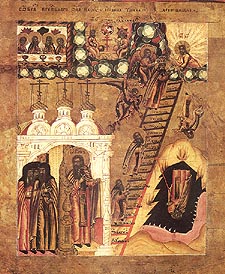
Saint John Climacus is seen standing at the foot of the ladder. With his left hand he directs our attention towards the ladder, while in his right hand he holds a scroll on which is written: "Ascend, ascend, Brethren."
 
During St. John's abbacy, another St. John, abbot of Raithu Monastery (commemorated on the Saturday of Cheesefare week) asked him to write the famous Ladder—instructions for the ascent to spiritual perfection. Knowing of the saint's wisdom and spiritual gifts, the abbot of Raithu asked on behalf of all the monks of his monastery for "true instruction for those who seek unwaveringly, and a kind of steadfast ladder that will take those who desire it to the Heavenly gates…" St. John, who had a humble opinion of himself, first balked at the task but then set about writing the treatise out of obedience to the request of the Raithu monks. He thus called the work, The Ladder, explaining his choice: "I have built a ladder of ascent… from earth to holiness… In honor of the thirty years of the Lord, I have built a ladder of thirty steps, which if we climb it to the age of the Lord, we will be righteous and safe from falls." The aim of this treatise was to teach us that the attainment of salvation requires difficult self-denial and intense ascetical labor. The Ladder first suggests the cleansing of sinful impurity, the uprooting of vices and passions of the "old man"; second, it shows the restoration of God's image in man. Although the book was written for monks, any Christian who lives in the world will find it a reliable guide on the ascent to God. Pillars of spiritual life such as St. Theodore the Studite, St. Sergius of Radonezh, St. Joseph of Volokolamsk, and others continually referred to The Ladder as the best book for soul-saving instruction. 

Sinai Monastery of st Catherine, monk climbs chapel, 1900-20 (from here)

The content of one of the steps of The Ladder (No. 22) discusses the labor of uprooting vainglory. St. John writes,
Like the sun, which shines on all alike, vainglory beams on every occupation. What I mean is this: I fast, and turn vainglorious. I stop fasting so that I will draw no attention to myself, and I become vainglorious over my prudence. I dress well or badly, and am vainglorious in either case. I talk or I remain silent, and each time I am defeated. No matter how I shed this prickly thing, a spike remains to stand up against me.
A vainglorious man is a believing idolater. Apparently honoring God, he actually is out to please not God but men. To be a showoff is to be vainglorious. The fast of such a man is unrewarded and his prayer futile, since he is practicing both to win praise. A vainglorious ascetic doubly cheats himself, wearying his body and getting no reward.…
The Lord frequently hides from us even the perfections we have obtained. But the man who praises us, or, rather, who misleads us, opens our eyes with his words and once our eyes are opened, our treasures vanish.
The flatterer is a servant of the devils, a teacher of pride, the destroyer of contrition, a ruiner of virtues, a perverse guide. The prophet says, Those who honor you deceive you (Isa. 3:12).
Men of high spirit endure offense nobly and willingly. But only the holy and the saintly can pass unscathed through praise.…
No one knows the thoughts of a man except the spirit within him (cf. 1 Cor. 2:11). Hence, those who want to praise us to our face should be ashamed and silent.
When you hear that your neighbor or your friend has denounced you behind your back or indeed in your presence, show him love and try to compliment him.
It is a great achievement to shrug the praise of men off one's soul. Greater still is to reject the praise of demons.
It is not the self-critical who reveals his humility (for does not everyone have somehow to put up with himself?). Rather it is the man who continues to love the person who has criticized him….
Our neighbor is moved by nothing so much as by a sincere and humble way of talking and of behaving. It is an example and a spur to others never to become proud. And there is nothing to equal the benefit of this….
The Lord often humbles the vainglorious by causing some dishonor to befall them. And indeed the first step in overcoming vainglory is to remain silent and to accept dishonor gladly. The middle stage is to restrain every act of vainglory while it is still in thought. The end—if one may talk of an end to an abyss—is to be able to accept humiliation before others without actually feeling it….
When those who praise us, or, rather, those who lead us astray, begin to exalt us, we should briefly remember the multitude of our sins, and in this way, we will discover that we do not deserve whatever is said or done in our honor.

This and other sayings that we can find in The Ladder serve as an example of that holy zeal for our salvation that is necessary to everyone who wishes live a pious life; and this written treatise, which is the fruit of abundant and subtle observation over his own soul along with very deep spiritual experience, is a great benefit and guide along the path of truth and goodness.
The steps of The Ladder are the ascent from strength to strength on the human path to perfection, which can only be attained gradually and not suddenly; for, in the words of the Savior, The Kingdom of Heaven suffereth violence, and the violent take it by force (Mt. 11:12).

More on this topic: Sunday of st John Climacus

About the book (here):

Many laypeople have attempted to read the great spiritual classic, The Ladder of Divine Ascent, but have been frustrated in attempting to apply the lessons of this monastic text to their everyday lives in the world. Archimandrite Vassilios interprets the Ladder for the ordinary Christian without sacrificing any of its beauty and power. Now you too can accept the challenge offered by St. John Climacus to ascend closer to God with each passing day.
 
Holy icon from here