Τρίτη 15 Ιουνίου 2021

1822: The abolition of slavery in Greece

In Greek: 1822: Η κατάργηση της δουλείας στην Ελλάδα

Translation K.N.

The 1821 Revolution had proceeded with daring for the abolition of slavery

Mural in the Hall of Parliament House

When embarking on the struggle for independence in 1821, the Hellenes were already deeply conscious of the meaning of slavery.  They had endured for more than 400 years the force and the brutality of the conqueror, which had rendered free people slaves, and selling them to the slave markets of the Mediterranean. We are witnessing analogous phenomena in our times, under the name of “trafficking”, where women and young children are essentially being sold as slaves in sleazy, “nocturnal” slave-markets.

In 1821, amid the flames of the Revolution, the fighters had also hastened to create institutions for freedom and fair administration. The first, important movement took place with the First National Convention, which had convened in Epidaurus and had voted the first Hellenic Constitution.

With that Constitution, the Hellenes had (entirely innovatively, for colonially-oriented Europe) also instituted the abolition of slavery.

Various European states, mainly after the French Revolution of 1789, had begun to abolish slavery, but only for their own lands. The slave-possessing status quo had entirely hypocritically persisted, throughout all the Europeans’ extended colonies.

Let’s also not forget that when Europeans had essentially wiped out the native population of the American continent, the demand for laborers was covered by slaves brought over from Africa, thus commencing the longest-lasting exploitation of human slavery. It is estimated that from the 15th to the 18th century, more than 20 million Africans had been transported to North, Central and South America. 

Movements for the abolition of slavery were noted during the 18th century; the 1788 Constitution of the U.S.A. had made provision for the liberation of slaves within a period of 20 years; and yet, slavery ad continued to exist, in the southern states of the U.S.A...  At the beginning of the 19th century, Britain, France, and most of the new, independent nations of South and Central America had abolished slavery.  However, in their new country (America), the Portuguese and the Spanish also covered their “needs” in manpower by bringing over Africans as slaves.

Sample of Theodore Negris’ signature

 Our guide, the 1921 Revolution

Safeguarded in the Archives of the Hellenic Renaissance that are stored inside the Library of Parliament House is a document that is characterized as one of vast historical and humanitarian value.  It is registered as Document 151 and its date of publication is the 25th of February, 1825.  It is signed by the chief Secretary of State, Minister of External Affairs and President of the Ministerial Council, Theodore Negris.

This document with its immense value is addressed to the War Minister, Notis Botsaris, containing the following statements:

“Per the prescript of the Administration, the War Minister is hereby advised that, because the Administration has as its fundamental principle the abolition of slavery:

A.  Unless a special law be issued, the sale and purchase, throughout the State, of people of either gender, of every nation, is forbidden.

B.  In the event that purchased individuals exist or hereafter are discovered, from that moment on, they are free and by their masters shall no longer be sought.

 The War Ministry shall act upon this command, since it belongs to this same Ministry.

In Korinth, on the 25th of February 1822.”

In our day and age, the phenomenon of slavery has been substituted by the phenomenon of trafficking; which, in spite of the struggles by the prosecuting authorities, has been spreading ferociously on account of the hypocrisy – but also the insatiable behavior of a significant portion of perpetrators – because the profits from this disgraceful operation are massive.  “Trafficking” is the term used for the illegal moving and trading of people for the purpose of sexual-financial exploitation; the enlisting, the transporting, the transferring, installation or acquisition of persons through threats or the use of violence or other means of coercion.

See also

 
Ecumenical Patriarch Opposes American Slavery in 1862 (καταδίκη της δουλείας στις ΗΠΑ από τον Οικ. Πατριάρχη Ιωακείμ Β΄ το 1862!)

OLD PROBLEMS IN THE NEW WORLD: A Forum on Modern Slavery in the Ecumenical Patriarchate

Σάββατο 12 Ιουνίου 2021

On the 11th - 15th of June (and a movie about St. Luke the Doctor: Healing Fear, Saint Luke the Surgeon)...


Please, see:

St. Luke the Doctor & Wonderworker, Icon and Hymn of Theotokos "Axion Estin" & the Naked Saints Onuphrius the Egyptian & Peter of Mt Athos (June 11 & 12)  

Healing Fear, Saint Luke the Surgeon (movie)


St. Justin Popovic (June 14): Whither does humanistic culture lead? 

St Augustine of Hippo & St Doulas the Passion-Bearer of Egypt (June 15)
 
St. Augustine (June 15): "love the sinner, hate the sin"

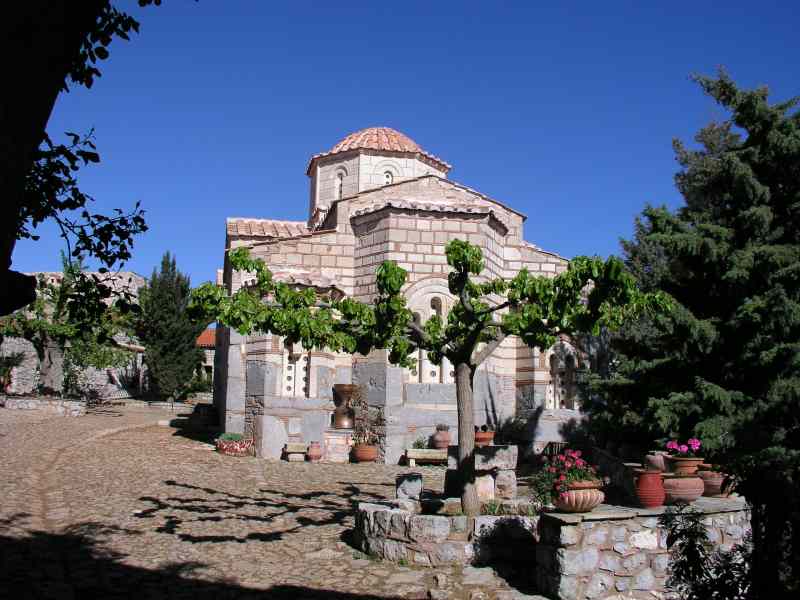
The Holy Monastery of Sagmata


The Holy Monastery of the Transfiguration of Christ, Sagmata (here)  
 
The Holy Monastery of Sagmata (amateur translation)
 
The Holy Monastery of the Transfiguration – Sagmata is among the oldest monasteries, built at the height of 747 meters on the peak of the Sagmatiou mountain. It is a half hour from the city of Thebes, and 8 kilometers from the “Ethnike Odo” between Athens and Lamia (about 80 kilometers from Athens).
  
The founding of the Holy Monastery
 
According to Pausania, the mountain in ancient years was named “Mount Ypatios”, and at the peak was a magnificent ancient Greek temple and statue to the Ypatou Dios. During the Byzantine period, specifically the 12th century, the Holy Monastery was built by St. Clement, and was supported by the Emperor Alexios Comenos, who granted a chrysobull of 1106, which granted special rights to the Monastery, along with rich gifts. During that period, the name of the mountain was changed from “Ypation”, to “Sagmation”, most likely because the mountain resembles a hood or a saddle, or because in olden times, the monks' handiwork was the crafting of saddles.
  
The Katholikon of Sagmata Monastery, dedicated to the Transfiguration of Christ (here)
  
The Katholikon
 
In the center of Holy Monastery stands the Katholikon, which is dedicated to the Transfiguration of the Savior, and which was built in the 12th century. It is in a cruciform style, topped with a dome, divided into four parts (the Holy Altar, the main church, the inner narthex or Liti, and the outer narthex) in addition to the bell tower, which was built in the 15th to the 16th century.
The most noteworthy portion of the church is mosaic floor. It is beautiful, from the samples that remain, crafted with multicolored stones, depicting wonderful scenes from the animal and plant kingdoms, along with geometric shapes...

The incredible view from the chapel of St. Clement at Sagmata Monastery (here)
  
The other buildings
 
Around the Katholikon are built the cells, the dining hall, and the rest of the support spaces. Towards the south side is the dining hall of the Monastery, the “photanamma”, and towards the western side the first cell, all constructions of the 12th century. The rest of the buildings (cells, the archondariki, etc.) date from the Turkish occupation.
  
The tomb of St. Clement in the Chapel dedicated to him, Sagmata Monastery (here)
  
The chapels
 
At a distance of 150 meters south of the Monastery is the scenic chapel of St. Nicholas, that dates most likely to the 16th century. To the west is the newly-built chapel of St. Clement, along with his tomb. From this location, the view of the fields and bays is majestic. From here begins a small footpath which leads to the steep cave where St. Clement lived in asceticism. Around the Monastery are the ruins of old chapels, while at a distance of about 1 kilometer, next to the road, is the chapel of the Holy Forty Martyrs, which was built during the Turkish occupation.
     
The path leading towards the ascetical cave of St. Clement of Sagmata (here)
  
The chapel of St. Luke the Surgeon
 
In recent years, the contemporary Russian Saint Luke the Surgeon, Archbishop of Simferopol and Crimea (1877-1961), became well known in Greece. Within the Holy Monastery is a chapel dedicated to St. Luke. His memory is celebrated on June 11th...

The Chapel of St. Luke the Surgeon in Sagmata Monastery, where they treasure a portion of the Saint's wonderworking Relics, the Saint's miter, and numerous personal items of the Saint (here)
  
The Saints of the Holy Monastery
 
(here)
 
St. Meletos (1035-1105) – The founder of his famous Holy Monastery in Kithairona. He was the Elder of St. Clement. Many sources hold that he spent some time at Sagmata. His memory is celebrated September 1st.
  
 
St. Clement (1050-1140) – The founder of the Holy Monastery of Sagmata. His family was from Athens, and at a young age he came to the Holy Monastery of Osios Meletios, where he was tonsured a monk by St. Meletios, and remained near him for 30 years. In the beginning of the 12th century, he came to Sagmata and lived as a hermit “alone except for God” in a came at the top of a steep rock. During his life he built the Monastery. His memory is celebrated on January 26th and May 1st.
  
St. Germanos (1480-1540) – He served as abbot of the Holy Monastery during the bitter years of slavery [to the Turks]. He was the spiritual father of St. Seraphim. His memory is celebrated on January 26th.

(here)
 
St. Seraphim (1520-1602) – His family was from the town of Zeli. In his youth he came to Sagmata, and lived there as a monk for 10 years. For greater asceticism, he fled to the area of Domvou Elikonos, and built his famous Holy Monastery. His memory is celebrated on May 6th.
  
Fr. Nektarios Antonopoulos (the Abbot of Sagmata Monastery - today Metropolitan of Argolis), who routinely takes the Holy Relics to churches outside the Monastery, and gives many talks on the life and miracles of St. Luke of Simferopol (here)
  
The Holy Monastery in later years
 
The Monastery knew days of wondrous spiritual greatness, and was a spiritual lighthouse for the region for centuries. Unfortunately, the national endeavors of later years did not leave the Monastery unaffected. The occupation by barbarians halted the processes of the Holy Monastery, along with other monasteries. Then, the Monastery was sacked and stripped of its Holy treasures, which continued later by contemporary thieves. The buildings suffered the corruption of time, and the lack of men allowed considerable damage. The formerly multitudinous Holy Monastery remained with a few ages monks, who, without the necessary resources and difficult conditions tried to salvage what was possible. From the 1970's, at the concern of the Metropolitans Nikodemos and Ieronymos, and after, began major restoration activities. The reconstruction had progressed to the point that the abandoned Holy Monastery had changed appearance. Since 1977, the Monastery has been inhabited by a small-numbered brotherhood, and functions as a male monastery.
 
The Monastery is open to pilgrims daily from 7:30AM-1PM, and from 4PM until sunset.
The Holy Monastery celebrates:
August 6th (The Transfiguration of Christ)
January 26th and May 1st (St. Clement)
September 14th (The Precious Cross)
(here)
  
See the following link for a short video about Sagmata Monastery (in Greek): here. The following is a longer video in Greek, depicting the Abbot discussing the history of the monastery and showing some of the sacred places within: here.
  
Through the prayers of our Holy Fathers, Lord Jesus Christ our God, have mercy on us and save us! Amen!

Τετάρτη 9 Ιουνίου 2021

“The Heart in Orthodox Spirituality”

 Orthodox Outlet for Dogmatic Enquiries // St Anthony of the Desert

The heart is central in Orthodox Spirituality. This is biblical: if your heart is pure, your actions are pure. If your heart is impure, so will your actions be.

In our Orthodox tradition, the heart is bigger than the mind and the mind is located in the heart; the combination is referred to as the nous (νους). The heart is not identified with the physical heart, but it is understood to be the center of our spiritual existence.

God takes up residence in the heart (Galatians 4:6; Ephesians 3:17). Christ refers to this residency in the heart as “the Kingdom of God,” which is not a state like New Mexico or Montana, but rather may be understood as a  reign  or  rule (βασιλεία). It is a verbal noun; it is not, in other words, static but energetic. When Christ says, “The Kingdom of God is within you” (Luke 17:21), he means that we are energized by God’s power through the Holy Spirit. This is where we know the “peace of God that passes all understanding” (Philippians 4:7), to which Paul also testifies at Romans 5:5. In the heart we receive both the grace of God and the enlightenment of our lives (II Corinthians 4:6).

The heart is the location for our feelings, for our will, and for our thinking.

Our objective as Christians is to have these three unified, for the heart to be one. Sin interrupts this process of unification. The mind may be convinced of the good, but the will is not able to follow because of the heat of desire; hence, the unity of the heart is broken.

When trouble comes, it comes in the form of double-mindedness (this concept is found in the Epistle of James, chapters 1 and 4, in particular). We are split apart in consciousness. Jesus uses a different metaphor for the same idea in Matthew 6:22: “The lamp of the body is the eye. If therefore your eye is good (sound, singular), your whole body will be full of light.” We are to be of one mind and focused. But we do not see the world aright because we are blind. The Slavonic word for this problem is  prelest, or delusion or, better still, spiritual blindness. Ironically, the word has the positive meaning of “lovely” in the sense of “enchanting.”

Because of the dynamic nature of our lives and our hearts, and because we are always strung between good and evil, light and darkness, life and death (see Deuteronomy 30:19), the Evil One may also take up residence in the heart. We may be deluded; we may be spiritually blind; we may not think right! The Orthodox Tradition, however, insists that the Light cannot be overcome (see John 1) by the darkness that Evil brings to it. Because of baptism, our hearts are filled with the grace of God that cannot be extinguished; therefore, the Evil One cannot take up residence in the heart but must remain outside as a goad (St Diadochos of Photiki, On Spiritual Knowledge, Philokalia Vol. 1). Metaphor or not, this is a powerful image that can bring us comfort in dark moments.

The heart is the seat of passion (pathos - πάθος). As our Lord says, “Out of the heart proceed evil thoughts” (Matthew 15:19). Paul writes, “Those who belong to Christ Jesus have crucified the sinful nature with its passions and desires” (Galatians 5:24) and goes on to list the virtues of life in the Spirit. But this is again part of the dynamic of life. There is no guarantee that we will remain in this condition; in fact we have every reason to commit ourselves to spiritual warfare for life. At the heart of this is the struggle for self-control (Galatians 5:23, Ephesians 4:22, and elsewhere) and for what the Tradition calls  apatheia (απάθεια), which means dispassion; it does not mean that we become apathetic, but that we view all things without clinging to them. In a way it relates to our use of the icon. Our vision does not stop with the icon; if it does, then we do indeed make an idol of the icon. Our vision must pass through the icon to see the reality it embodies.

At this point we must consider the process of temptation. The Fathers of the Philokalia clearly labeled this process. We should learn to recognize it in our own lives. At the core of the process is a  logismos, (λογισμός) a thought that potentially leads to action. First there is the suggestion to sin. A temptation arises: let’s be gluttonous. Let’s gorge ourselves on food and wine. Wow! Great idea!  Second, we begin to think about this suggestion, savor it, interact with it, and dwell on it. Third, we accept the premise as possible (to change the temptation: I can find a way to commit adultery with that person). Fourth, we enter into agreement with the suggestion (I want to commit adultery with that person), and we become captive to it. The thought becomes habitual and we become passionate about it. The Fathers say that this is the point when it becomes sin, in accord with Christ’s word (Matthew 5:28). We don’t have to fulfill the act. We have already stepped over the line, and we must repent and repeal our agreement to the suggestion. We must refuse the logismos with its allure. Now, back to our concern with the heart.

“Blessed are the pure in heart, for they shall see God,” says our Lord. The first step toward purification of the heart is the recognition that we need God’s power; we cannot purify ourselves. We can only invite this act of Grace into our lives. We can turn to it but we cannot purify ourselves.

The logical second step, then, is prayer. The Fathers particularly invite us to the Jesus Prayer. This prayer is performed in quiet (Greek  ησυχία hesychia  – hence, the term hesychast prayer), an injunction that goes back to Christ’s word at Matthew 6:5-6. Since this prayer penetrates deep within us, it is also called noetic prayer, i.e. the prayer of the nous, in this case the word meaning that supplication which embraces both mind and heart (see Mark 12:30).

Repentance (metanoia - μετάνοια) is the next step. Repentance means, literally, re-thinking: we have to enter into the depths of our own hearts to discover all those habits and temptations to which we cling that separate us from God’s Light. This is the capsule sermon with which Jesus begins his ministry, according to Mark 1:15, “The time is fulfilled. The Kingdom of God is at hand. Repent, and believe this good news.” Reflection on the Love of God draws us to repentance (Romans 2:4).

There is the possibility of return. As we pray at the Divine Liturgy, “Shine in our hearts, Loving Master, with the pure Light of your divine knowledge and open our hearts to the message of your Gospel.”

In the Orthodox tradition, a great deal of emphasis is placed upon tears of mourning for our alienation from God. This is called  penthos (πένθος)  in Greek; the word is the opposite of acedia (ακηδία), which means sloth or despair. Hence these are not tears of despair, but rather of mourning at the loss of paradise, so to speak, in our own lives. St Isaac the Syrian wrote much about the gift of tears, but he is one among many of the fathers who recognized the importance of mourning at loss.

If we desire purity of heart, we must see that the worship life of the church is of central importance. Simply put, we make no solo progress along this pathway; we join together with others in community in the knowledge that we are all seeking purity of heart. We need the sacraments and the Word of God to nourish us and to enable us. The ascetic life includes fasting. This is important but we must always remember that the fast is of the soul as well as the body. Bodily fasting is only the outward manifestation of inward fasting. If it is only outward, the fast is worthless (see Christ’s word at Matthew 6:16-17).


Κυριακή 30 Μαΐου 2021

The Light of the Christ Illumines Even Samaritans and Gentiles: Homily for the Sunday of the Samaritan Woman in the Orthodox Church


Acts 11:19-30; John 4:5-42

Christ is Risen!

There is a lot of truth in the saying that familiarity breeds contempt.  It is possible for even the best things in life to become so familiar that we become blind to their true importance. We can do that even with our celebration of the Savior’s victory over death, as though the Paschal season were simply about singing joyful hymns and enjoying rich food.  It is certainly possible to reduce any dimension of the life of Church to a mere cultural observance that we assume is only for some people, usually those we think are like us in some particular way.  Both today’s gospel and epistle readings challenge us, however, to consider how the good news of the resurrection impacts the world in a way that is so unfamiliar as to be unsettling, and which challenges our assumptions about who God’s people are.

The Samaritan woman certainly took nothing for granted about Jesus Christ.  The Jews viewed the Samaritans as heretics who had intermarried with Gentiles, and they had nothing to do with them; as well, men did not strike up conversations with women in public in that time and place.  So when the Lord asked her for a drink of water and engaged her in an extended theological discussion, she was completely surprised.  He knew the details of her broken personal history and obviously related to her very differently than had the men in her community.  This encounter made such an impression that “she left her water jar, and went away into the city, and said to the people, ‘Come, see a man who told me all that I ever did.  Can this be the Christ?’” She  did something quite shocking herself in that moment, proclaiming to her fellow Samaritans that this Jewish rabbi was the Messiah. “Many Samaritans from that city believed in Him because of the woman’s testimony, ‘He said to me all that I ever did.’  So when the Samaritans came to Him, they asked Him to stay with them; and He stayed there two days.  And many more believed because of His words.  They said to the woman, ‘It is no longer because of your words that we believe, for we have heard for ourselves, and we know that this is indeed the Savior of the world.’”

A Samaritan woman with an immoral lifestyle became the Great Martyr Photini, an unlikely evangelist whose testimony led many in her village to belief in Christ. Her transformation occurred because she received by faith the living water of which the Savior spoke, “a spring of water welling up to eternal life.”   Here is a foreshadowing of the coming of the Holy Spirit at Pentecost, for she is empowered from the depths of her soul to participate in the healing of the human person that our Risen Lord has brought to the world.  As we chanted at Great Vespers last night about Photini after her encounter with Christ, “that chaste woman hastened at once to the city and said to the crowds: Come and see Christ the Lord, the Savior of our souls.”  Yes, she was truly restored to the dignity of a beloved child of God in the divine image and likeness.

Remember that in the chapter of John’s gospel right before the Lord’s conversation with Photini, He spoke with the Pharisee Nicodemus, an expert in the Jewish law.  At that point, Nicodemus could not understand even the most basic points of the Lord’s teaching.  How shocking, then, that a Samaritan woman with a notorious past came to faith so quickly and even preached to others.  Through her witness, the Lord Himself spent two days in a Samaritan village, which must have been the last thing that anyone expected the Jewish Messiah to do.  His salvation does not operate according to the conventional categories of this world, but transcends and subverts them.  How odd:  Great religious teachers miss the point, while disgraced women from despised communities become glorious saints.

Our reading from Acts describes the foundation of the first Gentile church in Antioch, where the disciples were first called Christians.  It took a good bit of debate and discernment for the Church to determine how to respond to Gentiles who wanted to become Christians, for the origins of the faith are so clearly in Judaism.  At the council held by the apostles in Acts 15: 8-9, St. Peter said of the Gentile Christians, “God, who knows the heart, showed that he accepted them by giving the Holy Spirit to them, just as He did to us.  He did not discriminate between us and them, for he purified their hearts by faith.”  That, of course, is a very good description of what the Lord had done with St. Photini.  The letter to the Gentile Christians from that council did not require them to become circumcised or convert to Judaism, but “to abstain from food sacrificed to idols…and from sexual immorality.” (Acts 15:20) It is not surprising that the Jewish Christian leaders of the Church made a point of reminding Gentile converts to distance themselves from forms of spiritual and moral corruption so common in their culture.

The inclusion of Samaritans like Photini and Gentiles like the original Antiochian believers provides a powerful sign that the resurrection of Christ is not about business as usual in a world where people divide up according to all kinds of human characteristics.  When we do that, we define ourselves over against enemies, real and imagined, and tend to think that all the evil and wickedness are on the side of those we oppose.  Among the many dangers of such ways of thinking is that we easily become the self-righteous judges of others and inflame our own passions to the point that we see neither ourselves nor our neighbors clearly.  A Jew of the first century would typically have viewed Photini as a terrible sinner who did the wretched kinds of things expected of Samaritans.  The apostles could have easily put up almost insurmountable roadblocks to keep the Gentiles at arm’s length.  That the Church developed very differently is an indication that it is not simply another human institution of a world enslaved to the fear of death, but truly the Body of our Risen Lord in Whom “strangers and foreigners” become “fellow citizens of the saints and members of the household of God” by the power of the Holy Spirit.  (Eph. 2:19)  As St. Paul taught, “There is neither Jew nor Gentile, neither slave nor free, nor is there male and female, for you are all one in Christ Jesus.”  (Gal. 3:28)  He offers living water to all people who come to Him in humble faith as did St. Photini, the Samaritan woman.

Like her, we all encounter Christ as people with a history of personal brokenness in thought, word, and deed.  We may doubt, however, whether the Savior’s victory over death, the wages of sin, may truly become active in us.  The Church highlights the example of so many notorious sinners who have become great saints by receiving the Lord’s mercy through repentance.  Perhaps we have heard their stories so many times that we take them for granted and assume that, after their conversion, they were no longer troubled by temptations, doubts, and sorrow for their failings.  That would be an unrealistic assumption, of course.  Remember that St. Mary of Egypt spent her first seventeen years in the desert in fierce struggle with passions for all that she had left behind.  She said of this period, “Darkness after darkness, misery after misery stood about me, a sinner.”  If we are genuinely embracing the new life our Risen Lord, we will face battles in our own souls as we turn away from the darkness of the tomb and toward the brilliant light of His kingdom.

As the eyes of our souls gain the focus to behold His radiant glory more fully, the darkness within us will become all the more apparent.  We will then be like Photini when the Savior mentioned her history with men.  Instead of shutting down in shame or making excuses, she simply said, “Sir, I perceive that You are a prophet” as she continued to open herself to the healing mercy of the Lord through faith.  If we truly believe that Christ has conquered death, the wages of sin, then we must become as courageous as she was in offering even the most painfully broken dimensions of lives to the Savior for healing.  Like her, let us do so with the confident hope of those who know that something worth living and dying for has come into the world, for Christ is Risen!