Σάββατο 14 Μαΐου 2022

The Vindication of the Mother of God

At Christmas time, the Virgin Mary gets a bit of attention in the wider culture. A woman gives birth in difficult circumstances: Mother, baby, ox and ass, the manger. It’s a very touching scene. She quickly fades from the scene however, with some five centuries of culture desperately afraid that she will get too much attention.

In that vein, she is pretty much absent from Easter. We have eggs, chocolate, bunny rabbits, and the resurrection of Christ (along with new dresses and such), but Mary has no place in our culture’s Easter imagination. Some of this is undoubtedly the result of 500 years of a dominantly anti-Catholic Protestantism. You have to mention Mary at Christmas, but she can conveniently be forgotten at Easter.

Unless you’re Orthodox.

In Orthodoxy, there is essentially no teaching regarding Christ that ignores His mother. There is no teaching regarding Jesus that ignores His humanity and His humanity requires that we remember her. When the Council of 431 (3rd Ecumenical) declared Mary to be “Theotokos” (“Birthgiver of God”) it was on account of its concern that the full truth of who Christ is not be distorted. The mystery of the Incarnation (rightly understood) makes it possible to speak the paradoxical title of “Birthgiver of God” (not just “Birthgiver of Christ”). Christ is fully God and fully man. The one born of Mary was God and man. God was born of her.

This is echoed as well in the prophetic word that was spoken to Mary when she brought Jesus to the Temple 40 days after His birth (in concordance with the Law). Simeon the prophet, holding the child in his arms, said to His mother:

“Behold, this Child is destined for the fall and rising of many in Israel, and for a sign which will be spoken against (yes, a sword will pierce through your own soul also), that the thoughts of many hearts may be revealed.” (Luke 2:34-35)

His words speak of a “sword.” This is far deeper than a hint that what is to happen to her Son will make her sad. He didn’t say, “It will cause you grief.” The suffering of Christ on the Cross is equally the sword that pierces the soul of Mary. Mary is the first Christian, the first to believe the word concerning her Son. His suffering is her suffering. His suffering is to be our suffering as well. If you have been united with Christ on the Cross, then, in some measure, your own soul has been pierced by the sword that pierced the soul of Mary. St. Paul says,

“I have been crucified with Christ, nevertheless, I live. Yet, not I, but Christ lives in me, who loved me and gave Himself for me.” Mary is the first of those who have been crucified with Christ.

Our ignorance of such things (or our forgetfulness), encourage us to forget that our discipleship is marked by the Cross and defined by our communion with the Crucified Lord. Too easily, the resurrection of Jesus comes to mean nothing more than a promise of life after death. “Jesus died and was resurrected so that I could go to heaven.” While that is sort of true, it represents a serious diminishment of the gospel.

As Christ was on the Cross, His thoughts turned to His mother. He endures the suffering and the shame of the crucifixion. She shares in the shame and, in that, a sword pierces her own soul. Christ gives her to the care of St. John, “the disciple whom He loved.” He does not merely ask John to care for her, but says, “Behold your mother.” John must now be her son. Incidentally, this supports the Church’s teaching that the “brother and sisters of Christ” are not children of Mary. It would have fallen to them to take of her had that been the case.

As the Church enters into the depth of Holy Week and approaches the Lord’s death and resurrection, the Theotokos is ever present on its mind. At what becomes a liturgical climax the Church gathers around the funeral shroud icon (epitaphios) in the center of the Church. Following its commemoration of Christ’s suffering and death, the burial shroud had been placed there for the faithful to venerate. They have offered their lamentations.

At this last moment, as the priest stands before the image, we hear these verses from the choir:

Do not lament me, O Mother, seeing me in the tomb, the Son conceived in the womb without seed, for I shall arise and be glorified with eternal glory as God. I shall exalt all who magnify thee in faith and in love.

Glory to Thee, our God, glory to Thee!

I escaped sufferings and was blessed beyond nature at Thy strange birth, O Son, who art without beginning. But now, beholding Thee, my God, dead and without breath, I am sorely pierced by the sword of sorrow. But arise, that I may be magnified.

Glory to Thee, our God, glory to Thee!

By my own will, the earth covers me, O Mother, but the gatekeepers of hell tremble at seeing me clothed in the blood-stained garments of vengeance; for when I have vanquished my enemies on the cross, I shall arise as God and magnify thee.

Glory to the Father and to the Son and to the Holy Spirit, now and ever and unto ages of ages. Amen.

Let creation rejoice, let all born on earth be glad, for hateful hell has been despoiled, let the women with myrrh come to meet me, for I am redeeming Adam and Eve and all their descendants, and on the third day shall I arise.

Do not lament me, O Mother, seeing me in the tomb, the Son conceived in the womb without seed, for I shall arise and be glorified with eternal glory as God. I shall exalt all who magnify thee in faith and in love.

The verses are a dialog between Christ and His mother. It gathers her whose heart had been pierced with the sword of shame and grief into His own compassion. He encourages her with the promise that He will rise and vindicate her. He will be glorified and will magnify her. Her faithfulness, humility, and obedience will be justified before all the world. “All generations will call her blessed.”

She replies, recalling the mystery of her Son’s “strange birth.” Though she now sees His body lying “dead and without breath,” she urges Him to arise.

He responds that He is “covered by the earth” by His “own will.” He is no one’s victim but is doing the very thing He was born to do. And now He is clothed in the “blood-stained garments of vengeance.” Vanquishing His foes by the cross, He will rise and magnify her.

He closes, repeating the initial verse. At the repetition of “I shall arise,” the priest takes up the funeral shroud and bears it into the altar. The doors are shut and every light, every candle in the Church, is extinguished. In silence the Church waits. Mary waits. All creation holds its breath.

Quietly, the priest begins to sing, “Thy resurrection, O Christ our Savior, the angels in heaven sing…” He will shortly come forth bearing the newly kindled light which spreads to all. And the Paschal procession begins around the Church (I’m describing the Slavic practice).

His resurrection is a vindication of His mother. Equally, it is the vindication of every believer. For we, too, have stood silently by the tomb, venerating His dead body. We, too, have had some share in His shame, either from others or cast upon us by our own unfaithfulness and doubting. Was I wrong to believe in, O Lord? Have you forgotten me? I am surrounded by my enemies and they mock me. Where are You, Lord?

“I shall arise,” Christ says.

Mary saw Him. Mary Magdalen saw Him. Peter and John saw Him. Then the twelve. Then James the Brother of the Lord. Then by over 500. And even to St. Paul He appeared, as if to one born out of time.

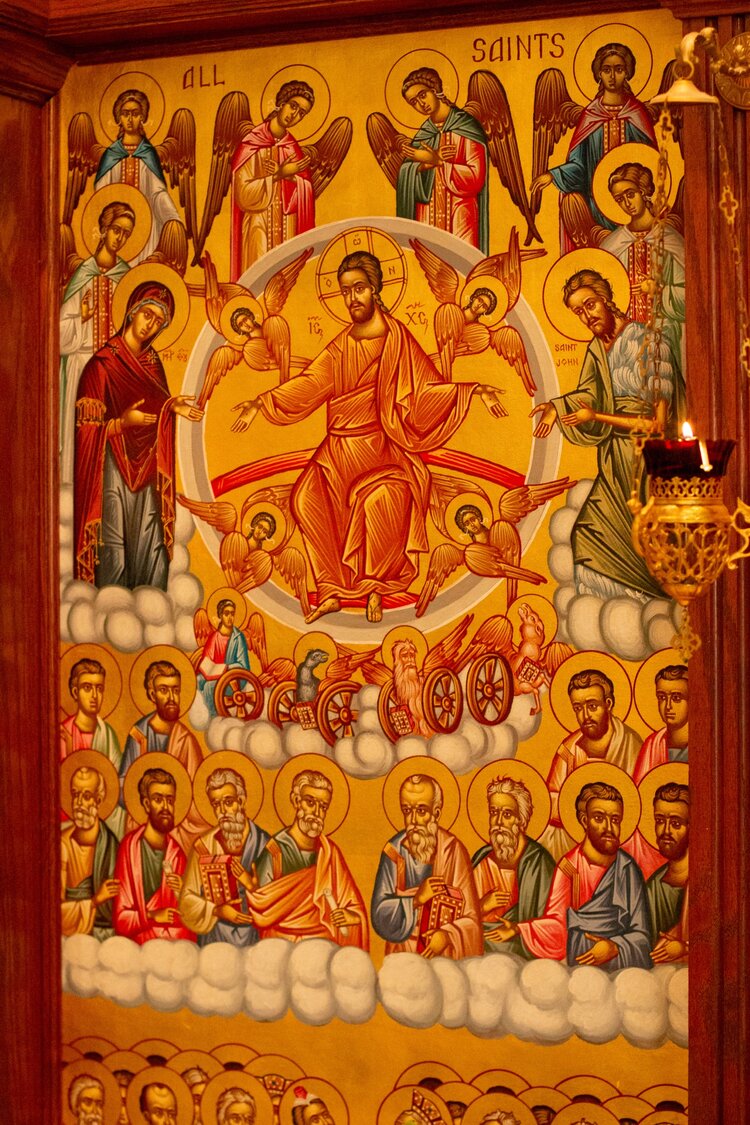
And they began the procession that continues to circle the earth singing, “Enable us on earth, to glorify Thee in purity of heart.” At the head of our procession is His Mother – now vindicated and magnified by all. She told the truth. She gave birth to God the Word. We call her blessed.

Videos from St. Maximus Orthodox Church Choirs & ORTODOX™ (Vatopedi monastery, Athos)

Τρίτη 10 Μαΐου 2022

Equals of the Apostles and Teachers of the Slavs, saints Cyril and Methodius


Orthodox Church in America

Saints Cyril and Methodius, Equals of the Apostles, and Enlighteners of the Slavs came from an illustrious and pious family living in the Greek city of Thessalonica. Saint Methodius was the oldest of seven brothers, Saint Constantine [Cyril was his monastic name] was the youngest. At first Saint Methodius was in the military and was governor in one of the Slavic principalities dependent on the Byzantine Empire, probably Bulgaria, which made it possible for him to learn the Slavic language. After living there for about ten years, Saint Methodius later received monastic tonsure at one of the monasteries on Mount Olympus (Asia Minor).

Saint Constantine distinguished himself by his great aptitude, and he studied with the emperor Michael under the finest teachers in Constantinople, including Saint Photius, the future Patriarch of Constantinople (February 6).

Saint Constantine studied all the sciences of his time, and also knew several languages. He also studied the works of Saint Gregory the Theologian. Because of his keen mind and penetrating intellect, Saint Constantine was called “Philosopher” (wise). Upon the completion of his education, Saint Constantine was ordained to the holy priesthood and was appointed curator of the patriarchal library at the church of Hagia Sophia. He soon left the capital and went secretly to a monastery.

Discovered there, he returned to Constantinople, where he was appointed as instructor in philosophy. The young Constantine’s wisdom and faith were so great that he won a debate with Ananias, the leader of the heretical iconclasts. After this victory Constantine was sent by the emperor to discuss the Holy Trinity with the Saracens, and again he gained the victory. When he returned, Saint Constantine went to his brother Saint Methodius on Olympus, spending his time in unceasing prayer and reading the works of the holy Fathers.

The emperor soon summoned both of the holy brothers from the monastery and sent them to preach the Gospel to the Khazars. Along the way they stayed in the city of Korsun, making preparations for their missionary activity. There the holy brothers miraculously discovered the relics of the hieromartyr Clement, Pope of Rome (November 25).

There in Korsun Saint Constantine found a Gospel and Psalter written in Russian letters [i.e. Slavonic], and a man speaking the Slavic tongue, and he learned from this man how to read and speak this language. After this, the holy brothers went to the Khazars, where they won a debate with Jews and Moslems by preaching the Gospel. On the way home, the brothers again visited Korsun and, taking up the relics of Saint Clement, they returned to Constantinople. Saint Constantine remained in the capital, but Saint Methodius was made igumen of the small Polychronion monastery near Mount Olympus, where he lived a life of asceticism as before. 


Saints Cyril & Methodius, from here

Soon messengers came to the emperor from the Moravian prince Rostislav, who was under pressure from German bishops, with a request to send teachers to Moravia who would be able to preach in the Slavic tongue. The emperor summoned Saint Constantine and said to him, “You must go there, but it would be better if no one knows about this.”

Saint Constantine prepared for the new task with fasting and prayer. With the help of his brother Saint Methodius and the disciples Gorazd, Clement, Savva, Naum and Angelyar, he devised a Slavonic alphabet and translated the books which were necessary for the celebration of the divine services: the Gospel, Epistles, Psalter, and collected services, into the Slavic tongue. This occurred in the year 863.

After completing the translation, the holy brothers went to Moravia, where they were received with great honor, and they began to teach the services in the Slavic language. This aroused the malice of the German bishops, who celebrated divine services in the Moravian churches in Latin. They rose up against the holy brothers, convinced that divine services must be done in one of three languages: Hebrew, Greek or Latin.

Saint Constantine said, “You only recognize three languages in which God may be glorified. But David sang, ‘Praise the Lord, all nations, praise the Lord all peoples (Ps 116/117:1).’ And the Gospel of Saint Matthew (28:18) says, ‘Go and teach all nations....’” The German bishops were humiliated, but they became bitter and complained to Rome.

The holy brothers were summoned to Rome for a decision on this matter. Taking with them the relics of Saint Clement, Saints Constantine and Methodius set off to Rome. Knowing that the holy brothers were bringing these relics with them, Pope Adrian met them along the way with his clergy. The holy brothers were greeted with honor, the Pope gave permission to have divine services in the Slavonic language, and he ordered the books translated by the brothers to be placed in the Latin churches, and to serve the Liturgy in the Slavonic language.

At Rome Saint Constantine fell ill, and the Lord revealed to him his approaching death. He was tonsured into the monastic schema with the name of Cyril. On February 14, 869, fifty days after receiving the schema, Saint Cyril died at the age of forty-two.

Saint Cyril commanded his brother Saint Methodius to continue with their task of enlightening the Slavic peoples with the light of the true Faith. Saint Methodius entreated the Pope to send the body of his brother for burial in their native land, but the Pope ordered the relics of Saint Cyril to be placed in the church of Saint Clement, where miracles began to occur from them.

After the death of Saint Cyril, the Pope sent Saint Methodius to Pannonia, after consecrating him as Archbishop of Moravia and Pannonia, on the ancient throne of Saint Andronicus (July 30). In Pannonia Saint Methodius and his disciples continued to distribute services books written in the Slavonic language. This again aroused the wrath of the German bishops. They arrested and tried Saint Methodius, who was sent in chains to Swabia, where he endured many sufferings for two and a half years.

After being set free by order of Pope John VIII of Rome, and restored to his archdiocese, Saint Methodius continued to preach the Gospel among the Slavs. He baptized the Czech prince Borivoi and his wife Ludmilla (September 16), and also one of the Polish princes. The German bishops began to persecute the saint for a third time, because he did not accept the erroneous teaching about the procession of the Holy Spirit from both the Father and the Son. Saint Methodius was summoned to Rome, but he justified himself before the Pope, and preserved the Orthodox teaching in its purity, and was sent again to the capital of Moravia, Velehrad.

Here in the remaining years of his life Saint Methodius, assisted by two of his former pupils, translated the entire Old Testament into Slavonic, except for the Book of Maccabbees, and even the Nomocanon (Rule of the Holy Fathers) and Paterikon (book of the Holy Fathers).

Sensing the nearness of death, Saint Methodius designated one of his students, Gorazd, as a worthy successor to himself. The holy bishop predicted the day of his death and died on April 6, 885 when he was about sixty years old. The saint’s burial service was chanted in three languages, Slavonic, Greek, and Latin. He was buried in the cathedral church of Velehrad. 

"Cyril & Methodius, the Apostles of Slavs", full movie with English subtitles (2013)!  

Honey and Hemlock
Suraj Sebastian

Hollywood doesn’t make many big-budget films of holy people, and when they do, it’s usually a dog’s breakfast. However, an exciting docudrama project from the Czech Republic in 2013 has resulted in an excellent series on the lives and historical importance of the two brothers, Saints Cyril and Methodius.
Saints Cyril and Methodius were two Byzantine brothers born in the 9th century who became prominent Christian missionaries. Their mission influenced the cultural development of all Slavic nations, for which they are called the Apostles of the Slavs. In order to commemorate the 1150th anniversary of their legacy, a 4-part docudrama was created tracing their lives and work.
This project, established in the Czech Republic, involved cooperation between the Catholic and Orthodox Churches, as these saints established what would be the foundation and future development of Czech and Slavic culture and education.
The series follows Cyril and Methodius, two Byzantine Greek brothers born in the 9th century. They became missionaries of Christianity and influenced the cultural development of the Great Moravian territory. 
Original title: Cyril and Methodius – The Apostles of the Slavs. Audio: German. Subtitles: English. Format: HD. Director: Petr Nikolaev. Writers: Petr Hudský, Miroslav Oscatka. Stars: Josef Abrhám, Milan Bahúl, Jirí Bohm. 
Cast: Methodius - Roman Zach, Cyril - Ondřej Novák, Fotios - Josef Abrhám, Hermanrich - Marian Roden, Rostislav - Milan Bahul, Svatopluk - Jan Jankovský, Živena - Radka Fidlerová.

See also

Mad Max & Orthodox Christianity!
Orthodox Christianity In Czech and Slovakia Is Growing
Basic Points of Difference between the Orthodox Church and Roman Catholic Church
The Way - An introduction to the Orthodox Faith
Protestants ask: Why be Orthodox?
The Road to Rome? Why Orthodoxy Deserves a Look
The ancient Christian Church - About Orthodox Church in the West World...
I love the Pope & the Roman Catholic faithful, but...


During the time that Luther and Calvin were formulating the Reformation... 

"True freedom is to choose the better in the light of truth..."
Miley Cyrus, or: why Orthodox Mission in the West is an urgent need...
 
LIVE, BEYOND THE LIMITS! 
Theosis (deification): The True Purpose of Human Life
Theosis, St. Silouan and Elder Sophrony
Orthodoxy's Worship: The Sanctification of the Entire World   


Κυριακή 24 Απριλίου 2022

The Last Pascha – A Reverie

I had a reverie around the time of Pascha. My life has had many chapters. I have loved friends and lost friends. My memory is filled with much that is bittersweet – not my favorite flavor. But my reverie was a dream of Pascha – the Last Pascha. I wrote this in a Facebook post and have looked it up numerous times for balm for my tired soul. Today, I wanted more balm. So I’m posting this to share it with you. If it helps, that is well. If it doesn’t, then ignore the reverie of an old man. And have peace. And do not quit singing.

The Last Pascha.

It dawns and everyone is there. And we can’t quite remember what we might have had against each other. We’re so glad to see faces that we know. Memory fades like the pains in our bones as we stand with joy and see the Face of Christ. In the light of His Face, only the present has any reality. All things become present in Him. And a sound is heard, first in the distance, but we can’t quite figure where in the distance, and it draws nearer…

It is a song being sung. It seems strange though familiar and then I seem to know the words and I’m surprised at the sound and the strength of my own voice and how it interacts with every other voice, no two singing the same tune and yet it’s one song. Everyone hears it in their own language. It is the Song of the Lamb.

And since every moment is present, there is no sense of how long we have been singing or how long we will sing. But in the Song, everything comes right. The creation beneath our feet begins to awaken. And the Song is taken up by trees and rocks, rivers and sky, until all of creation sings.

And slowly, the motion of a Dance…


About The Paschal Lamb

 
by Fr. Patrick Henry Reardon
Preachers Institute

Very early in the Fourth Gospel, John the Baptist sees Jesus and exclaims,

Icon from here
“Behold the Lamb of God, who takes away the sins of the world!” (John 1:29)
The Evangelist tells us that John repeated this identification on the following day (1:36).
For the rest of the Fourth Gospel, nothing more is said of John’s exclamation; he identified Jesus as the sacrificial lamb, but the theme is not further pursued in the story.
When Jesus dies, however, the Evangelist suddenly comments on the fact that Jesus’ legs were not broken on the Cross. Interpreting this fact as a fulfillment of biblical prophecy, he quotes the Book of Exodus:
“Not one of his bones shall be broken” (19:36; Exodus 12:46).
John expects his readers to be familiar with that text; he assumes they will recognize that this verse pertains to the Paschal Lamb. In citing it, John identifies Jesus as the true Paschal Lamb.
If we look closely at this imagery, however, we recognize that the image of Jesus as Paschal Lamb has passed through a filter, so to speak. In the Mosaic Law the paschal lamb was not a sin offering. It was a special sacrifice immediately tied to Israel’s deliverance from Egyptian slavery. It represented—if the expression be allowed—the embodiment of liberation from slavery.
How, then, does John the Baptist, who identifies Jesus as the Paschal Lamb, declare that he takes away the sins of the world? Here is where I want to employ the metaphor of the filter: the theme of the paschal lamb has been filtered through the Isaian image of the Suffering Servant, whom the prophet declares,
“He was led as a sheep to the slaughter, and as a lamb is silent before his shearers, so he opens not his mouth.”
Holy Week 2018, Kenya (here)
The original lamb was not a sin offering; it was offered in the context of Israel’s deliverance from slavery. The blood of that lamb marked the doorposts of the houses of the Israelites, so that the angel of the Lord would spare those houses the dreadful tenth plague which was visited on Egypt on the night of Passover.

This new Lamb of God, however, does more than free the Israelites from servitude in Egypt. He is the Suffering Servant of the Lord, described in the Book of Isaiah as a sin offering. This new Paschal Lamb takes away the sins of the whole world. He does not perish for one people only, but to gather into one all the scattered children of God. This verse from Exodus, cited at the scene on the Cross, ties the end of John’s account back to the exclamation of John the Baptist in the first chapter.
This imagery ties St. John’s theology to that of St. Paul, who wrote to the Corinthians,
“Christ, our paschal lamb, has been sacrificed.”
It ties John also to Peter, who declared our redemption by
“the precious blood of Christ, as of a lamb without blemish and without spot” (1 Peter 1:19).
We are now observing the Christian Passover, that feast of which St. Gregory the Theologian wrote,
“Then comes the Sacred Night, the anniversary of the confused darkness of the present life, into which the primeval darkness is dissolved, and all things come into life and rank and form, and that which was chaos is constrained to order. Then we flee from Egypt; that is, from sullen persecuting sin; and from Pharaoh the unseen tyrant . . . (Orations 45.25).

 "The Lamb" in the Holy Commuion, Orthodox Holy Liturgy (from here)

St. Gregory perceives the conflation of the imagery from Exodus 12 and Isaiah 53. Here is how he describes the Paschal Lamb:
“Thus then and for this cause the written Law came in, gathering us into Christ; and this is the account of the Sacrifices as I account for them. And that you may not be ignorant of the depth of His Wisdom and the riches of His inscrutable judgments. He did not leave even these unhallowed altogether, or useless, or with nothing in them but mere blood. But that great—and if I may say so—in its first [divine] nature ‘unsacrificeable’ Victim was intermingled with the Sacrifices of the Law, and was a purification, not for a part of the world, nor for only a short time, but for the whole world and for all time.”
Recognizing that the wool of the lamb—though it is the lamb’s native nakedness—provides the clothing for the human being, Gregory transposes this imagery to the case of Christ, whose very innocence becomes the proper clothing for the wedding feast, the very garment of incorruption:
“For this reason a Lamb was chosen for its innocence, and its clothing of the original nakedness. For such is the Victim offered for us, who is both in name and fact the garment of incorruption.”
Gregory continues the symbolism of the lamb, finally identifying it with the suffering Victim in Isaiah 53:
“And he was a perfect Victim not only on account of his divinity, than which nothing is more perfect; but also on account of that which he assumed, having been anointed with the divinity, and having become one with Him who anointed it, and I am bold to say, made equal with God. He was a male, because he was offered for Adam . . . He both took on Him our sins and bore our weakness (Isaiah 53:4), yet he did not himself suffer anything that needed healing. For he was tempted in all points like as we are yet without sin. For he that persecuted the Light that shines in darkness could not overcome him” (45.13).
This is the meaning of the Passover, said Gregory, because
“the Lamb is slain, and act and word are sealed with the Precious Blood” (45.25).
He goes on,
“we will feed on the Lamb toward evening— for Christ’s Passion was in the completion of the ages; because, in addition, he communicated his disciples in the evening with his Sacrament, destroying the darkness of sin” (45.26).
Here we perceive the symbolism of the darkness that covered the earth for three hours, as the true Paschal Lamb was being slain. Here we detect the mystery of the redemptive blood that flowed from his side to anoint our hearts and minds against the avenging angel.

Σάββατο 23 Απριλίου 2022

Old Testament prophecies hinting the Crucifixion and confirmed historically


Source: https://ethnegersis.blogspot/ -  (selected excerpts from Catechesis No.13)

Orthodox Outlet for Dogmatic Enquiries / Translation:  K.N.

ΕΛΛΗΝΙΚΑ: ΑΓΙΟΥ ΚΥΡΙΛΛΟΥ ΙΕΡΟΣΟΛΥΜΩΝ: ΟΙ ΠΡΟΦΗΤΕΙΕΣ ΠΟΥ ΕΚΠΛΗΡΩΘΗΚΑΝ ΚΑΤΑ ΤΗ ΣΤΑΥΡΩΣΗ ΤΟΥ ΚΥΡΙΟΥ [Μέρος πρώτο]


Saint Cyril of Jerusalem**:  “....and was crucified for our sake during the time of Pontius Pilate, and suffered and was buried....”

 *****

But let us now return to the subject of prophetic proofs that you asked for. The Lord was crucified - you have heard all the testimonies. You have seen the location of Golgotha hill. You agree with the information and applaud it as praiseworthy and you glorify it. But take care lest there come a time during a period of persecution that you renounce Him.  Do not delight in the Cross only during a period of peace, but preserve the same faith also during a period of persecution. Do not be a friend of Jesus in a time of peace, and in a time of war become an enemy. (…)

***********

So, Christ was crucified for our sake:  He, who had been judged during an icy-cold night – which is why there was a coal burning fire nearby:

John 18:18: “Now the slaves and servants who had made a fire of coals stood there, for it was cold, and they warmed themselves. And Peter was with them and warming himself.”

Christ was crucified at the third hour:

Mark 15:25:  Now it was the third hour, and they crucified Him”...

(The “third hour” means it was 3 hours after sunrise, that is, at 9 in the morning when they crucified Him)

Matthew 27:45: “Now from the sixth hour until the ninth hour there was darkness over all the land.”

(The 6th hour was 12 noon, so from 12 noon, darkness covered the entire land, until 3 in the afternoon).

Could these same details have been written by the Old Testament Prophets also? Let us check it out:

The prophet Zacharias said:

Zacharias 14:7:  On that day there shall be no light; it will be cold and icy for one day – and that day is known to the Lord – and it is not day and not night, and at evening time there shall be light.”

(During that one day, there will be no sunlight, so it will be a cold, icy day – hence Peter warming himself at a coal fire outside).

”So?  Didn't the Lord know about the other days?  Indeed, days are many, but this was the day of the Lord's patience, a day “which the Lord had created” (Psalm 117:24).  He likewise knew the day that was “not day and not night” (Zacharias 14:7).

What was the meaning of this enigma mentioned by the Prophet: “...and that day is known to the Lord – and it is not day and not night”?

What was that day? What should we call it?

The Gospel interprets this, as it narrates the events:  It was not “day”, because the sun did not shine while moving from east to west; instead, from the 6th hour (12 noon) until the 9th (3 afternoon), complete darkness prevailed (as above, Matthew 27:45), in the middle of the day! Hence, darkness suddenly prevailed in the middle of the day – which darkness God had named “night” (Genesis 1:1: “...and God called the light “day”, and the darkness He called “night”).

That is why it was neither “day” nor “night” literally, for there was not enough light to be called “day”, nor dark enough to be called “night”, given that after the 9th hour (3 afternoon) the sun shone again in the sky. This too was foretold by the Prophet when saying:not day and not night” (Zacharias 14:7), and adding at the end of v.7: “and at evening time there shall be light”.

Do you see the accuracy of the Prophets? Do you see how much truth there is in what has been prophesied and written in advance of the actualized events?

***********

Do you want to know exactly what time the sun was blotted out from the face of the earth? Was it perhaps on the 5th hour or the 8th or the 10th?  

Then state the exact time to the inconvincible Jews, o Prophet! When did the sun set?

The prophet Amos said:

And it will be on that day, says the Lord God, and the sun will set at noon, and the light will be darkened upon the earth in the daytime.”  (Amos 8:9)

– exactly as above:  

Now from the sixth hour until the ninth hour there was darkness over all the land.” (as above, Matthew 27:45)

What season would it take place in, o Prophet, and what day will it be?  

And I will turn your feasts into mourning and all your songs into lamentation. And I will bring sackcloth on every loin and baldness on every head. And I will make Him like the mourning for a loved one and those with Him like a day of suffering” (Amos 8:10]

These details implied the feast days of Unleavened Bread and the Jewish Passover - which was to “contain” the event of the Crucifixion during those days.  To which the Prophet adds the following:  And I will make Him like the mourning for a loved one and those with him like a day of suffering.”

And a great multitude of the people followed Him, and women who also mourned and lamented Him  (Luke 23:27)

While the Apostles may have remained in hiding, nevertheless, their souls were also filled with despair and mourning....

This prophecy also deserves our admiration.

***********

Now someone else might say:  Find yet another characteristic from the Passions of Christ which had been preannounced by the Prophets with such precision.'

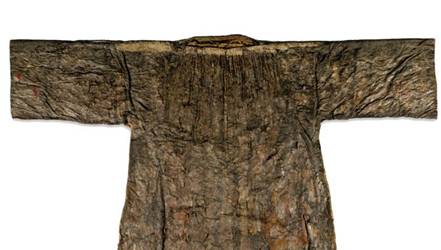
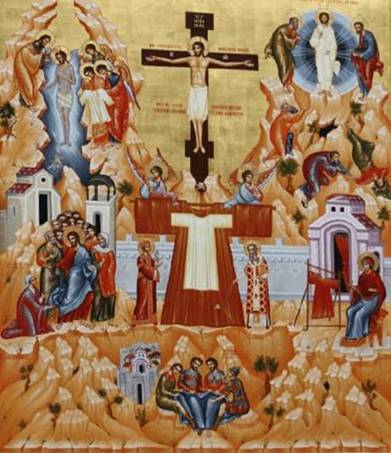
What other accurate evidence is there, related to the event of the Crucifixion?  When Jesus was being led to be crucified, He was wearing only a tunic and His robe was thrown over Him.
 https://chilonas.files.wordpress.com/2021/11/2-min.jpg

https://s1.neakriti.gr/images/756x429/files/2019-04-25/xitonas6.jpg

Then the soldiers, after they had crucified Jesus, took His clothes and made them into four parts, to each soldier one part, and also His undergarment (tunic). Now the tunic was seamless, woven from the top all in one piece.”  (John 19:23)

This garment was not torn into parts, as it would have become useless. So they decided to cast lots to see who it would fall to:

They said therefore among themselves, ‘Let us not tear it, but cast lots for it, whose it shall be’, so that the Scripture might be fulfilled which says: ’They divided My garments among them, and on My clothing they cast lots.” (John 19:24)

Was this also mentioned somewhere else?  Let us see what the Book of Psalms (11th century B.C.)says:  

they divided my clothes for themselves, and on my tunic they cast lots.”  (Psalm 21:19)

 ***********

Also, when He was being interrogated by Pilate, He had been wrapped in a red cloak:  

And they stripped Him and put a scarlet robe on Him”. (Matthew 27:28)

They had intentionally stripped Him, wishing to mock Him for making claims of royalty.

Was this also written in the old Testament?

Isaiah says:

Who is He that has come here from Edom, with a redness of garments from Bosor – so splendid in apparel, mighty, with power?”   (Isaiah 63:1)

Who is He that wears scarlet and is being dishonoured? Bosor apparently had such an interpretation for the Jews.

Why are your clothes red, and your garments like those of a wine press worker?”  (Isaiah 63:2)

To which He replied:

I had My arms outstretched all day long towards an inconvincible and contrary people who did not walk in a true way, but after their own sins.”   (Isaiah 65:2)

**************

He extended His arms upon the Cross, thus “embracing” the ends of the inhabited world. Because the centremost point on earth is Golgotha. And this is not my own reasoning. The Prophet is the one who said:

Yet God is our King from before aeons; He laboured for salvation in the midst of the earth.”  (Psalm 73:12).

 (You, o Lord, forged our salvation through Your world-saving Passions at the centre of the earth).

He who had stretched out the firmament with His divine arms has stretched out His human arms, which were pierced with nails so that when His human nature was nailed to the Cross – bearing the sins of mankind – and eventually perished, sin would also perish with it, but we would also be resurrected blameless and righteous.

For one may die with difficulty for a righteous man; but for a good man, perhaps someone may dare to die”. (Romans 5:7)

So, because death originated from a man (Romans 5:17), life was restored also by a Man – our Saviour - who died voluntarily. To be certain that this is the case, remember the One who said:

No one takes it away from Me, but I lay it down of Myself.  I have authority to lay it down, and I have power to take it back again”.    (John 10:18].

(No-one has the authority to take my life and kill Me if I do not want it. But I give it up on my own. I have the authority to offer my life, and I have the authority also to take it back again)

*************

But He of course had endured all these things in order to save everyone, but His people reciprocated with a wretched repayment.  Jesus said “I am thirsty” (John 19:28].  He who made abundant water spring from a steep precipice, and had asked for the fruits of the vine that He had planted:

Yet I planted you as a fruitful vine, from pure stock. How did you turn to bitterness, you foreign vine?”  (Jeremiah 2:21):

But what was that “vine”?  As regards its nature, it is of course mentioned by the Holy Fathers; as for its proclivity, it was Sodomic, because their vine originated in Sodom and its branches in Gomorrah; and yet, when the Lord thirsted, they took a sponge dipped in vinegar, tied it to a reed and offered that to Him!

Immediately one of them ran and took a sponge, filled it with soured wine, and put it on a reed, and offered it to Him to drink.”  (Matthew 27:48)

 In the book of Psalms we read:

And they gave gall as my food, and for my thirst they gave me vinegar to drink.”     (Psalms 68:22)

Do you see the transparency in the foretelling by Prophets?  Well, what kind of gall (bile) did they put in His mouth? They gave him, he says, 'wine mixed with myrrh, but He did not take it (Mark 15:23).

Myrrh is disgusting and terribly bitter to taste; is that how you reciprocate to the Lord?  Is that the kind of offering that the vine gives to its master?  Isaiah has rightly mourned for you ever since, saying:  

I must sing to my beloved one a song concerning My vineyard: A vineyard was created for My beloved one upon a hill, on a fertile place”.    (Isaiah 5:1)

But let us see what he says further on:

2 And I put a border around it and furrowed it and planted a Sorech vine, and I built a tower in the midst of it and dug out a wine vat in advance in it and I waited for it to produce grapes but, it produced thorns. And now, those who dwell in Jerusalem and you of Judah, judge between Me and My vineyard.  4 What more should I do for My vineyard that I have not done for it? For I have waited for it to produce grapes, but it produced thorns.5 So now I will announce to you what I will do to My vineyard:  I will remove its border and it shall be seized; and I will tear down its wall, and it shall be trampled on. 6 And I will abandon My vineyard and it shall not be pruned or dug, and they shall walk over it as if it is a wasteland of thorns; and I shall command the clouds to not deposit any rain on it. 7 For the vineyard of the Lord Shavaoth is the house of Israel and the man of Judah is the beloved new plant. I waited in order to make judgment, but it has made lawlessness; not justice, but noisiness.”  (Isaiah 5:2-7)

Look at the border of thorns that they surrounded My head with; I waited for the vine (Israel) to make Me grapes to quench My thirst with its wine, but My vineyard brought forth thorns.... So what decision should I make? I will order the clouds not to let rain fall on this vineyard... And of course the clouds stopped raining over that vineyard - that is, the prophetic voice stopped revealing God's will to them.

And as the apostle Paul said, Prophets thereafter would act within the Church:

28 But if there is no interpreter, let him keep silent in church, and let him speak to himself and to God. 29 Let two or three prophets speak, and let the others judge.   30 But if anything is revealed to another who sits by, let the first keep silent. 31 For you can all prophesy one by one, so that all may learn and all may be encouraged. 32 And the spirits of the prophets are subject to the prophets. 33 For God is not the author of confusion but of peace, as in all the churches of the saints.   (1 Corin.1:28-33)

And elsewhere:

And He Himself gave that some  be apostles, some prophets, some evangelists, and some pastors and teachers, 12 for the equipping of the saints for the work of ministry, for edifying the body of Christ.”  (Ephesians 4:11-12)

Agabus was also a prophet, who tied his hands and feet with a waistband and thus prophesied the apostle's imprisonment in Jerusalem

10 And as we stayed many days, a certain prophet named Agabus came down from Judea. 11 When he had come to us, he took Paul’s belt, bound his own hands and feet, and said, ‘Thus says the Holy Spirit - thus shall the Jews at Jerusalem bind the man who owns this belt, and deliver him into the hands of the Gentile Romans.’ ”    (Acts 21:10-11)

***********************

Saint Cyril of Jerusalem on the Creed**
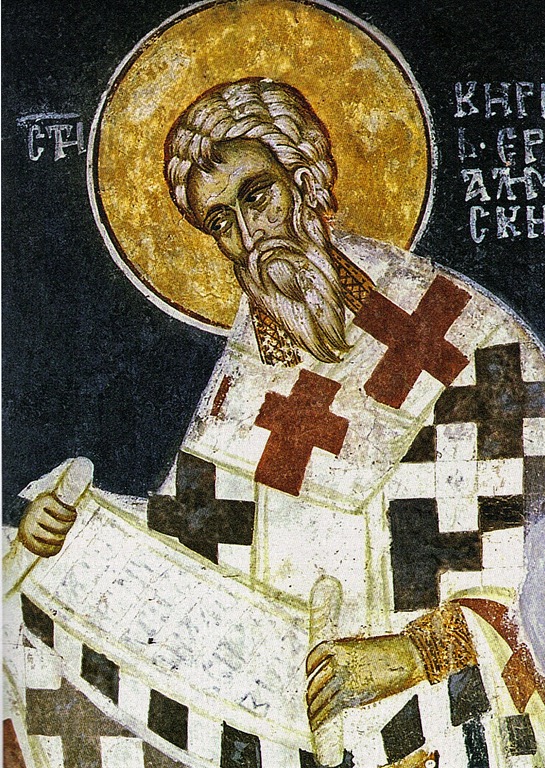
Cyril became Bishop of Jerusalem ca. 350, during the years of Arian controversy that persisted after the first ecumenical Council of Nicea, convened by the emperor Constantine in 325. Cyril came to accept wholeheartedly the Nicene Creed’s definition of the divinity of Christ as “consubstantial” with God the Father. He attended the First Council of Constantinople in 381. Of his many writings, Cyril’s twenty-four famous catecheses (lectures on aspects of the faith), which he delivered as bishop in about 350, have been preserved. The first five of the catecheses concern 1) the prerequisites for Baptism, 2) repentance and remission of sins, 3) the Sacrament of Baptism, 4) ten key points of doctrine, and 5) on faith and the Creed, or Symbol of Faith.

Following is an excerpt from his Catechesis No. 5 on the Creed, §§12 and 13.

But in learning the Faith and in professing it, acquire and keep that only, which is now delivered to you by the Church, and which has been built up strongly out of all the Scriptures.  For since all cannot read the Scriptures, some being hindered as to the knowledge of them by want of learning, and others by a want of leisure, in order that the soul may not perish from ignorance, we comprise the whole doctrine of the Faith in a few lines.  This summary I wish you both to commit to memory when I recite it, and to rehearse it with all diligence among yourselves, not writing it out on paper, but engraving it by the memory upon your heart, taking care while you rehearse it that no catechumen chance to overhear the things which have been delivered to you.

I wish you also to keep this as a provision through the whole course of your life, and beside this to receive no other, neither if we ourselves should change and contradict our present teaching, nor if an adverse angel, transformed into an angel of light (II Corinthians 11:14) should wish to lead you astray.  For though we or an angel from heaven preach to you any other gospel than that you have received, let him be to you anathema. (Galatians 1:8-9)

So for the present listen while I simply say the Creed, and commit it to memory; but at the proper season expect the confirmation out of Holy Scripture of each part of the contents. For the articles of the Faith were not composed as seemed good to men; but the most important points collected out of all the Scripture make up one complete teaching of the Faith.  And just as the mustard seed in one small grain contains many branches, so also this Faith has embraced in few words all the knowledge of godliness in the Old and New Testaments.  Take heed then, brethren, and hold fast the traditions which you now receive, and write them on the table of your heart. (§12)

Guard them with reverence, lest per chance the enemy despoil any who have grown slack; or lest some heretic pervert any of the truths delivered to you. For faith is like putting money into the bank, even as we have now done; but from you God requires the accounts of the deposit. I charge you, as the Apostle says, before God who quickens all things, and Christ Jesus, who before Pontius Pilate witnessed the good confession, that you keep this faith which is committed to you, without spot, until the appearing of our Lord Jesus Christ.

A treasure of life has now been committed to you, and the Master demands the deposit at His appearing, “which in His own times He shall show, Who is the blessed and only Potentate, the King of kings, and Lord of lords; Who only has immortality, dwelling in light which no man can approach unto; Whom no man has seen nor can see. To Whom be glory, honor and power for ever and ever. Amen”. [I Timothy 6:15-16] (§13)

  *****

Translated by Edwin Hamilton Gifford. From Nicene and Post-Nicene Fathers, Second Series, Vol. 7. Edited by Philip Schaff and Henry Wace. (Buffalo, NY: Christian Literature Publishing Co.,1894.) Revised and edited by Kevin Knight for New Advent. Reprinted with permission. (Complete text: newadvent.org/fathers/310105.htm).

https://adoremus.org/2010/11/saint-cyril-of-jerusalem-on-the-creed/